Warning: Undefined variable $show_stats in /home/jdqespth/public_html/wp-content/plugins/stats/stats.php on line 1384

(vegan) Saniyet Batates

(this post doesn’t start vegan, but keep reading to the second attempt!)

I’ve been taking a class on food and culture in the Islamic Middle East, and my assigned country to research is Egypt. As part of this, I’ve been looking at Egyptian cookbooks.

I started with Egyptian Cooking: A Practical Guide by Samia Abdennour, published in 1984 by the American University in Cairo Press. It looked very sensible and traditional with bare bones recipes and no pictures. The cookbook inspired confidence that this is recording traditional cooking. There were 2 versions presented: one with veal and the other with beef, but all of the same ingredients and quantities for both. I figured I would give it a try.

Here are the recipes as published in the cookbook:
MC 180 SANIYET BATATES, NAY FI NAY – Casserole of potatoes (1)
1 kg potatoes, peeled and sliced 2cms thick
1/2 kg beef
4-6 ripe tomatoes, peeled and chopped coarsely
12-15 garlic cloves, halved diagonally
2 onions, sliced thinly
2 cups tomato juice
salt and pepper

Cut beef into bite-sized cubes. Put all the ingredients together in an oven pot, cover with seasoned tomato juice and cook in preheated moderate oven for 1-2 hours.

MC 181 SANIYET BATATES – Casserole of potatoes (2)
1 kg potatoes, peeled and sliced 2cms thick
1/2 kg veal
3-6 ripe tomatoes, peeled and chopped coarsely
12-15 garlic cloves, halved diagonally
2 onions, sliced thinly
2 cups tomato juice
cooking oil
salt and pepper

Peel and slice potatoes 2cms thick. Cut veal into small cubes. Peel and chop tomatoes coarsely. Peel garlic and halve diagonally. Slice onions very thin, keeping all items separate.

Saute onions, add tomato juice and cook for 10 minutes. Add [meat,] garlic and seasoning and cook for another 10 minutes.

Arrange sliced potatoes in lightly-greased oven dish, bury the meat mixture among the slices and cover with the cooked tomato sauce. Bake in slow oven for about 1 hour.

Now I didn’t have a full kilogram of potatoes handy and was only cooking for 1 person, so I scaled the recipe down a bit.

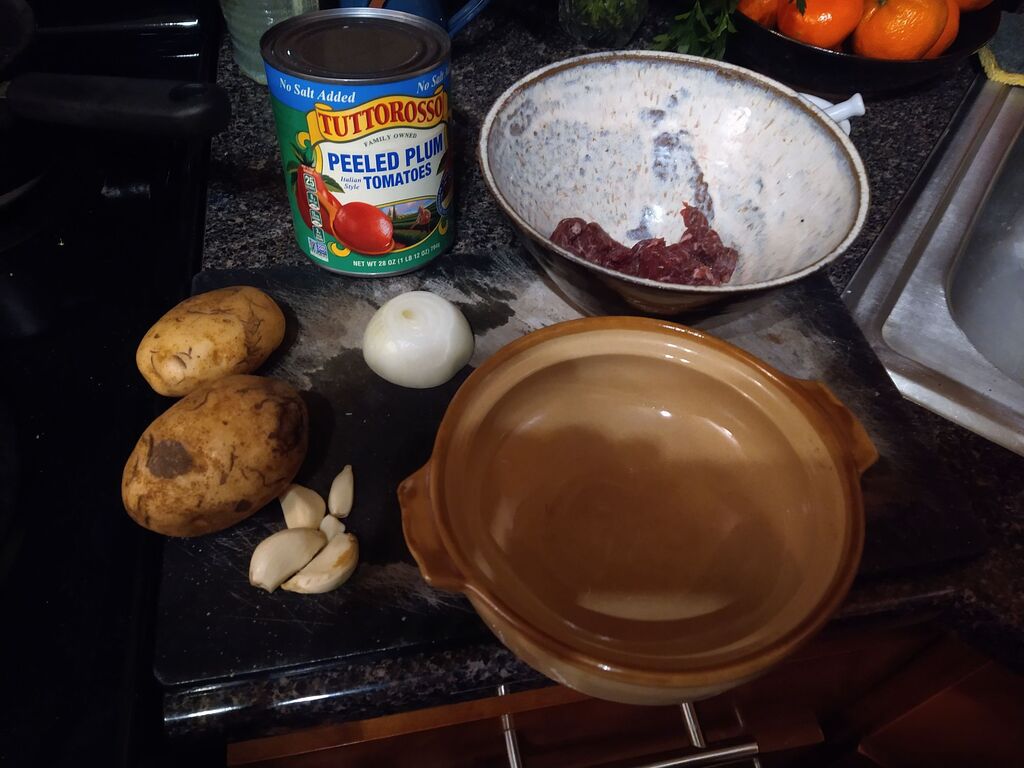
mise en place with an empty donabe, 2 sad potatoes, 5 peeled garlic cloves, 1 small peeled white onion, 1 can of peeled plum tomatoes, and a bowl with small cubes of beef

I had 2 russet potatoes that were not in great shape. (I had purchased them on delivery instead of looking them over in the store, and this batch was damaged. The delivery place gave me a full refund for the potatoes after I sent them a picture. Then I split up the bag with a few people so we could use them up before they went off. So I washed them and peeled them and sliced them into thick rounds and put them in the casserole dish. And this is where I had my first misgivings – when I’m building a dish like this, I usually like to put the onions between the bottom of the dish and the main meat (or in this case potatoes) so that there’s less worry about sticking and burning. But we’re trying to follow the recipe here!

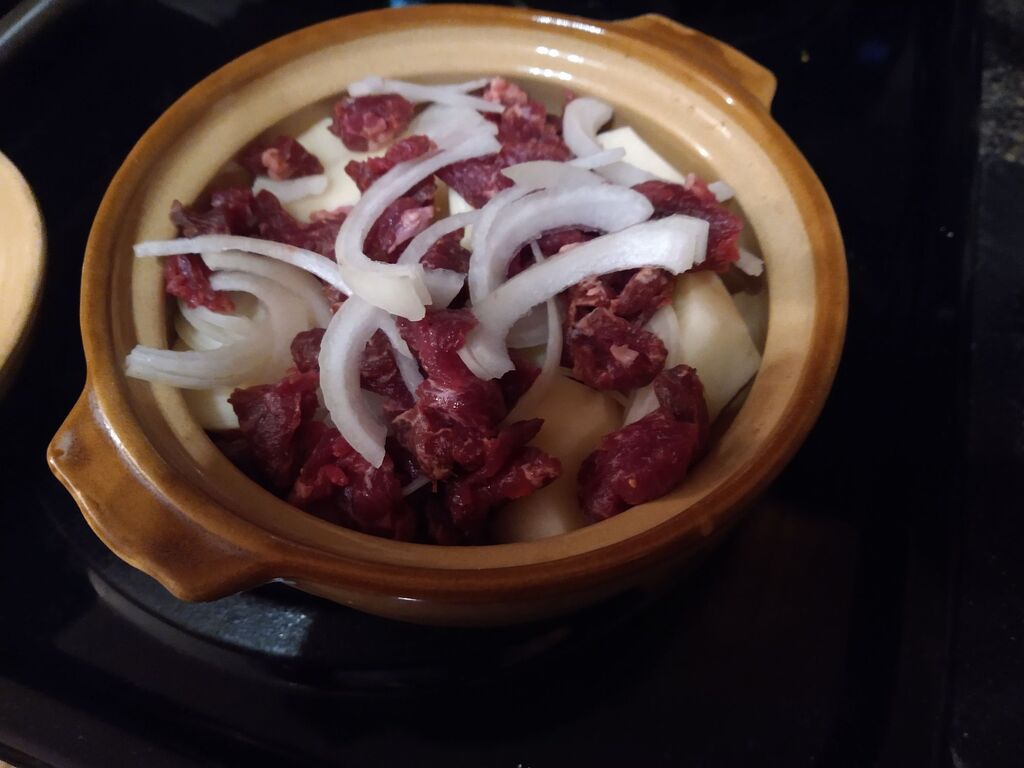
Donabe filled with potatoes with small beef cubes tucked all around and thinly sliced onions on top. There are also garlic slices in there, but none are showing in the picture.

Once I had a solid layer of potatoes in there, I started tucking the garlic pieces and the small beef cubes around the potatoes. And then I (foolishly!) decided to not get another pan dirty by precooking the onions in the tomato juice, like in the second recipe, and just add them directly the way the first recipe says/implies. I added the tomato juice from the pan and sliced some of the tomatoes on top. Then it went in the oven!

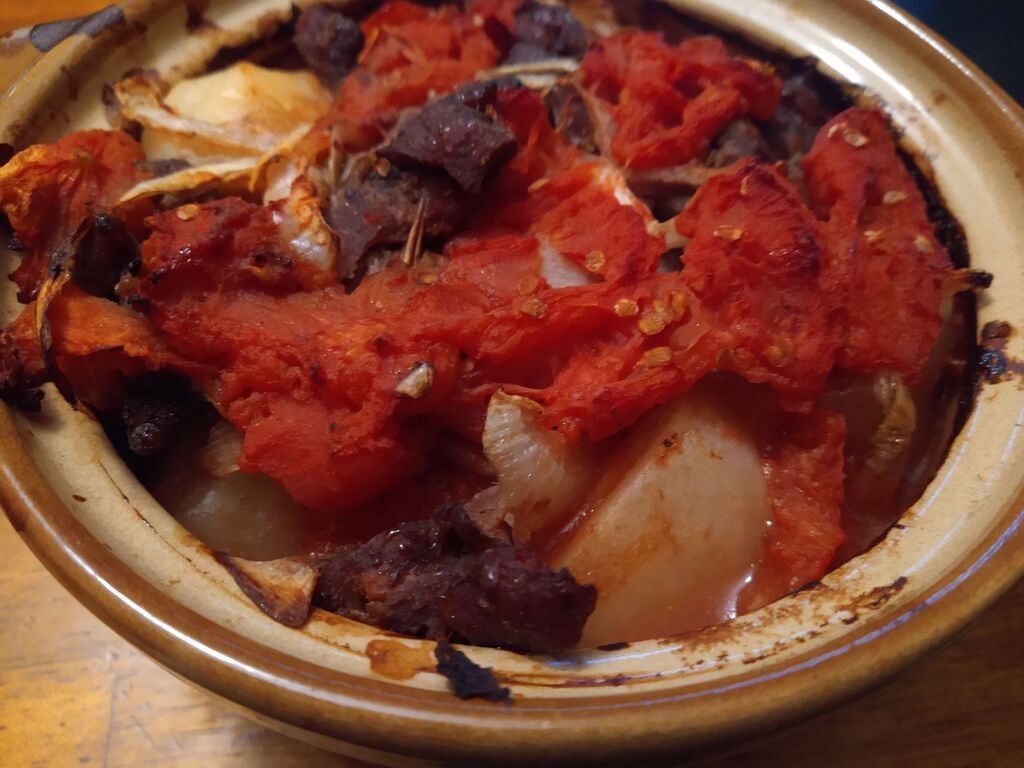
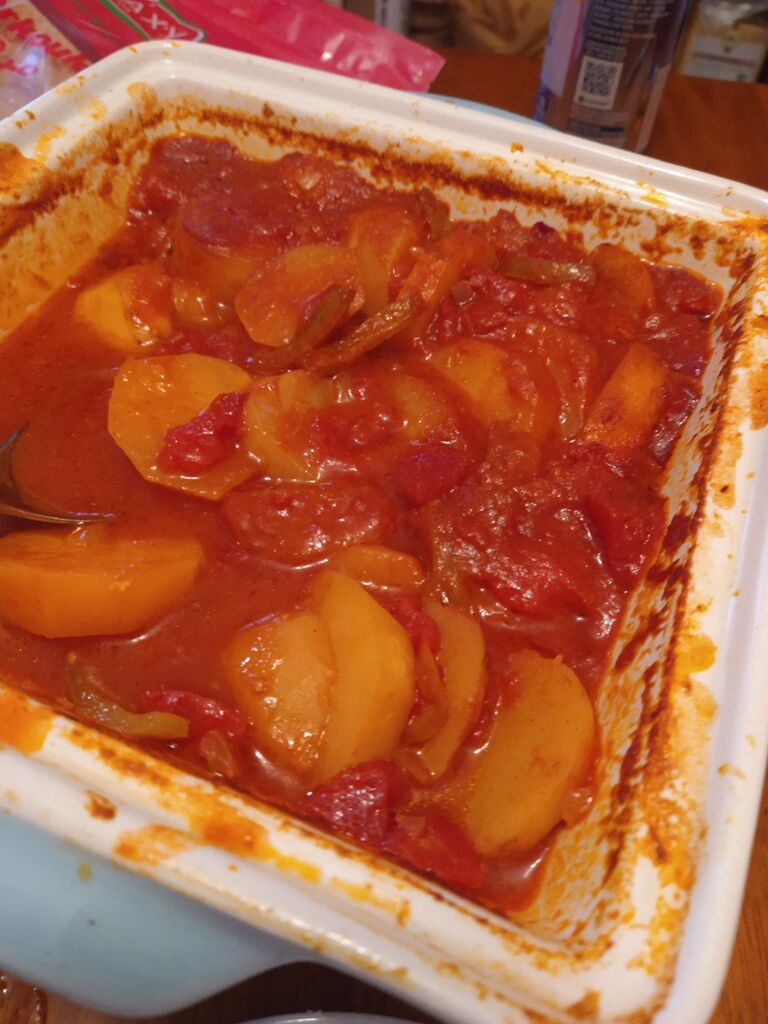
donabe with a cooked dish with potatoes in thin liquid and you can see the other ingredients – tomatoes, beef, and onions – looking a little dry and cooked with some small amounts of burning, especially right around the edge of the bowl where liquid bubbled up the sides.

After about an hour and a half, it was smelling pretty good and like food, so I gave the potatoes a poke with a fork – they were still fairly firm, so back they went for another half hour. Then I waited for the potatoes to cool enough to eat and I was very optimistic about this dish.


It was terrible! The potatoes might have been cooked, but they were not soft and none of the sauce had penetrated to flavor the potatoes. And the onions! I don’t know how, but the onions tasted even more strongly of raw onion flavor after cooking than they did before! Nothing went together and it put me off of using that whole cookbook!

But this should be a viable dish! It sounds so simple, stable, and reliable. So I went looking to see if it appeared in other cookbooks. Of the ones I checked, nothing particularly close appeared.

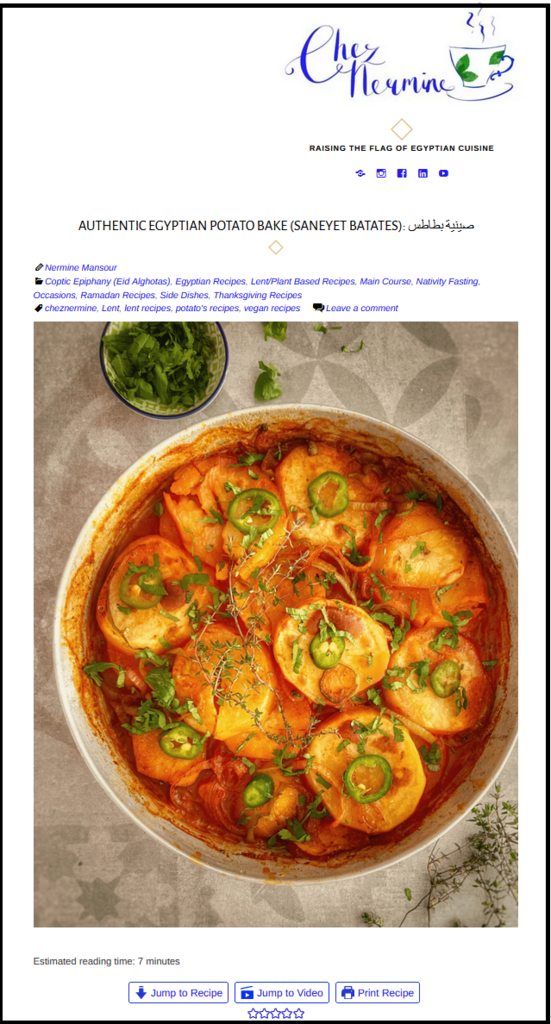
And then I found a food blogger with a VEGAN version! https://cheznermine.com/2026/03/27/authentic-egyptian-potato-bake-saneyet-batates/

screencapture of the start of Chez Nermine’s page about Saneyet Batates – site linked to picture if you want to click through

And this was more like it! With detailed instructions, discussions about ingredient varieties, and even a video recap. So this time I made it for lunch with a friend. She has been having chemo on Friday afternoons and then I’ll pick her up and make a meal before the nausea kicks in. It has all of the fun of dining out with none of the risks of dining in public while immunocompromised. So I asked her opinions about the ingredients, and she asked for minimal garlic and onions and that it not be particularly spicy, so those are the big changes here.

Using an 8″x8″ casserole dish, I started with some oil in the base. And then I added about 1-2 Tablespoons (not measured, just was left in the container I had) of dried shallots (to replace the fresh onions) and the spices – this version called for spices, so that’s exciting – ground coriander (the last one the ones I dried from my 2025 garden), ground cumin (from the Egyptian cumin a former couchsurfer had brought me!), dry oregano (also dried from my garden), and a generous sprinkle of paprika (a little more generous than the recipe because I’m trying to use up that container). And then that got kind of mixed together.

This time, I was using a fresh bag of yukon gold potatoes. Even though the directions say to slice one inch thick, looking at her video I decided to slice them closer to half an inch thick. And then I sliced up some fresh bell peppers without any spiciness to them. That gets tossed with the spices to distribute as evenly as possible.

I still used the same kind of canned whole tomatoes, so I first poured out some of the liquid and mixed it with tomato paste and vegetable soup base. Then I sliced the tomatoes on top again and poured the enriched liquid over everything. The whole large-sized can was perfect for this size casserole dish.

And then I cooked it – first on the stovetop and then in the oven. But for much longer than called for because my friend’s appointment ran later then I’d been expecting. By about an hour and a half. I had been planning the switch to the oven for right when I left the house, but it ended up almost completely finished before she even called me for a pickup. So I made sure there was enough liquid and that the heat was just high enough to keep a low bubbly simmer but low enough to not dry out or misbehave while I was out of the house.

Finished dish of tomatoes that have turned orange from braising in the tomato sauce and small chunks of tomato and pepper in a saucy base.

We came back in the house, and the smell was amazing! The potatoes were very hot, but that gave us some time to chat while waiting for it to cool.

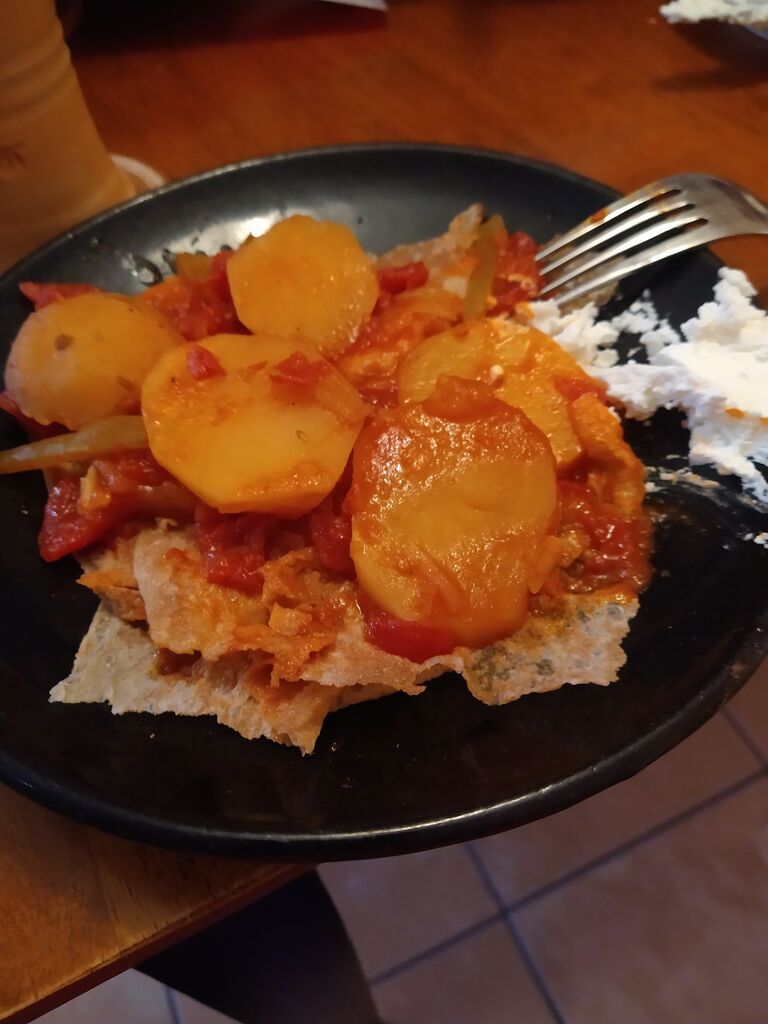
I still had a little ruqaq (an Arabic thin crepe-like bread) left from an experiment, so we used that as a base layer to soak up the sauce. And we had feta brined white cheese on the side.

A plate made up with the potatoes on top of a layer of soaked flatbread and some white cheese on the side

This version ended up amazing! A+ Would make again. The spiced tomato broth flavored the potatoes all the way through, and it was just the right amount of warm and comforting without being too heavy for lunch.


Let’s also do a quick roundup of Egyptian food blogs I found:

Chez Nermine: authored by Nermine Mansour, who was born in Egypt, a former Egyptian diplomat (her husband still seems to be a diplomat), and lives in Virginia (united states). Oldest recipe posted 17 August 2017; most recent recipe 3 April 2026. Primarily Coptic, she has recipes tagged for Christian, Islamic, and Jewish holidays and includes both vegan and meat. Has a recipe for macarona forn, saneyet batates, koshari, and molokhia. Tagline is Raising the Flag of Egyptian Cuisine. Likelihood of using: 10/10 (see above)

TheEgyptianCook: Signature cooking by Muhammed Elgammal, but posts and videos are made by a team and his site has a merchandise store “in development.” He is an Egyptian-American Muslim who resides in the United States. Oldest recipe posted 11 December 2023; most recent recipe 17 November 2025. Has a recipessddd for macarona bechemel, baked potatoes and lamb, koshari, and molokhia, Recipes are fairly meat heavy, but includes vegan kofta (as well as beverages and desserts). Likelihood of using: 1/10 (autoplay videos)

Scarf Gal Food: Simona Afifi does not have a separate “about” section, but does sprinkle anecdotes throughout the posts. Diaspora Egyptian with actual experience making and buying food in Egypt, posting from the united states. Oldest recipe posted 21 April 2015; most recent recipe 13 December 2021. Has a recipe for macarona bechamel, saneyet batates, koshari, and molukhia. Likelihood of using: 6/10 (most likely this recipe for easy ful starting with canned beans)

The Egyptian Kitchen: abissada was 1st generation born outside Egypt and lists her location as France, but she has visited Egypt. Earliest recipe posted 18 January 2010; most recent recipe . Has recipes for macarona bil bechemel, koshari, and molokhia (first posted recipe). Likelihood of using: 3/10

Food of Egypt: References christian and Islamic holidays. Oldest recipe posted 28 July 2010; most recent recipe 1 August 2013 (posted to facebook through August 2015). Has a recipe for molokheya. Likelihood of using: 2/10 (too many intrusive ads)

Cleobuttera: Tasbih is a food blogger in Egypt who specializes in pastry and baking. Oldest recipe posted 11 November 2014; most recent recipe 25 August 2019. Best web design, includes a section of which major publications have referenced her blog. Likelihood of using: 7/10 (would be higher if I were more of a baker/confectioner)

JulienJulia: Julia is a cooking nom de plume for Kariman Al Essawy, a home cook in Egypt. Oldest recipe posted 22 April 2010; most recent recipe 26 June 2017. Includes restaurant reviews. Has recipes for bechamel lasagna, koshari and molokhia. Also includes this write up of cookbook author Nazeera Nicola. Likelihood of using: 5/10

see also: History of Egyptian Cookbooks and Ask Abla Nazira

One bowl potato soup

I wasn’t sure if it would be possible to make just one bowl of potato soup, but I figured I would try.

The bowl of soup with some bacon crumbles and cheese on top

I used my 1 quart pot so that I’d not have room to add too much.

Starting by dicing half a large onion, I put it in the pot with some bacon fat and turned the burner to medium to start sweating the onion. I washed and diced two smallish medium potatoes and added them to the pot as well (and turned the heat a little higher).

I mixed two cloves of garlic and threw those in as well, but I didn’t want either celery or carrots. I have carrots, but I didn’t feel like it

Once the vegetables were pretty evenly translucent and a bit softer, I added two teaspoons of flour. Then I thoroughly stirred that into everything and let it cling evenly to the vegetables and get cooked until it was no longer raw flour.

Then I added just enough soy milk to cover. (Last time I was ordering groceries, I wanted a little dairy but the smallest quantity was a half gallon and the soy milk was cheaper than the cow milk. The main thing I look for in a plant milk is that it has no sweetener and no vanilla flavoring. If I want sweet milk, I can always add sugar, but there’s no taking it out when I want savory (which is most of the time).

I added a bunch of seasonings – salt, black pepper, gochugaru, paprika, powdered thyme, and some mushroom powder. Because that was what was on hand. Because my paprika is losing its color so I want to use it up.

The soy milk thickened faster than I was expecting, so I added a little more. I’m not sure if that’s because of how much flour I added or if it is party of the qualities of soy milk and how it behaves. But I made sure I kept cooking long enough for the potatoes to be cooked through.

Then I topped it with cheddar cheese and bacon crumbles.

It’s was very rich, but definitely tasty. As long as I still have an abundance of ‘milk’, I might make this again. It was a very satisfactory dinner

Breakfast Kale with an Egg on Top

Close up of the finished dish with a nest of cooked shredded kale and a soft poached/steamed egg in the middle of that nest

I’ve already written up this recipe a couple of times, but I wanted to update it. Here’s the post where I cite the original Roman recipes that inspired this meal.

Diced purple onions in a skillet

Start with finely chopping up a few slices of purple onion and sauteing them in a little olive oil.

A pile of shredded kale with a bottle of sweet red wine and a bottle of Red Boat fish sauce in the background

Let’s talk about ingredients

Kale – I like growing Red Russian Kale because it has a flatter leaf that is easier than most varieties to check for bugs as it is growing, but also a softer texture that cooks up nicely when harvested. This recipe will work with any variety of kale.

Wine – This should be a red wine, and I prefer a sweeter variety. Honestly, I love the kosher Manischewitz concord grape or blackberry flavors both for drinking and cooking with. But I also keep a bottle in my refrigerator of boiled down and concentrated red wine from any time I have a leftover partial bottle, and that would also work well here. Whatever you’ve got.

Fish sauce – I am pretty sure the ancient Romans used at least two different kinds of fish sauce. There’s the garum, which is very light colored and quite polite. That’s the table fish sauce for adjusting flavor after cooking. And then there’s the liquamen, which is almost ubiquitous in these recipes and seems to function for adding salt. So I look for the funkiest and saltiest fish sauces available. I’ve had good luck with the Squid Brand and Red Boat. Use the salty one with kale!

[if you want to avoid fish sauce, then you can switch to a powdered bouillon (maybe half a cube or less), soup base, or Maggi cube]

Skillet with some onions and kale

Okay, so your onions are getting caramelized around the edges and a little brown. Your patience will be rewarded. Now you can fill your pan with shredded kale (this is about 5 or 6 large leaves) and you can throw in other green herbs (parsley, cilantro, dandelion greens, scallion greens, dill, mint, random foraged edible things) if you want, but I usually just go with kale because if I’m growing it in my garden, then I already have too much of it to get through.

Cook the kale until it just brightens. If you want, you can add a teaspoon or two of water to help it move around, but it should be pretty dry right now. Because as soon as it’s a little cooked, v you’re going to add a teaspoon of fish sauce and a teaspoon of red wine and that with sizzle and steam everything up.

Mix everything together well and then tuck everything toward the middle of the pan with a little divot in the middle to make a nice nest.

Then crack an egg into the middle of the nest, grind some black pepper on top, and cover the pan and let the egg poach in that steam to cook.

A skillet with a silly hat of an aluminum takeout container as a lid.

I’m just a few minutes (it’s okay to peek) the egg will set. The yolk will turn from yellow to a pinkish color and the white might jiggle but it will all be white. If you want the white harder, you can go a little longer, but you risk your yolk solidifying and not being as runny. It’s your egg, so make it the way you like.

The finished dish!

I like to eat this with a bagel and cream cheese. And with a spoon. Enjoy!

Sigara böreği

The last day I was in Istanbul, my host let me help her make Sigara böreği. Here’s my attempt to document what we did so I can remember for the future.

Filling

3 bunches of fresh spinach (with large leaves) from the farmers market were washed thoroughly in several changes of water. She had 2 salad spinners going at once.

In a skillet, 1 minced medium/large white onion was softened in a generous glug of olive oil. Once it was soft, she peeled and shredded in 2 smaller potatoes (all that she had on hand, perhaps more would have been used if she had it) (large holes on a box grater). Stir stir stir. Cook Cook Cook.

And then the cleaned and roughly chopped spinach went in. And we cooked it until is was a soft and homogeneous mixture.

Season with black pepper and salt.

Then the heat was turned off, and it was set aside to prepare the wrappers.

Wrapping

Was not made with phyllo dough! She hod bought freshly made circles of thin dough from the local market. Yufka! Which I just found at a market in this city, which is why I am now thinking about making them on my own.

So she spread out this 2″ round of dough in a single layer on the counter (and kept the rest covered lest it dry out).

And she mixed together yogurt, eggs, and olive oil until it had a soupy texture (and she added ingredients as needed to get the right consistency).

Spread a thin-ish layer of the egg mixture over the yukfa. Fold the yukfa in half, so you now have a semi-circle. Slice the semicircle into 6-8 (I forget which) long triangle wedges.

Assembly

Spoon 1-2 Tablespoons of the spinach filling on the wide part of the triangle. Tuck in the corners and roll the dough around the filling. If it seems dry, feel free to add more of the egg mixture to seal, but it shouldn’t be wet either.

Lay your finished cigars on a lined baking sheet. They can now sit overnight in the refrigerator (I don’t remember if this is just okay or preferred).

When ready, bake at 425F for 15-20 minutes.

Things that are missing from this recipe
She also had white cheese (like feta) that went into this dish. Was it mixed into the spinach once it had cooled? Or was it in the egg mixture? I don’t remember.

Were there any herbs in the spinach mixture? A bit of parsley wouldn’t hurt.

Other similar recipes online
http://www.deliciousistanbul.com/blog/2011/03/15/sigara-borek/
http://www.deliciousistanbul.com/blog/2012/02/14/swiss-chard-pastirma-borek-recipe/

Sigara Boregi – Crispy Cheese and Herb filled Filo Pastry Rolls


http://www.turkishcookbook.com/2006/08/cigarette-borek.php

slow bounce

Turkish Cigarette Börek (Sigara Böreği) with Roasted Tomato Sauce

vegan -> http://www.messyvegetariancook.com/2010/05/19/vegan-spinach-borek/

ETA: Okay – so I’ve made it now and can answer all the questions I had before!

First – this is not a crispy version. This dough looks terrifyingly designed to be crispy. I was sure that everything was ruined because I only had storebought Yufka instead of getting a fresh batch from a local market. Everything turned out fine.

Second – Yes, add the cheese to the filling once it has cooled. I ended up using a mixture of peccorino romano and sheep milk beyaz peynir. Whatever brined white cheese should be tasty. Also, I was worried about the saltiness of my cheese, so I was moderate about the salt in the filling. But, really, it could have used more salt.

Third – resting time is important! The first batch I cooked was the last batch I made, and it ended up releasing a puddle of oil that made the rolls soggy. I was resigned to finding them tasty anyway. But the second batch, which had been sitting long enough for the dough to fully hydrate and the tops (brushed with more of the egg/yogurt/oil mixture) to get a little tacky, didn’t lose any liquid and came out fairly similar to the ones I’d had in Istanbul. And the tops turned lovely golden and brown.

Cooking time – 425F for 20 minutes.

Beans for Breakfast – Azuki Bean, Lemon, and Coconut Bread Pudding; Red Bean Paste Cinnamon Rolls; Kale and White Bean Quiche; Conchicla Commodiana; Marrow Bean Jook

Okay, so you’re going to have to forgive me on this one – I’m trying to take pictures of my food, and photography isn’t one of my interests. However, of all the people I invited to eat my beans, I didn’t manage to invite anyone else who wanted to take pictures, either, so it was all up to me and the camera in my phone.

That said, I can cook – and cook I did. I wasn’t expecting a particularly good success rate. In fact, I did run out and buy bagels just in case everything failed – that’s how little confidence I had. This was way out of my comfort zone, and yet I ended up liking everything!

So I cook with beans regularly – why was this out of my comfort zone? Well, for one – one of the dish was a baking project, and I’m still not fully pleased with my breadmaking skills and don’t consider myself a competent baker yet. And for another – when I make beans for just me, I really enjoy cooking them to mush, but for this I wanted to much more precisely control the textures of the beans and have a wide range of firmnesses… and if I were going to be playing with it, they might all end up crunchy after 3 hours cooking and what would I do? Oh, my!

So my two main weapons for playing with texture were baking soda (basic) and citric acid (acidic). Well, okay, I had many options for acidifying, but alkalizing has fewer options.

Marx Foods is a lovely company, and so far they’re the only people to ever offer me free things to experiment with, and some of my favorite experiments have come from working with exotic samples they have given to me. This time, they gave me three kinds of beans: Marrow, Mayacoba, and Azuki.

And I made at least one dish for each bean.

Azuki beans – intrinsically sweet, source of red bean paste (on language)

my opinion – I didn’t find them all that sweet… just not so savory that sweet things wouldn’t work with them. But I did end up adding sugar to both dishes.

I separated the 700g of red beans into two sets of 350g each, and I cooked one with baking soda to make paste, and the other batch with an added 1/4 tsp of citric acid as soon as they started to soften so that I could work with whole beans. With both batches, I ended up using less than the whole quantity (noted in the recipes)

Dish 1 –
Azuki Bean, Lemon, and Coconut Bread Pudding

(dairy free)

ingredients:
1 lemon peel (after having been used for something else)
1 cup water
1 cup sugar

350g 150g azuki beans
50g coconut sugar
1/4 tsp citric acid

1 loaf challah, day old
1 cup large flake unsweetened dried coconut, loosely filled
1/2 cup golden raisins
8 10 eggs
3/4 cup coconut sugar
(2) 15oz can coconut milk

Two days before:

Take the peel of 1 lemon (organic, since you’re using the peel) and boil it in plain water. After the peel is soft and the water has a yellow tinge (the longer you boil it, the less bitter – I aim for about an hour), drain. Boil (low boil, not rolling, because this is hot sugar!) it again in equal parts sugar and water. Again, for as long as you have patience – at least half an hour. This time, when you remove the peel, reserve the syrup as well.

Put red beans on to soak. (I put them in an empty quart yogurt container, add plenty of water, and let sit about 24 hours)

The evening ahead:

Drain red beans and simmer in plenty of water until they just start to soften. Add sugar and cook for another 10 minutes. Bite a bean and see if it has a pleasing texture. When the texture is firm but not crunchy, add the citric acid. Stir. And then drain the beans.

Oil large casserole dish and tear the challah loaf into chunky pieces so that they fill the casserole dish. Add drained beans, coconut, and raisins. Slice off the pith from the lemon peel, and cut the candied peel into thin slivers – add as many of these slivers as you like, I used half a lemon’s worth.

Beat together the eggs, sugar, and coconut milk (I did this in a couple batches so that I could use a bowl with a spout – having a container that pours well is more important than efficiency here). Pour the mixture over the bread and fillings. Cover and refrigerate overnight – to make your life easier in the morning when you’re hungry, and so that it has a creamier texture because everything has longer to soak the liquids in.

The next morning:

Cook in a slow oven. (In this case, the cooking temperature and time were determined by another dish, but on it’s own I would guess that it would do well at 325F for 45minutes, but definitely check to make sure it’s cooked through)

Heat up a quarter cup of the reserved lemon syrup, and pour overtop the pudding.

Verdict:
I ended up with the beans a little harder than what I had pictured when I devised the dish, but it really worked well that way – they were almost like nuts. But my guest who abhors nuts in bread pudding (or almost anything sweet), still loved the dish. The beans and the coconut really play well together, and I’m thinking of taking the beans I ended up not using and simmer them with coconut milk to have with sweet sticky rice. I’ve adjusted the recipe also to include more liquid because mine ended up near the dry side, but I was limited by my coconut milk and didn’t want to switch to adding dairy to the amazingly dairy free bread pudding.

How original is this recipe? Let’s say it’s a 6 out of 10
I found things with similar names on some restaurant menus (Ozumo’s execution in very different; Bamboo Sushi’s is also a bread pudding and has a citrus note, but the execution is darker and it does not have coconut), but I did not find any recipes or blog posts with a similar recipe. The closest I came there was a rice pudding.


Dish 2 – Azuki Bean Paste Cinnamon Rolls
(note: dough is only slightly adapted from King Arthur Flour’s guaranteed recipe)


ingredients:
(dough)
2 1/2 teaspoons active dry yeast
198 to 255g lukewarm water
361g all-purpose flour
85g unsalted butter, at room temperature
35g vanilla sugar
1 1/4 teaspoons salt
30g dry milk
21g oat flour
20 cardamom seeds, ground

(filling – enough for 2 batches of the dough above)
350g azuki beans, having soaked overnight
42g coconut sugar
1-2 tsp baking soda
1 tsp korintje cinnamon

2 tsp milk
oil for pans

(icing)
3oz cream cheese
1/3 cup powdered (vanilla) sugar
milk to thin for consistency

The evening ahead:

Make the dough – proof the yeast, mix everything together in a mixer with a dough hook for, “about 7 minutes at second speed, and the dough should barely clean the sides of the bowl, perhaps sticking a bit at the bottom,” put in a greased container to rise in the refrigerator overnight. (more complete directions here)

Make the paste:

Only use about an equal quantity of water to beans because you aren’t going to be pouring any off – add more as needed. Simmer. beans and water until soft.

Oh, what, they aren’t getting soft? Add 1 tsp of baking soda and stir that in. There’s no reason not to add the first teaspoon right at the beginning, but you get a fun foaming action if you wait until the beans have started to cook.

If they still take a while to soften, add up to another teaspoon of baking soda, but increase slowly.

Often with sweet things you add a pinch of salt for balance – do not do that here because baking soda has a salty taste of its own.

Once the beans are soft, add the sugar to taste. I like the coconut sugar because it’s not as sweet as regular sugar, and it has a bit of a toasty dark undertone. I was aiming for the low end of sweetness, so you might want more sugar.

Add the cinnamon. If you are using a milder cinnamon, feel free to increase the amount to taste.

Note that I don’t have any mushing directions. I found that just stirring broke down the beans to the point where there was a lumpy paste, and I liked the additional texture enough that I didn’t see a benefit to breaking it down further.

Refrigerate overnight.

That morning:

Roll out the dough to 16″ x 12″ (possibly just those dimensions because it fits well on the KAF cookie mat or because everything happens in half sheet pan measures – I was rolling it on the mat to measure). If the dough starts to resist and pull back in, cover it in plastic and come back in a few minutes to keep going.

Brush dough lightly with milk.

Spread a thin layer of the bean paste on top.

Roll dough the long way as tightly as will keep everything tight but not distort the dough too much. It will stretch some as you roll. Pinch the end to the roll to create a smooth seal (it seals especially well if you roll the seam to the bottom as you slice the cylinder).

Slice into 1″ pieces and set in your tins (I had 1 8″ round, which held 7, and 1 9″ square, which held 9). Cover and let rise for an hour.

Bake at 375F for about 20 minutes.

Whip together the cream cheese and powdered sugar, and then drizzle in the milk until it’s loose and runny. Drizzle lightly on top of the hot rolls.

Serve!

Verdict:
Wow! These came out perfect. And they were never frustrating, even though I’d been told that this sweet roll dough could be hard to work with. And I was going to put all of the credit on the King Arthur Flour recipe, but no – I have also gained skills, too! The giving up and letting the dough rest when it starts to fight back is definitely a new skill. There was no frustration rolling it out at all. And I now want to use my mixer for my bread doughs instead of all of this kneading by hand craftsmanship. Though the reason I went with mechanical help was that in the reviews and comments on the King Arthur site there were a couple people who had troubles, and the answer was almost always insufficient kneading time.

To prep for this recipe, I also checked Cooks Illustrated‘s techniques for making the dough. And while the dough wasn’t so useful there, they spent a lot of time discussing the problems of filling leaking and burning. And you know what – I think bean paste cinnamon rolls might be superior to cinnamon sugar ones. One – it stays where you put it and doesn’t leak. Two – instead of using the sugar for texture and quantity of filling as well as sweetness, you don’t have nearly as much flexibility with the sweetness level of the roll and they often end up too sweet.

How original is this recipe? Let’s say it’s a 2 out of 10
This was hard to search as there are many permutations of rolls and buns, which might include or just be on the same page as cinnamon, using azuki beans or red bean paste. So it’s hard to be sure I wasn’t missing a lot. That said, I didn’t find many exact matches, which is actually a shame since I think it’s a superior result. The first match I found that was close was a cinnamon roll that used the beans in the dough, instead of the filling, but then I found someone with the exact same idea (in fact, that search was where I got the idea to include cardamom in the dough), only she did not enjoy the results as much as I did – partly because she processed her red bean paste more than I.

Mayacoba beansdescribed as mild beans that are thin skinned and also good at keeping their shape in cooking.

I knew exactly what I wanted to do with these! You know those kale and white bean soups that are so delicious? Imagine that – as a quiche!

Dish 3 – Kale and Mayacoba Bean Quiche

ingredients:
400g Mayacoba (Canary) beans, soaked overnight
1 sprig rosemary
1 bay leaf
1 Tablespoon dried oregano

1 Pie crust (sorry, I used up all my baking mojo on the rolls – this was purchased)
egg white

1/3 lb pancetta, in 3 thick slices, then diced (bought at Milk & Honey Market)
1 medium purple onion, diced
3 large curly kale leaves, cut off the stem and sliced into thin shreds

4 eggs
1/2 cup heavy cream
1/2 cup milk
1 Tbsp spicy mustard (obtained mine at the Philly Food Swap

Put the beans and herbs together in a pot with plenty of water and simmer for an hour – but keep a close eye on them. We want them completely soft, but not at all mushy or broken down. And, yes, these beans were amazing for that – the skin might break, but the beans kept their shapes nicely. When they’re cooked to your satisfaction, drain them and rinse with cold water to stop the cooking. Pick out the rosemary stem and the bay leaf.

Cook the diced pancetta all the way until at least half of it is looking crispy. Pull out the pieces and drain on paper towels.

Take 2 Tablespoons of the pancetta fat, and cook the diced onion down in that over medium high heat. Once the onion is soft and starting to brown at the edges, add the kale. Just dump it over top, and then start turning it as the bottom wilts. Stop cooking it when the kale is a bright, vibrant green, soft all through, and glistening with an even coating of fat. (note: pancetta fat can be exceptionally salty, so wait until you can taste the kale before deciding whether to add more salt to accommodate the beans.

If you’re going to make the pie crust, do so. Lay the pie crust into the pan and ease it into the base. Prick all over with a fork and then brush with some egg white. (in the land of not being wasteful, I just go ahead and crack the first egg for the filling and aim the brush for whites – thus having one fewer dish to wash). Bake for 10 minutes at 350F

So now you have ready to go in: beans, cooked pancetta cubes, and a kale/onion mixture.

Take your pre-cooked pie crust and layer those fillings in. (I considered also adding a hard cheese, but that idea was abandoned when I saw how rich my other ingredients were already going to be). If you can, end with the kale on the top, but that doesn’t matter much.

Thoroughly scramble your eggs and beat in the dairy (yes, you can use half and half, instead) and the mustard. Pour the eggs over the filling, and then stir them together a bit (which will break up your layers – no worries.

Bake at 350F for about 45 minutes.

Verdict:
Yum! OMG Yum! This was exactly what I’d hoped. Everyone loved it. You really can’t go wrong with quiche. It didn’t even seem heavy at all, even with the full measure of beans. I’ve even frozen some pieces to reheat as breakfasts over the next few weeks. I tried microwaving one this morning, and it even reheats well. ♥


How original is this recipe? Let’s say it’s a 8 out of 10
I have no idea why I didn’t find anyone else making this recipe – it’s delightful. Possibly because there are just so many white bean options that I didn’t search the right one. Here are the ones vaguely in the same family of delicious: white bean quiche with fennel and corn; spinach olive bean quiche; parsnip and kale quiche avec bacon; spinach and white bean quiche; vegan cannellini bean & kale quiche)

Erm… so I ran out of original ideas, and this next one is from a recipe. That said, it’s a recipe from ancient Rome that’s very different from a lot of food going on these days.

Dish 4 – Conchiclam Commodiana (Dried Beans in Commodus’ Style)

Conchicla Commodiana: pisam coques. cum despumaverit, teres piper, ligusticum, anethum, cepam siccam, suffundis liquamen, vino et liquamine temperabis. mittis in caccabum ut combibat. deinde ova IV solves, in sextarium pisae mittis, agitas, mittis in cumanam, ad ignem ponis, ut ducat, et inferes. (Apicius book 5, section 4, number 4) (I mostly used this site’s redaction, except for where I corrected their translation or substituted based on what I had available – and I didn’t look up the measurement equivalences… so only a little bit, but I did use it as a source)

ingredients:
400g Mayacoba (Canary) beans, soaked overnight
1 tsp black peppercorns
1 tsp dill seeds (anethum is dill, not anise)
1 tsp epazote (because I wanted more green herbs, and it might be helpful with beans)
1 tsp fat or oil
1 small-medium yellow onion, finely diced (dried in recipe)
half a dozen healthy sprigs of parsley, leaves and stems divided, both chopped finely
1 tsp Phu Quoc fish sauce
2 Tbsp red wine
4 extra large eggs

Boil the beans, skimming off the froth.

With a mortar and pestle, grind the pepper, dill seed, and epazote.

In a skillet, fry the onion and parsley stems in a little oil (I used a teaspoon of the pancetta fat from the previous dish). Add the cooked beans, ground herbs, and fresh parsley – stir that together. Add the fish sauce and the wine, and it should be easy to stir, but not liquidy.

Take the beans off the fire and let cool.

Beat together the 4 eggs, and then stir into the cooled bean mixture.

Put it in the oven and cook very slowly. You could use a water bath, but I was already using the pan I usually use for that with the bread pudding, so instead I slowly raised the oven heat – letting it settle a bit at 180F, 220F, 275F, 325F, and 350F. And I think it was almost 2 hours before it looked cooked through.

Surprisingly, it was a souffle! I made ancient Roman bean souffle!

Verdict:
Fascinating. The (other) classicist among us said that it tasted like spring time – with the bright dill, green herbs, and earthy loamy beans. It was simultaneously heavy and light. It wasn’t a dinner dish, and I’m not sure it’s a breakfast dish. This was solidly in the land of brunch food.

How original is this recipe? Let’s say it’s a 2 out of 10
You won’t find it anywhere else, but I certainly didn’t make it up.

Ohhh… this next one might be my favorite. This is the only one that could actually be a workday breakfast.

Marrow beans – described as having a creamy texture with either a meaty or a bacon-y flavor.

Okay, so this past year I finally started to enjoy congee or jook – by making it at home. I was inspired by both Tea and Cookies and David Lebovitz to make it at home with rich and flavorful little tidbits.

And I thought to myself – why not cook a very thin bean soup full of tastiness like you do with rice? I was so confident of this recipe, that I used the whole measure instead of dividing it into two potential recipes.

So I have no idea how incredibly inappropriate the name of this dish is – probably a bit, since it’s not rice – but I also have no better word to describe to you what is going on in this dish.

Marrow Bean Jook

ingredients:
1 tsp bacon fat (or pancetta fat, or any oil, really)
1 large yellow onion, finely diced
4 garlic cloves, finely diced
2 inches of ginger, cut into thin 1″ matchsticks
750g marrow beans, soaked overnight

duck stock

1 cup dried chanterelle mushrooms, steeped in hot water for half an hour

3 scallions, sliced into thin rounds
2 garlic cloves, sliced into thin rounds
2 mild peppers, sliced into thin rounds with no seeds

Stock:
Right, so I made special duck stock for this dish. I picked up a container of duck heads and feet from Siu Kee Duck House in Chinatown, and I cooked it overnight at 200F with my allium ends and carrot peelings, seasoned with 2 dried chilies (one of the few remaining things from the first sampler of free things Marx Foods sent me), black peppercorns, 3 whole cloves, 1 star anise, some fennel fronds, and a sprig of rosemary.

Jook:
In a bit of fat, cook down the onions. When they are creamy, add the garlic and ginger. After a minute, add the drained beans. Stir a few times, and then in goes the stock. Don’t worry if the stock is gelled solid, it will melt as it gets warm.

And then cook it for hours as you make everything else.

After the first hour, take the rehydrated mushrooms and cut them into centimeter pieces. And go ahead and add both the mushrooms and their water to the jook – it’ll only make it tastier.

Stir it every 15-30 minutes to encourage it to break down. I found that the marrow beans did not need any baking soda to turn smooth.

Near when it was time to serve, I took the three condiments above (scallions, garlic, and hot pepper) and toasted them separately in a barely-oiled skillet and put them out for toppings.

Also, go ahead and taste the soup. Mine was plenty salty, but if it had not been, I would have added a teaspoon of fish sauce.

Would also be excellent with a poached egg on top – but this particular meal had used plenty of eggs already.


Verdict:
YUM! Totally breakfast-y. Rich flavors, mellow intensity. Felt like a big hug.

How original is this recipe? Let’s say it’s a 7 out of 10
There’s millions of years of history of thin bean soups. Gruel, porridge, pottage, pulse – there’s really very little possibility this is a unique innovation. But as far as I can tell, it’s the only one on the internet.

Here’s a small selection of other things vaguely like it that I found while searching: lima bean potato gruel (wow – least exciting name for food ever); mung bean millet gruel; Pat jook (made with azuki beans, so that wouldn’t have been original); fruited green bean congee; congee with mung bean; 1889 bean porridge; Tutu – dutch Antilles bean porridge; mung bean porridge in coconut milk; Molly Katzen’s Bean Porridge; Ful