Warning: Undefined variable $show_stats in /home/jdqespth/public_html/wp-content/plugins/stats/stats.php on line 1384

(vegan) Saniyet Batates

(this post doesn’t start vegan, but keep reading to the second attempt!)

I’ve been taking a class on food and culture in the Islamic Middle East, and my assigned country to research is Egypt. As part of this, I’ve been looking at Egyptian cookbooks.

I started with Egyptian Cooking: A Practical Guide by Samia Abdennour, published in 1984 by the American University in Cairo Press. It looked very sensible and traditional with bare bones recipes and no pictures. The cookbook inspired confidence that this is recording traditional cooking. There were 2 versions presented: one with veal and the other with beef, but all of the same ingredients and quantities for both. I figured I would give it a try.

Here are the recipes as published in the cookbook:
MC 180 SANIYET BATATES, NAY FI NAY – Casserole of potatoes (1)
1 kg potatoes, peeled and sliced 2cms thick
1/2 kg beef
4-6 ripe tomatoes, peeled and chopped coarsely
12-15 garlic cloves, halved diagonally
2 onions, sliced thinly
2 cups tomato juice
salt and pepper

Cut beef into bite-sized cubes. Put all the ingredients together in an oven pot, cover with seasoned tomato juice and cook in preheated moderate oven for 1-2 hours.

MC 181 SANIYET BATATES – Casserole of potatoes (2)
1 kg potatoes, peeled and sliced 2cms thick
1/2 kg veal
3-6 ripe tomatoes, peeled and chopped coarsely
12-15 garlic cloves, halved diagonally
2 onions, sliced thinly
2 cups tomato juice
cooking oil
salt and pepper

Peel and slice potatoes 2cms thick. Cut veal into small cubes. Peel and chop tomatoes coarsely. Peel garlic and halve diagonally. Slice onions very thin, keeping all items separate.

Saute onions, add tomato juice and cook for 10 minutes. Add [meat,] garlic and seasoning and cook for another 10 minutes.

Arrange sliced potatoes in lightly-greased oven dish, bury the meat mixture among the slices and cover with the cooked tomato sauce. Bake in slow oven for about 1 hour.

Now I didn’t have a full kilogram of potatoes handy and was only cooking for 1 person, so I scaled the recipe down a bit.
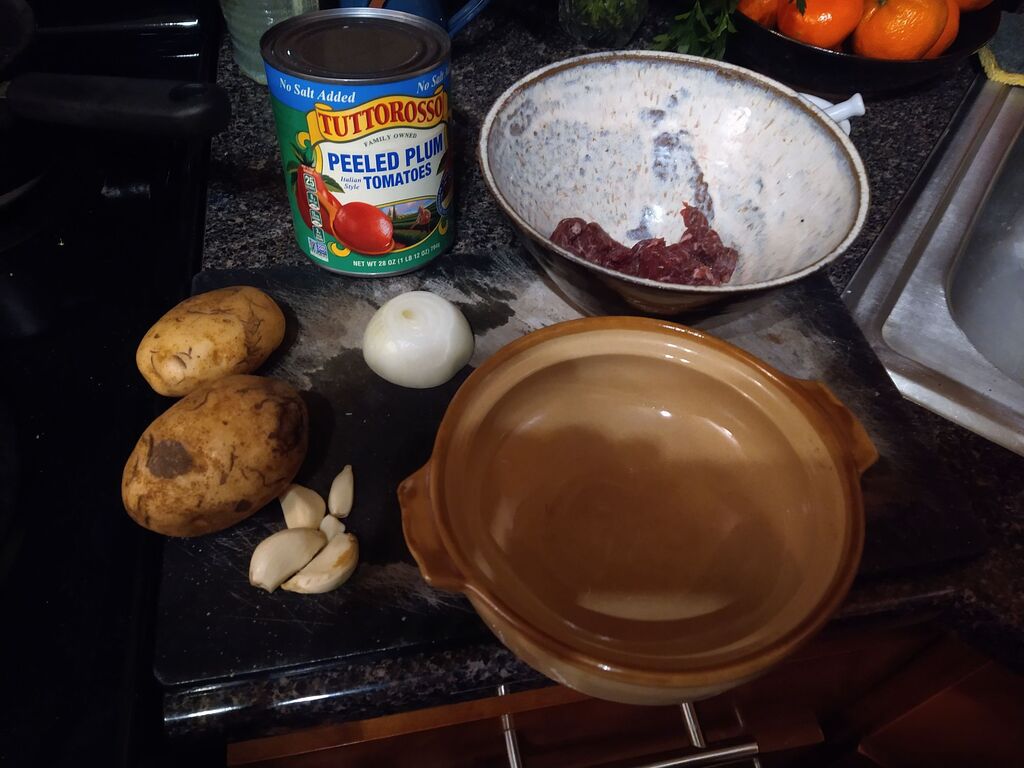
mise en place with an empty donabe, 2 sad potatoes, 5 peeled garlic cloves, 1 small peeled white onion, 1 can of peeled plum tomatoes, and a bowl with small cubes of beef

I had 2 russet potatoes that were not in great shape. (I had purchased them on delivery instead of looking them over in the store, and this batch was damaged. The delivery place gave me a full refund for the potatoes after I sent them a picture. Then I split up the bag with a few people so we could use them up before they went off. So I washed them and peeled them and sliced them into thick rounds and put them in the casserole dish. And this is where I had my first misgivings – when I’m building a dish like this, I usually like to put the onions between the bottom of the dish and the main meat (or in this case potatoes) so that there’s less worry about sticking and burning. But we’re trying to follow the recipe here!
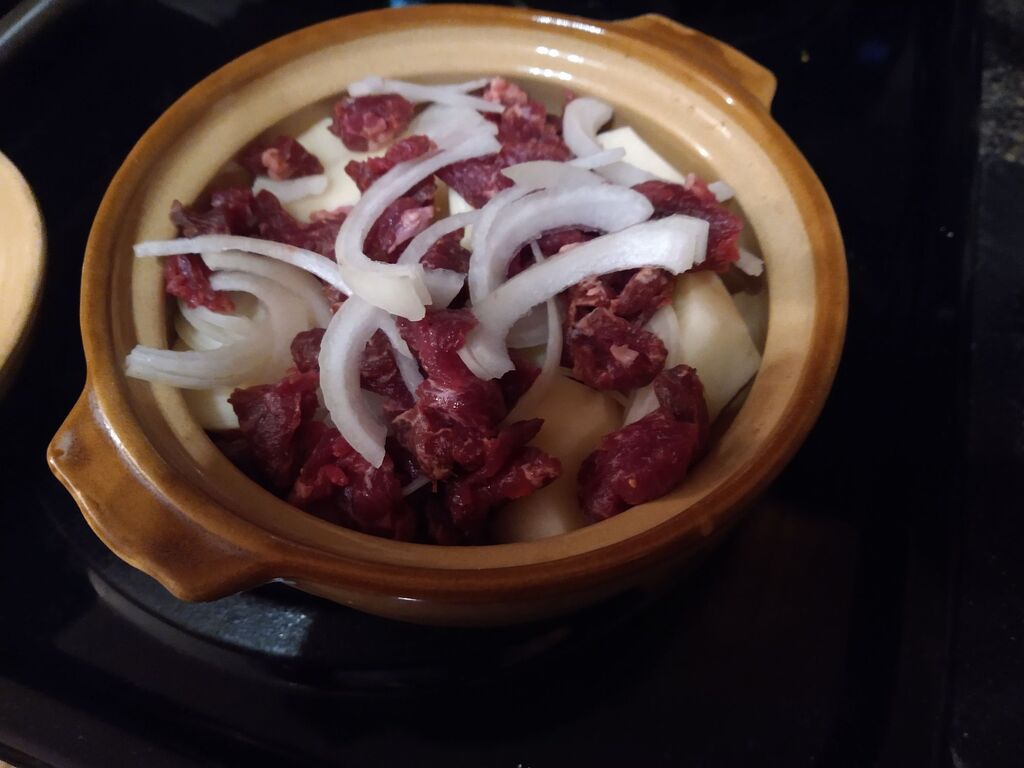
Donabe filled with potatoes with small beef cubes tucked all around and thinly sliced onions on top. There are also garlic slices in there, but none are showing in the picture.

Once I had a solid layer of potatoes in there, I started tucking the garlic pieces and the small beef cubes around the potatoes. And then I (foolishly!) decided to not get another pan dirty by precooking the onions in the tomato juice, like in the second recipe, and just add them directly the way the first recipe says/implies. I added the tomato juice from the pan and sliced some of the tomatoes on top. Then it went in the oven!
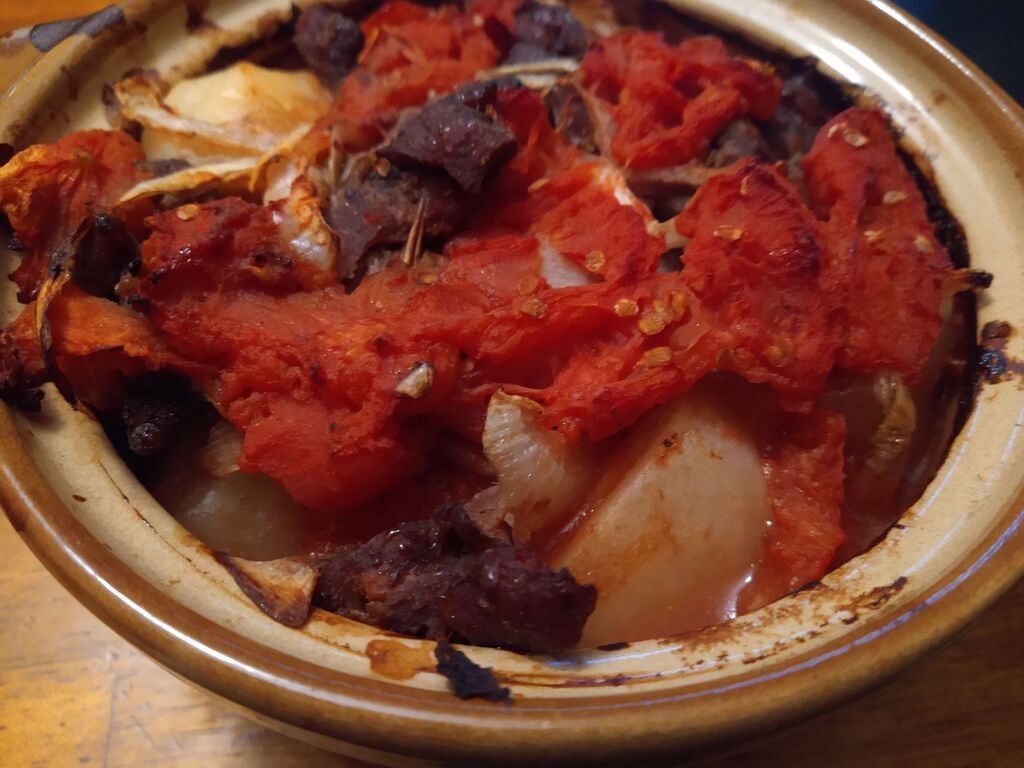
donabe with a cooked dish with potatoes in thin liquid and you can see the other ingredients – tomatoes, beef, and onions – looking a little dry and cooked with some small amounts of burning, especially right around the edge of the bowl where liquid bubbled up the sides.

After about an hour and a half, it was smelling pretty good and like food, so I gave the potatoes a poke with a fork – they were still fairly firm, so back they went for another half hour. Then I waited for the potatoes to cool enough to eat and I was very optimistic about this dish.


It was terrible! The potatoes might have been cooked, but they were not soft and none of the sauce had penetrated to flavor the potatoes. And the onions! I don’t know how, but the onions tasted even more strongly of raw onion flavor after cooking than they did before! Nothing went together and it put me off of using that whole cookbook!

But this should be a viable dish! It sounds so simple, stable, and reliable. So I went looking to see if it appeared in other cookbooks. Of the ones I checked, nothing particularly close appeared.

And then I found a food blogger with a VEGAN version! https://cheznermine.com/2026/03/27/authentic-egyptian-potato-bake-saneyet-batates/
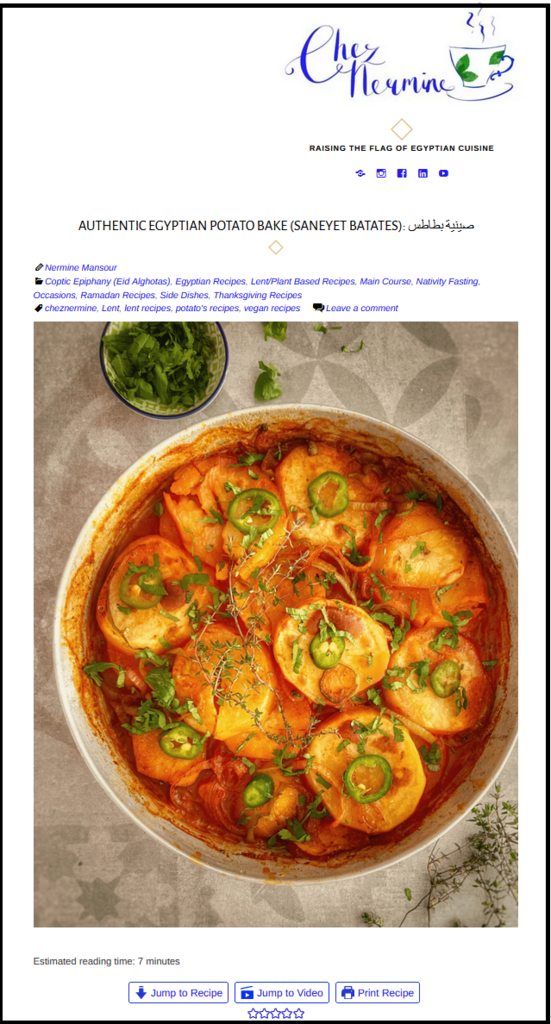
screencapture of the start of Chez Nermine’s page about Saneyet Batates – site linked to picture if you want to click through

And this was more like it! With detailed instructions, discussions about ingredient varieties, and even a video recap. So this time I made it for lunch with a friend. She has been having chemo on Friday afternoons and then I’ll pick her up and make a meal before the nausea kicks in. It has all of the fun of dining out with none of the risks of dining in public while immunocompromised. So I asked her opinions about the ingredients, and she asked for minimal garlic and onions and that it not be particularly spicy, so those are the big changes here.

Using an 8″x8″ casserole dish, I started with some oil in the base. And then I added about 1-2 Tablespoons (not measured, just was left in the container I had) of dried shallots (to replace the fresh onions) and the spices – this version called for spices, so that’s exciting – ground coriander (the last one the ones I dried from my 2025 garden), ground cumin (from the Egyptian cumin a former couchsurfer had brought me!), dry oregano (also dried from my garden), and a generous sprinkle of paprika (a little more generous than the recipe because I’m trying to use up that container). And then that got kind of mixed together.

This time, I was using a fresh bag of yukon gold potatoes. Even though the directions say to slice one inch thick, looking at her video I decided to slice them closer to half an inch thick. And then I sliced up some fresh bell peppers without any spiciness to them. That gets tossed with the spices to distribute as evenly as possible.

I still used the same kind of canned whole tomatoes, so I first poured out some of the liquid and mixed it with tomato paste and vegetable soup base. Then I sliced the tomatoes on top again and poured the enriched liquid over everything. The whole large-sized can was perfect for this size casserole dish.

And then I cooked it – first on the stovetop and then in the oven. But for much longer than called for because my friend’s appointment ran later then I’d been expecting. By about an hour and a half. I had been planning the switch to the oven for right when I left the house, but it ended up almost completely finished before she even called me for a pickup. So I made sure there was enough liquid and that the heat was just high enough to keep a low bubbly simmer but low enough to not dry out or misbehave while I was out of the house.
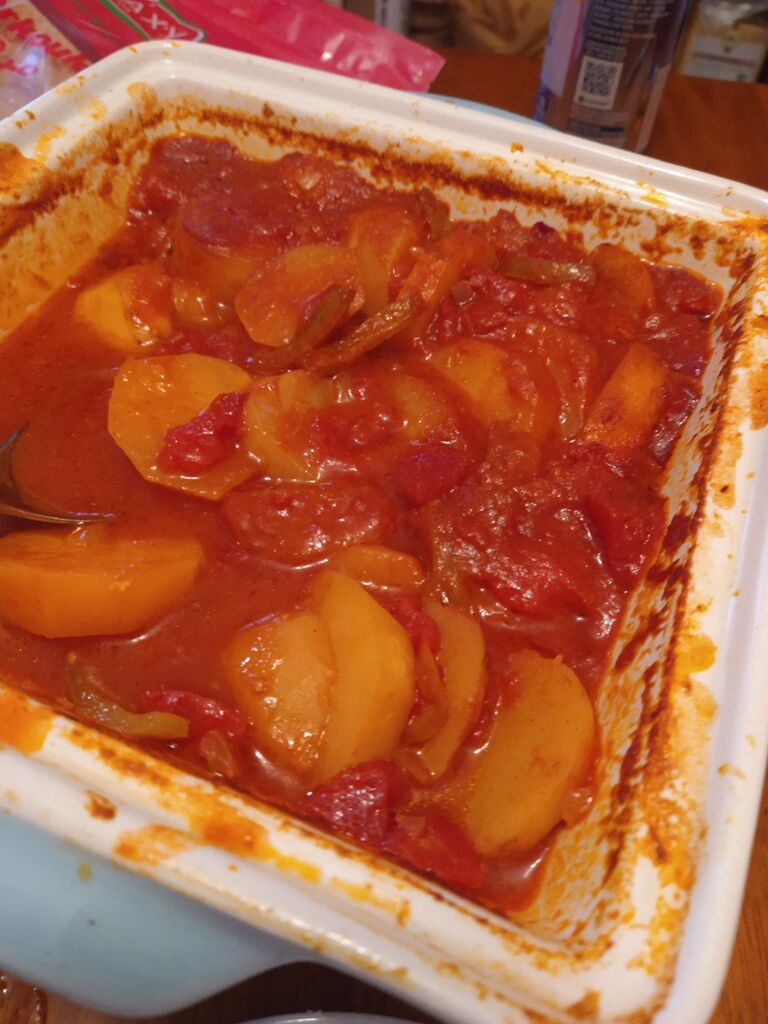
Finished dish of tomatoes that have turned orange from braising in the tomato sauce and small chunks of tomato and pepper in a saucy base.

We came back in the house, and the smell was amazing! The potatoes were very hot, but that gave us some time to chat while waiting for it to cool.

I still had a little ruqaq (an Arabic thin crepe-like bread) left from an experiment, so we used that as a base layer to soak up the sauce. And we had feta brined white cheese on the side.
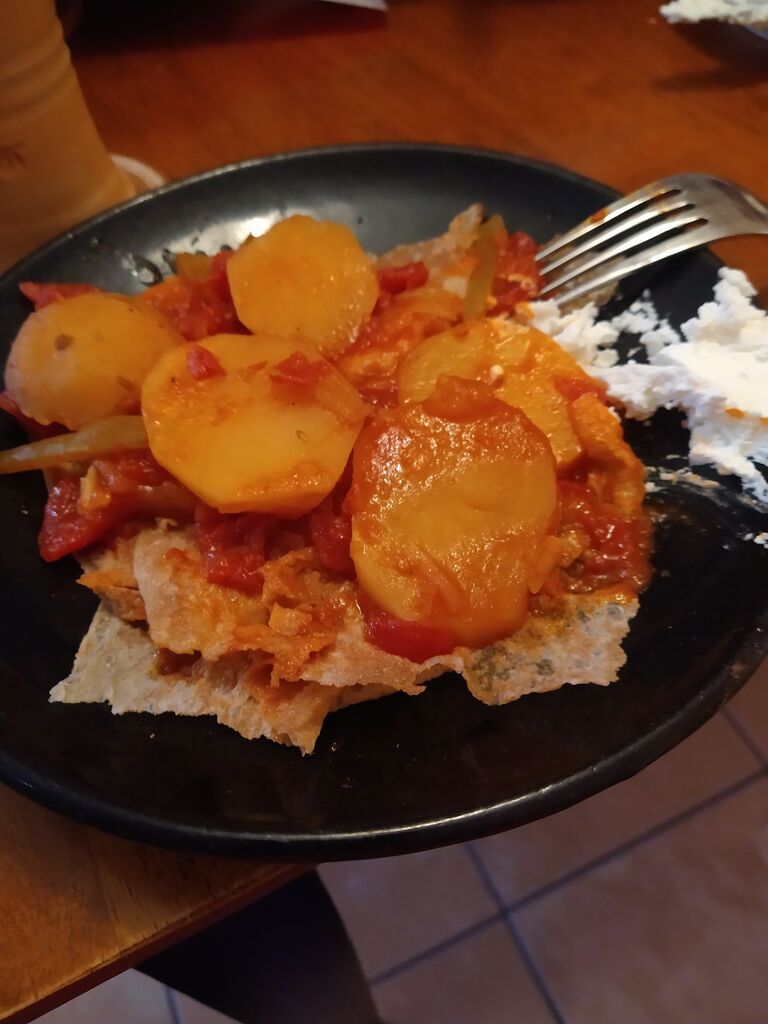
A plate made up with the potatoes on top of a layer of soaked flatbread and some white cheese on the side

This version ended up amazing! A+ Would make again. The spiced tomato broth flavored the potatoes all the way through, and it was just the right amount of warm and comforting without being too heavy for lunch.


Let’s also do a quick roundup of Egyptian food blogs I found:

Chez Nermine: authored by Nermine Mansour, who was born in Egypt, a former Egyptian diplomat (her husband still seems to be a diplomat), and lives in Virginia (united states). Oldest recipe posted 17 August 2017; most recent recipe 3 April 2026. Primarily Coptic, she has recipes tagged for Christian, Islamic, and Jewish holidays and includes both vegan and meat. Has a recipe for macarona forn, saneyet batates, koshari, and molokhia. Tagline is Raising the Flag of Egyptian Cuisine. Likelihood of using: 10/10 (see above)

TheEgyptianCook: Signature cooking by Muhammed Elgammal, but posts and videos are made by a team and his site has a merchandise store “in development.” He is an Egyptian-American Muslim who resides in the United States. Oldest recipe posted 11 December 2023; most recent recipe 17 November 2025. Has a recipessddd for macarona bechemel, baked potatoes and lamb, koshari, and molokhia, Recipes are fairly meat heavy, but includes vegan kofta (as well as beverages and desserts). Likelihood of using: 1/10 (autoplay videos)

Scarf Gal Food: Simona Afifi does not have a separate “about” section, but does sprinkle anecdotes throughout the posts. Diaspora Egyptian with actual experience making and buying food in Egypt, posting from the united states. Oldest recipe posted 21 April 2015; most recent recipe 13 December 2021. Has a recipe for macarona bechamel, saneyet batates, koshari, and molukhia. Likelihood of using: 6/10 (most likely this recipe for easy ful starting with canned beans)

The Egyptian Kitchen: abissada was 1st generation born outside Egypt and lists her location as France, but she has visited Egypt. Earliest recipe posted 18 January 2010; most recent recipe . Has recipes for macarona bil bechemel, koshari, and molokhia (first posted recipe). Likelihood of using: 3/10

Food of Egypt: References christian and Islamic holidays. Oldest recipe posted 28 July 2010; most recent recipe 1 August 2013 (posted to facebook through August 2015). Has a recipe for molokheya. Likelihood of using: 2/10 (too many intrusive ads)

Cleobuttera: Tasbih is a food blogger in Egypt who specializes in pastry and baking. Oldest recipe posted 11 November 2014; most recent recipe 25 August 2019. Best web design, includes a section of which major publications have referenced her blog. Likelihood of using: 7/10 (would be higher if I were more of a baker/confectioner)

JulienJulia: Julia is a cooking nom de plume for Kariman Al Essawy, a home cook in Egypt. Oldest recipe posted 22 April 2010; most recent recipe 26 June 2017. Includes restaurant reviews. Has recipes for bechamel lasagna, koshari and molokhia. Also includes this write up of cookbook author Nazeera Nicola. Likelihood of using: 5/10

see also: History of Egyptian Cookbooks and Ask Abla Nazira

Bits & Bobs – Beans and Rice, Coconut Chutney Butternut Squash Soup

Okay, so if you’ll remember from the last soup, I had leftover the liquid drained from a can of tomatoes.

Well, at that enchilada dinner, one of the participants made a pot of rice (with a seasoning packet) and heated up some kidney beans. Her rice came out perfectly, and I took home what leftovers there were.

And reheated them. All classy-like. But I’m telling you about it anyway because I’m proud of having essentially made dinner for free.

Leftover Beans & Rice

First, I wanted to soften the beans a bit more, so I put them in a small pot with just enough tomato liquid to cover, and cooked that for five or so minutes.

And then I went to look around for other flavors to jazz things up.

Oh, yeah, I have a jar of pipian, so I melted about half a teaspoon into the liquid.

And I have some Lime Cilantro salad dressing, which is more like a pesto than a salad dressing, from a local restaurant – so I added a dollop of that, too.

And then I added the rice.

And as everything came to temperature, I crumbled some dried oregano in it as well.

End result – delicious and filling dinner

I also still had about a third of the roasted butternut squash lingering in my fridge. What was I going to do?

So, again, I went poking for inspiration in the other bits and bobs in there. Aha! I had a small container of coconut chutney from take out dosas a friend had brought to my house. I can play with those flavors.

Coconut Chutney Butternut Squash Soup

I diced a yellow onion fairly small, and I cooked it in coconut milk (6.5oz).

I added some asafoetida and a fairly large amount of garam masala – somewhere around a rounded teaspoon. Oh, and 3 cloves of roasted garlic because it was there.

Once everything was aromatic, I added the butternut squash. I also put a Tablespoon of mustard seeds in a dry skillet to heat.

And about a quarter cup of finely shredded, unsweetened coconut.

Like the previous soup, this one also needed some kick, so I added some cayenne pepper. And some black pepper. And a little bit of cilantro. And adding about a teaspoon of brown sugar really made it sing.

Then I thinned the soup out with some vegetable stock.

Once the mustard seeds started to pop, stirred them into the soup as well.

Done! Rich, tasty, and a bit out of the ordinary.

Mexican Butternut Squash Soup

Would this soup be made in Mexico? I have no idea. No people or cookbooks provided any support for this claim. But its seasonings and flavor went well with the enchiladas my friends made.

So there I was at my farmers’ market this weekend near the end of the market – and one of the farmers had a box of butternut squash seconds for $1/lb. The tops were going mushy. And I asked the guy how many he thought I could get for $5… and walked away with 6 decent sized squash.

I scrubbed the outsides, trimmed the tops as necessary, split them in half lengthwise with my big knife, scooped out the seeds, and set them to roasting cut side down. It took 2 half sheet pans to roast them all.

Once they were tender, I let them cool a little, and then I peeled them and put the flesh all together in a container in the fridge – purpose to come soon.

Then this week I had 1 friend request vegetarian soups and another invite me over for enchilada dinner. Woo!

Mexican Butternut Squash Soup

Start off with about 4-5 cups of roasted butternut squash and a roasted head of garlic.

I began building the soup with a roux base, so I poured… oh, about 2 Tablespoons… olive oil into my soup pot and heated that up.

Since I wasn’t sure whether I would want to blend the soup smooth, I diced the (1 medium) onion fairly small. Toss that in and cook until translucent.

Once the onions were soft, I sprinkled flour on top until the onions were coated with flour, but none was still dry in the pan (about 2 Tablespoons – if it’s too dry, add more oil)

Then I opened up a jar of vegetable stock and added until everything went smooth and liquid (it took about 1 cup, but I’d been expecting to use more stock).

I added the roasted squash (2/3 of my total… somewhere around 4-6 cups) and I poured in the liquid the squash had released overnight in the fridge.

Cook that a bit until everything is hot and the squash is starting to break down. Meanwhile – drain a 24oz can of diced tomatoes (and reserve the liquid to use either if the soup becomes too dry during cooking or to use in making rice later in the week) and grind 1 tsp cumin, 2 tsp coriander, and 2 tsp ground oregano (or use ground herbs and spices).

And dices tomatoes to the squash. Stir. Break up the squash more every time you stir.

Sift the ground spices into the soup (because whole coriander is ornery in a mortar & pestle YMMV). Add salt and pepper. I added some ground savory, too. If the color isn’t pleasing, you could go for some paprika, but I was pleased with things without.

I added about half of the cloves from the roasted garlic.

Stir, mash, stir.

This soup really came together quickly – about 20 minutes – so I also added the juice of half a lime to encourage it to stay the pretty color it had hit. And I was pleased with the amount the squash had broken down (mostly smooth, with some chunks, no pieces larger than half a teaspoon), so I left it chunky.

What this soup was really missing was spice, but that was a deliberate choice based on its audience, so I took a chipotle hot sauce with me instead.

Hazelnut Tamarind Rice

I was very lucky back in January to catch a twitter exchange between @HeleneDujardin (of Tartlette and http://www.helenedujardin.com/) and @glutenfreegirl (of Gluten Free Girl about Tamarind Rice.

The recipe comprised only two tweets:

recipe for 3 cups dry rice: 3tb oil, sautee 1/2 c raw peanuts, 1/4 unsalted cashews, 1 tb black mustard seeds, (cont)
2:12 PM – 19 Jan 11

1 tb cumin seeds, 3/4 tsp asafetida powder. When mustard seeds splatter, add 1 cup tamarind pulp, add to cooked rice mix
2:14 PM – 19 Jan 11

Now let me link you to a more detailed version of a Tamarind Rice recipe.

So back in January I favorited these two tweets.

And then in February I ended up with a lot of leftover basmati and looking for a way to package it into lunches I could freeze.

Only I had neither peanuts nor cashews.

But I did have pine nuts and hazelnuts. Okay, so whatever. I can try that. And I did – and I’ve kept making this weird version ever since.

Hazelnut Tamarind Rice

Soak a little less than a cup of hazelnuts overnight.

Put a teaspoon or so of oil in a pan and a palmful of mustard seeds. If you remember, add a teaspoon of asafoetida, but I often forget. Turn the heat to medium high, and if you are particularly clever you might cover it with a splatter shield or a clean aluminum takeout container.

Drain the liquid from the hazelnuts.

As soon as the first mustard seed pops, but before many do, add a bunch of pine nuts (depends on how many you have and how much leftover rice you are trying to use up – let’s say 1/3 cup for now).

Oh, and you can add a bunch of whole cumin seeds, too!

After just half a minute, start stirring the pan intermittently because your pine nuts are toasting and your mustard seeds are popping.

As soon as the pine nuts are almost fully toasted, add the drained hazelnuts. Hey! Water-laden things in hot oil! This will hiss and spit very satisfyingly. Don’t stand too close without a shirt on.

As soon as you get a whiff of things getting really toasty – that is, catching it right before your nuts burn – dump in your leftover rice.

Stir it about, heat the rice thoroughly and evenly mix in the nuts and seeds.

Take a jar of tamarind chutney, and pour some in, stir, pour some in, stir – until you like the color and it tastes good.

Done!

Unusual Black Bean Dips

Wooo! Let me tell you something amazing!

So my sister got me a food processor for a house warming gift. And this is the magic key to making bean dips. I had no idea.

But now there is so much freedom!

Last weekend I had people over to craft, and I made up a platter of sandwich fixings. But I forgot to make something vegan (I mean, there was bread and lettuce and tomato and all, but nothing of bulk to hold it together). I’d meant to buy some hummus – as you do – but I’d forgotten and checked it off my shopping list in error.

And the person came up to me and softly asked, “Erm… food?” Or words to that effect.

And I could just go to my cabinet and pick a random can of beans and turn it into random dip.

Random Dip, I tell you!

First option: Chipotle Black Bean Dip

Step 1 – drain the beans, rinse thoroughly (otherwise it can get too salty), and dump into the processor.

And then I said unto myself – we need a saturated fat alternative to lard, and I have this here awesome coconut fat. So I added about a tablespoon of that. And some olive oil, because why not?

Oh, and you’re closing the food processor and turning it on in between each addition and then tasting to see what else would be good – I don’t think you can over-process bean dip.

And then some fajita seasoning. But the beans are a strong flavor, so also some powdered oregano and thyme and maybe some cinnamon, too, for fun.

Oh, yeah, and there were a few cloves of the roasted garlic I had in the fridge. Raw would have been fun, too.

And, yet, still not spicy – and rather thick.

So I squeezed a lime into it and added about half a teaspoon of chipotle sauce (maybe more?).

And it was amazing. The non-vegans were all over that, too! I enjoyed it on potato bread with microgreens.

So then a few months later, there was a need for dip again… and a guest had started a bottle of red and turned out to be the only one drinking wine that night, so I decided a swig of red wine wouldn’t go amiss, and I shaped the dip around that flavor.

Red Wine and Ginger Black Bean Dip

Drain, rinse, and add the beans to the food processor. And a slug of red wine!

Oh, yeah, coconut fat would be even more appropriate in this combination.

And then peel and grate about an inch of ginger into the bowl of the processor (and then brush it off the middle part because that gets awkward).

Grind some black pepper. Squeeze some lime. sprinkle just a little cinnamon and thyme.

And a teaspoon of dijon mustard rounds it out nicely.