The first time I went to Morocco I was fascinated by the many varieties of flatbread, many of which were not particularly flat.
So this reminded me of SCA research by Mistress Judith bas Rabbi Mendel into early forms of matzah (unleavened bread made for Passover) being as thick as a finger.
I tried some of her experiments, but unleavened bread that thick was challengingly dense. But also, until Morocco, I had never seen bread that thick being called flatbread.
Today was a long day. I headed out before the shops opened, and by the time I finished dinner and headed home the shops were mostly closed up
It was this long because I went on a day excursion. And I had tasty food, so I wasn’t starving. So I texted my host and asked for a recommendation for a place with especially good soup between our drop off point and where I’m staying. And she recommended two places. I mapped them out and figured that whichever one I spotted first would be my choice
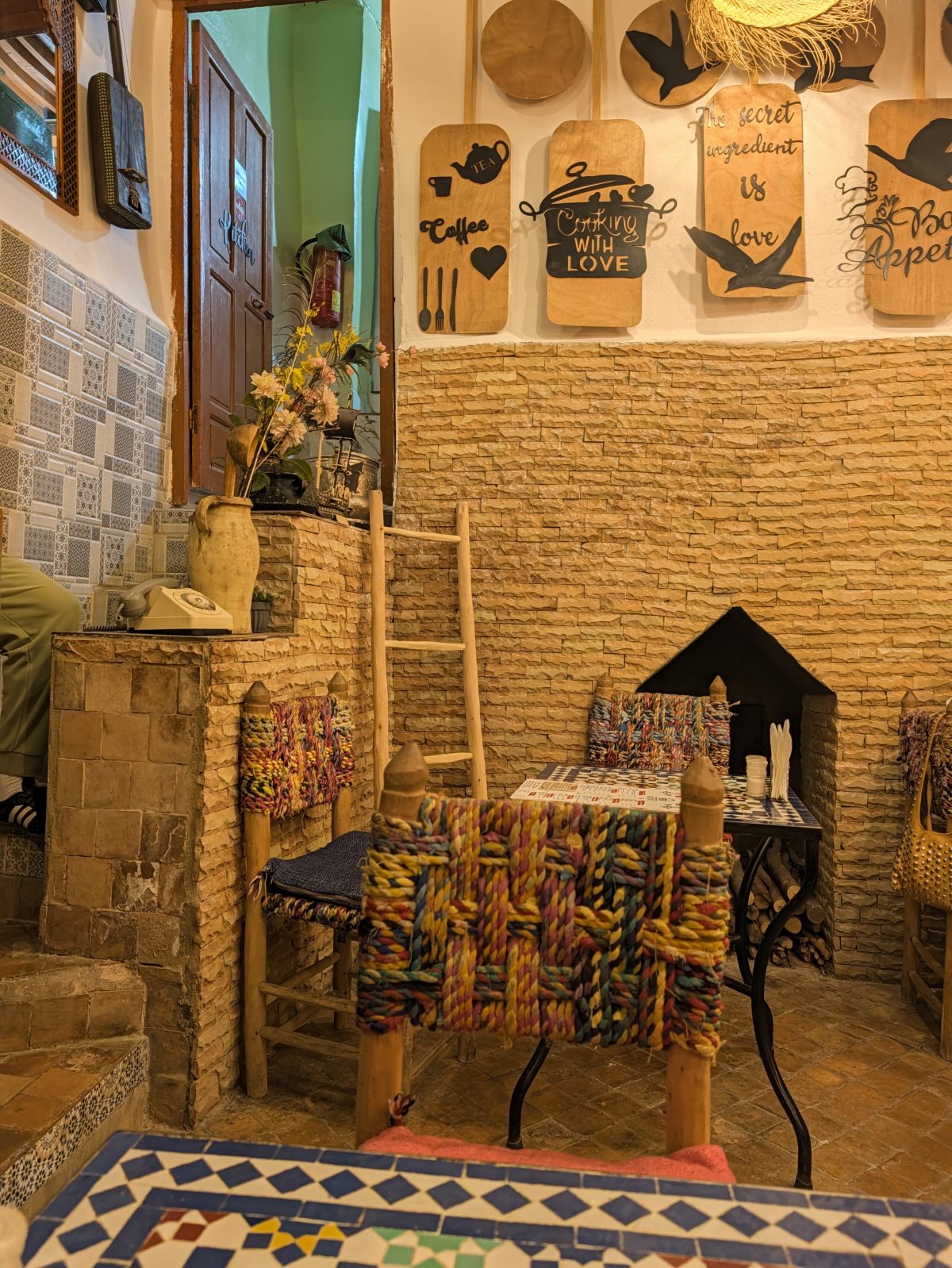
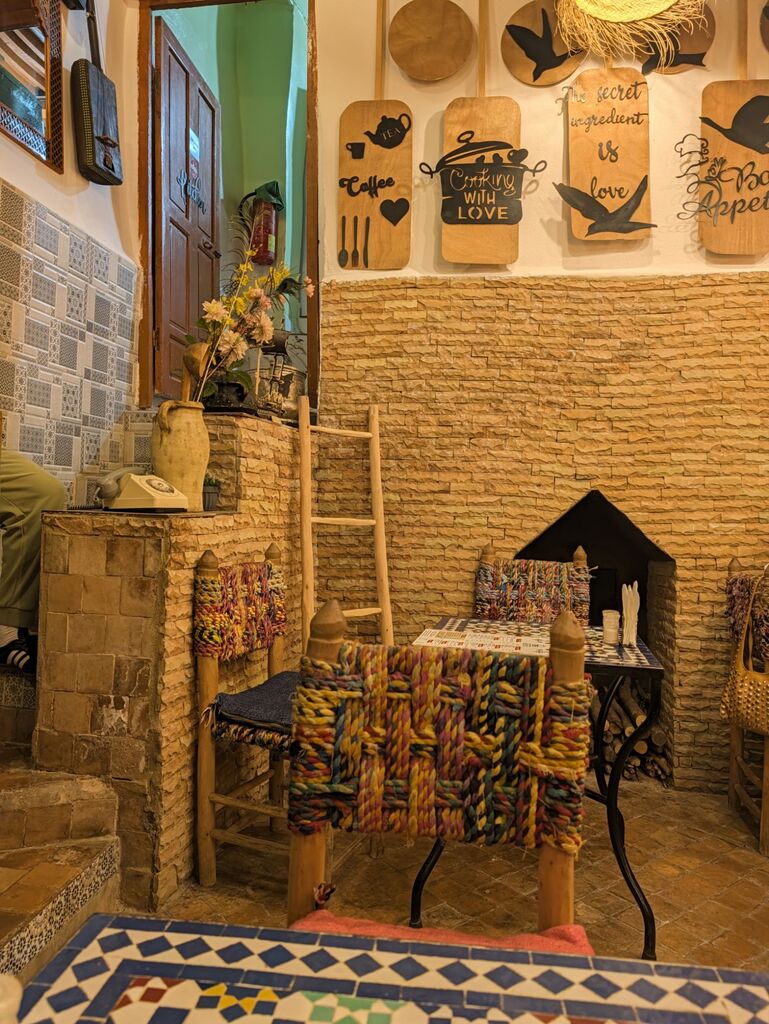
I should have walked out when I saw the decor
I should have read the Google reviews more closely, since they mostly praise how approachable it was, how well the air conditioning worked, and how clean the bathroom was.
But it had been a long day and I felt like my host might give good suggestions
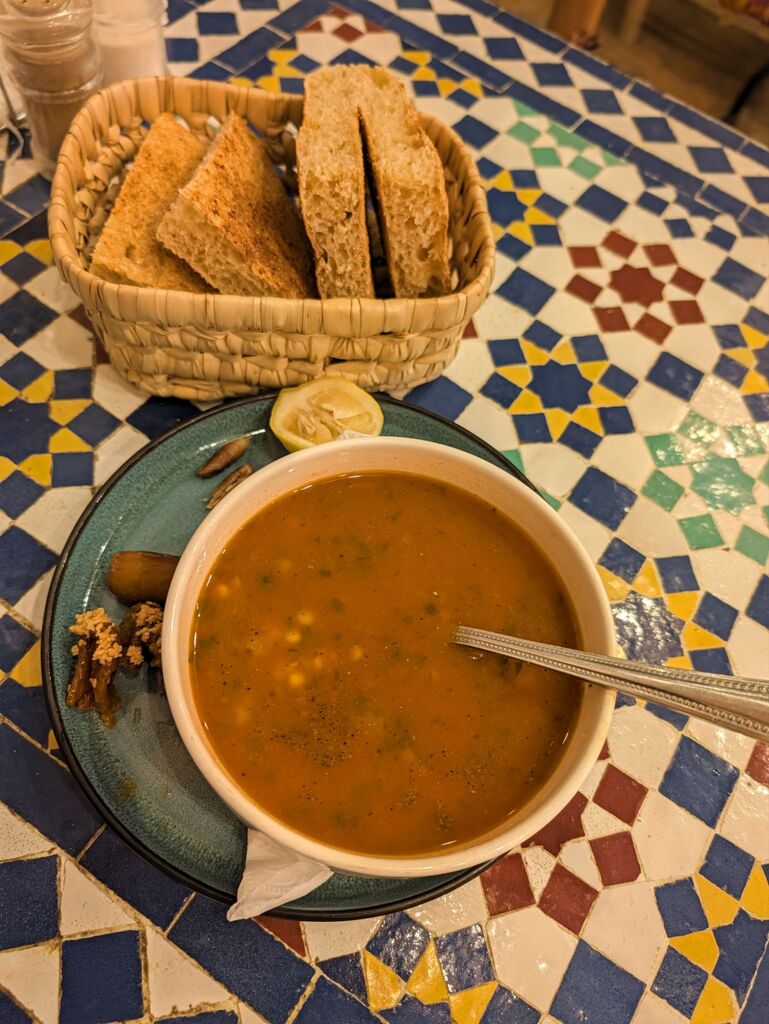
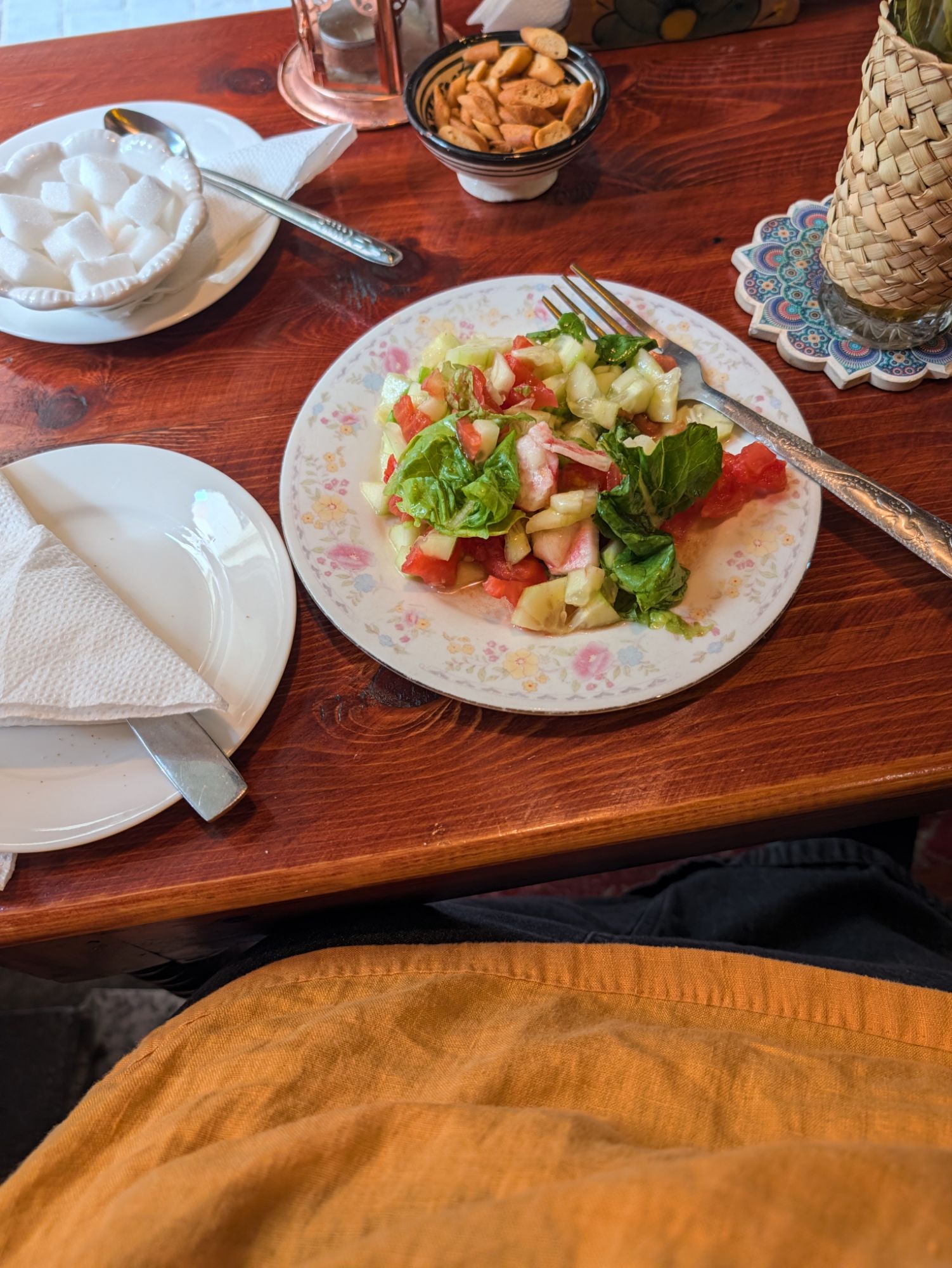
So I ordered the soup (there was only the standard harira soup), the eggplant salad, and the Moroccan salad (which is your standard tomatoes, cucumbers, and miscellany all marinating together)
This soup. This soup was seasoned for white people
I squeezed the whole quarter lemon in. I tried to add pepper, but the container on my table had already been emptied so I stole the pepper from the next table. Even then, it was still sad and bland
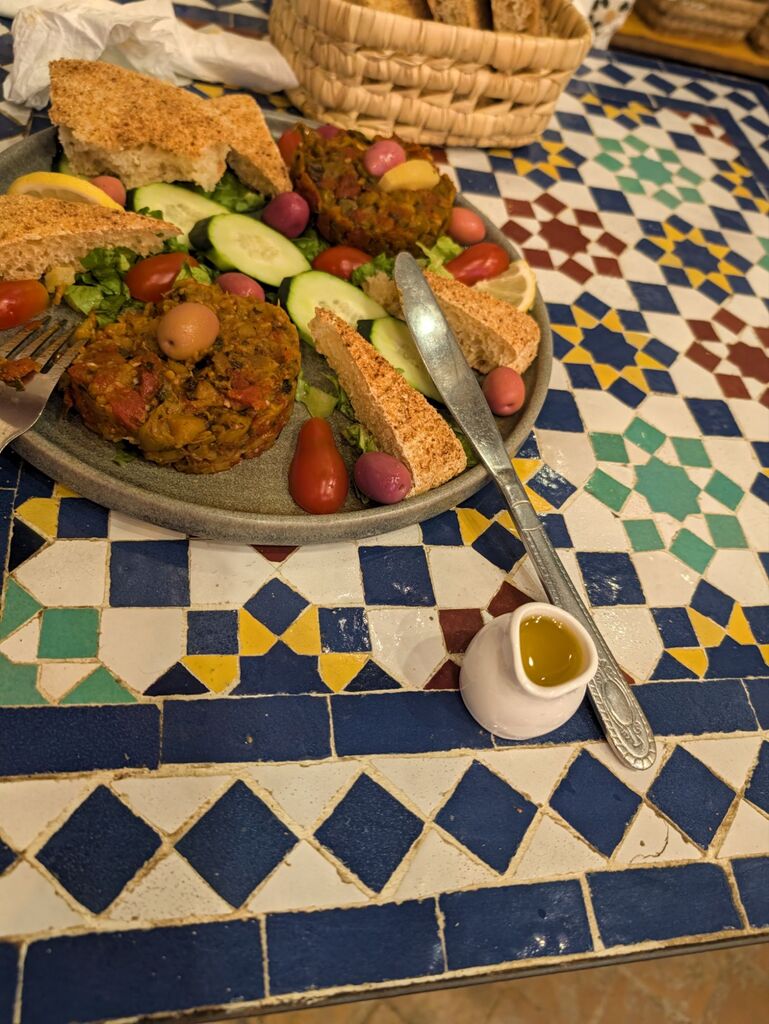
The eggplant salad came out. The plating was gorgeous.
This was actually pretty tasty, but the bread was whole wheat and very earnest and I had to ask for olive oil to smooth it all out. The salad was best scooped onto the cucumber slices like dip for chips, but there weren’t enough slices for the whole thing.
The server waited until I was halfway through before asking if I’d like my other salad now or to wait. And I was all, “Do you not understand the smorgasbord of tasty appetizers? Bring me all the things!” Okay, I actually only said Yes Please
This salad
Y’all
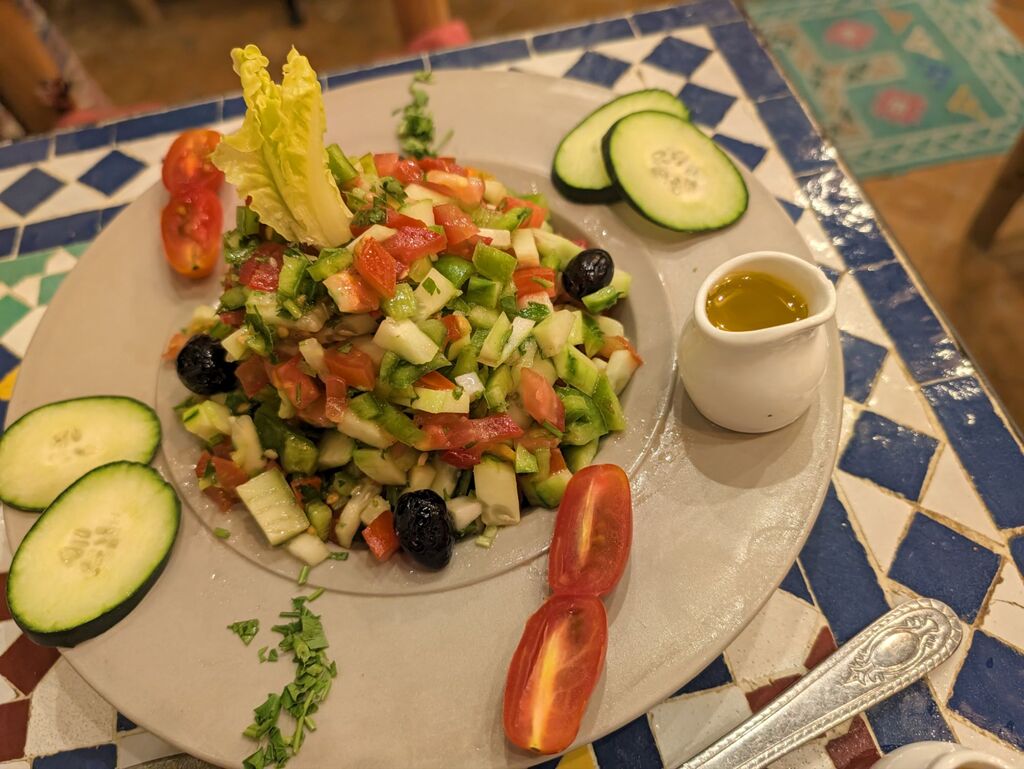
This salad was made to order.
This salad’s primary ingredient must have been love because it wasn’t the local in season tomatoes I’ve been getting the rest of my visit. And it wasn’t salt. And, as you see, the oil was served on the side.
This is freshly chopped cucumbers, green bell peppers, and winter tomatoes. Garnished with 5 black olives, two sprigs of parsley (minced), and a tiny center of a head of lettuce.
No spices. No acid. No oil. And no sitting together with the salt to release their juices and become friends with each other
At this point I looked up their reviews more carefully to see if anyone talked about the nice white lady who had moved to Fes to start over after a disappointing legal career and her first divorce.
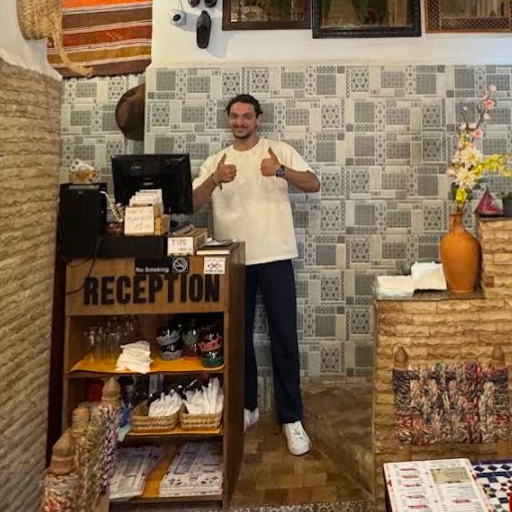
But apparently this is the owner?
I did check and ask as naturally as I could whether I had recognized correctly that this salad was only made once I had ordered it, and I was very proudly told that Oh, Yes! All their food is made fresh to order.
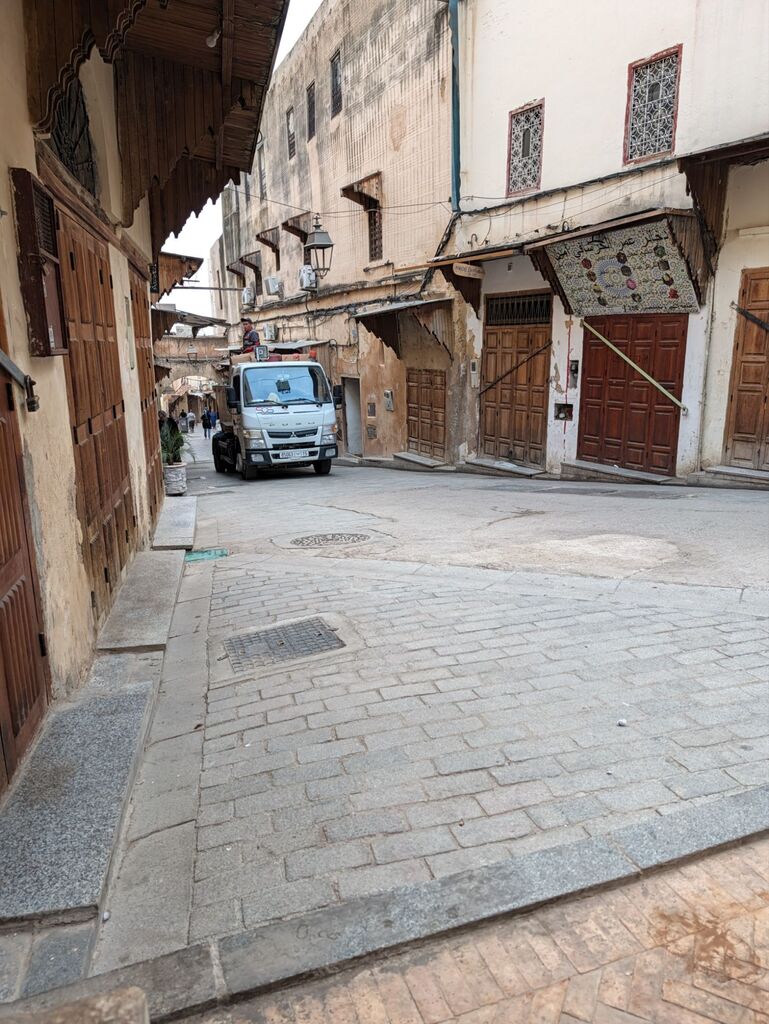
I was told to meet for the day trip at 7:30, so I set out at 7am to give myself time to find the cafe. But it felt especially morning when the stores were still all closed. If was so early that there were vehicles on the streets! One guy was delivering sacks for grain with a tractor. And then I got to see the trash truck collecting garbage.
The trash truck is going down this long street backwards
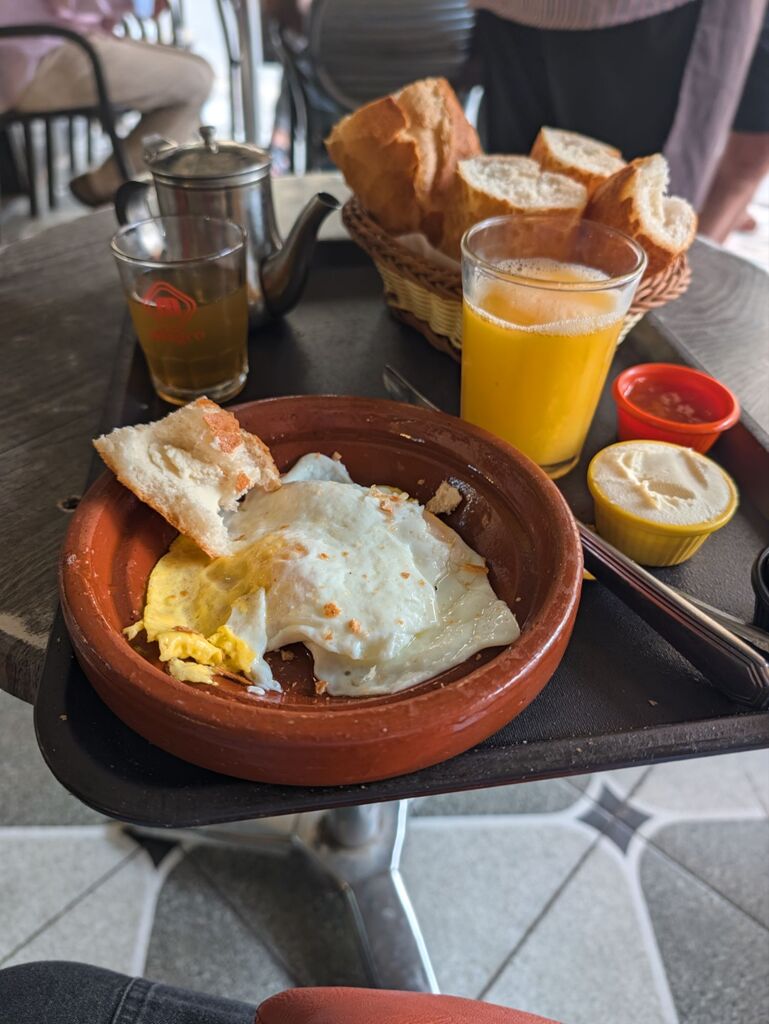
The cafe meeting point was much earlier to find than I expected (it was in a slight different spot on each of my maps). The cafe was basic – okay, the free breakfast from the cafe was basic – a fried egg, a roll, orange juice, and hot beverage of your choice. Still, I hadn’t even been expecting food to be included, so that was nice.
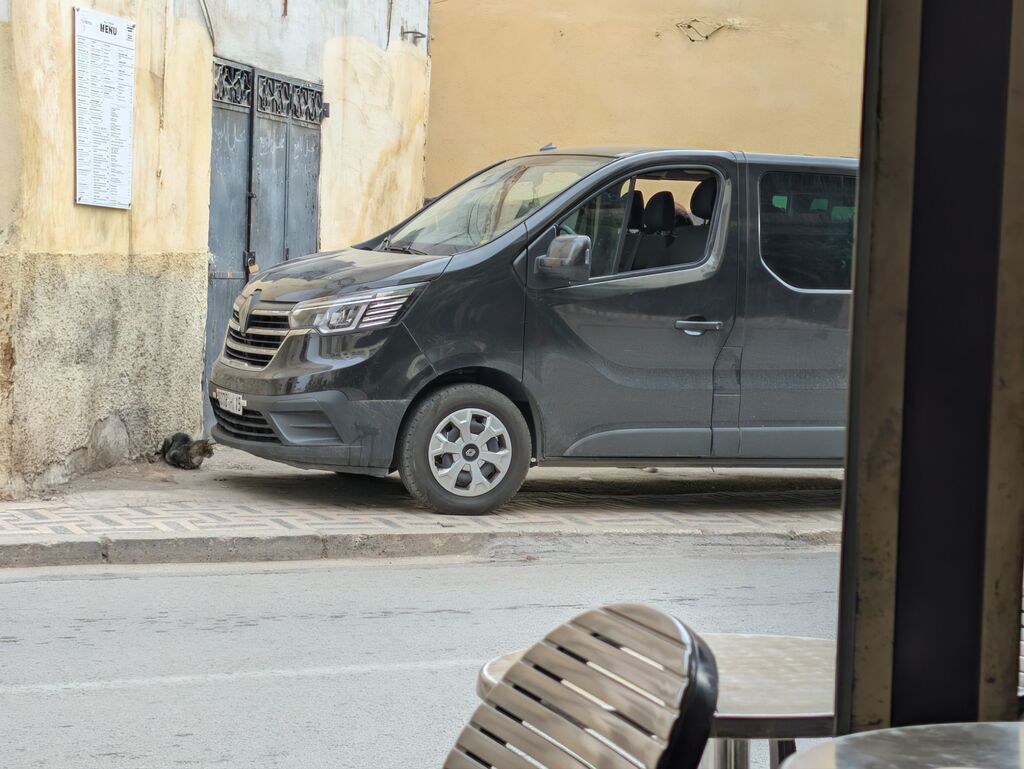
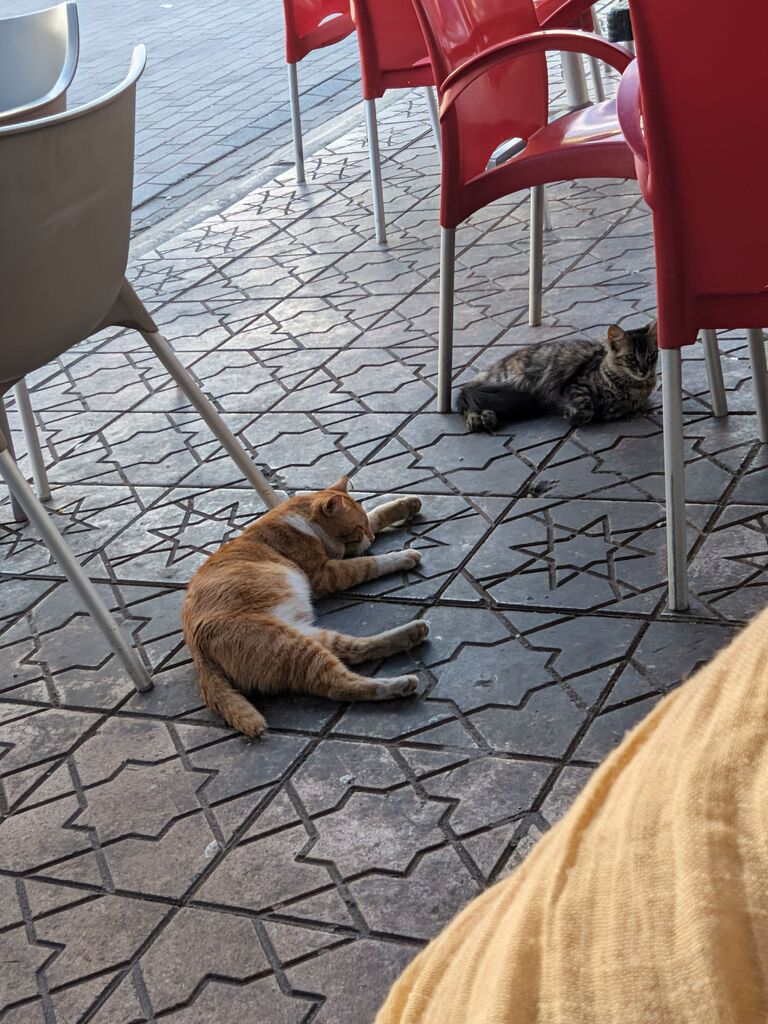
Breakfast on a trayThe van we’ll be taking, with a bonus cat in front
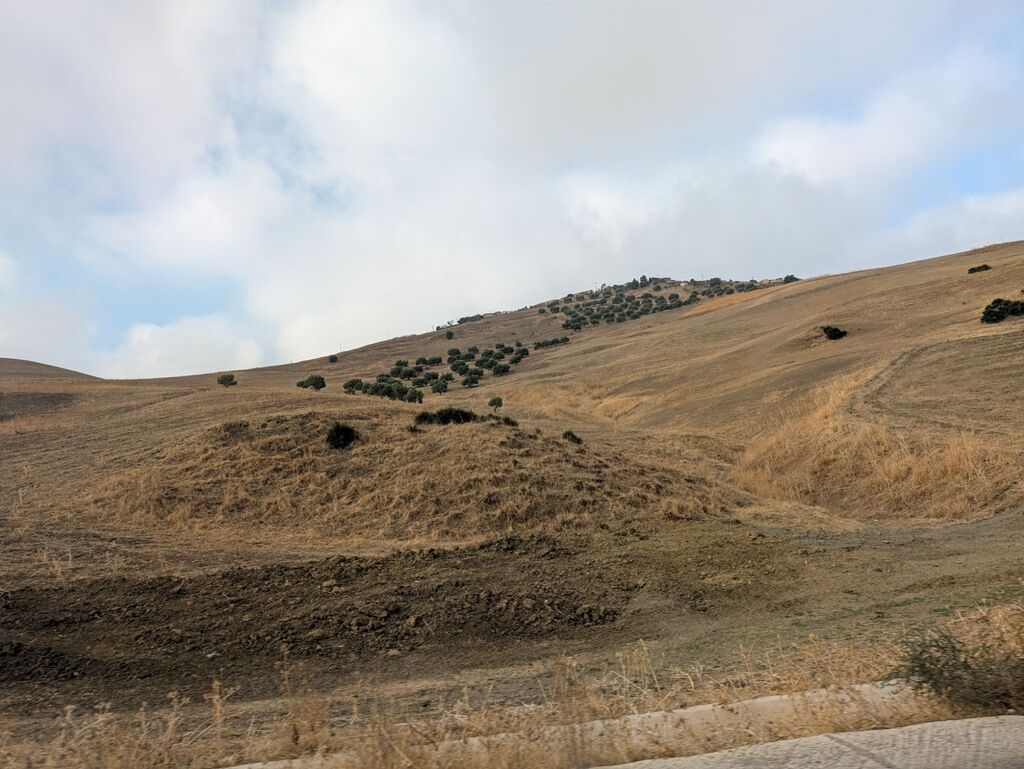
I volunteered to share a table with a cute woman with braids and bohemian clothes. Alas she was not as interesting as her style, and it turned out she was a heterosexual from California. And then we set out to Chafchaouen. It was more than a 3 hour drive, with surprisingly bumpy roads. Surprising because much of it would be pretty smooth and then there would be a sudden dip in the road.
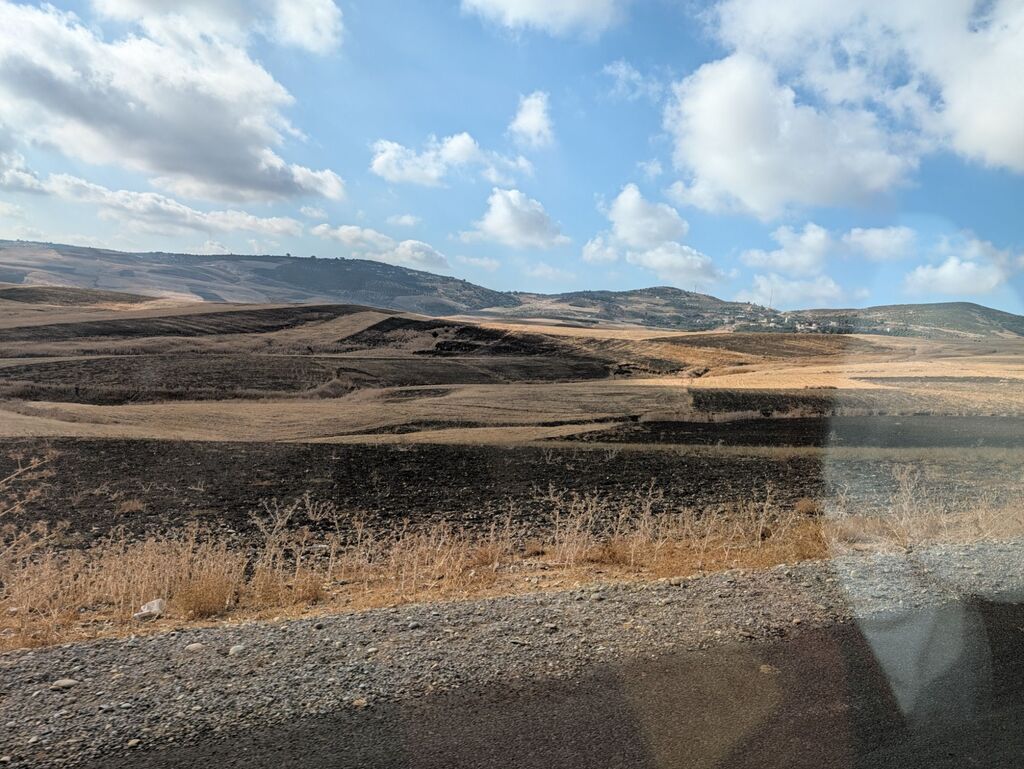
Trees and hillsNear yellow hills, far mountainsScenery out the window of the can on our way to Chefchaouen
We had two quick stops. One of a large space with a cafe and a bathroom – which was a very well maintained set of toilets that was able to accommodate whole vans full of tourists at a time. But the cafe side only has sweets and beverages. So we got hot beverages and then got back on the bumpy van. No lids were available.
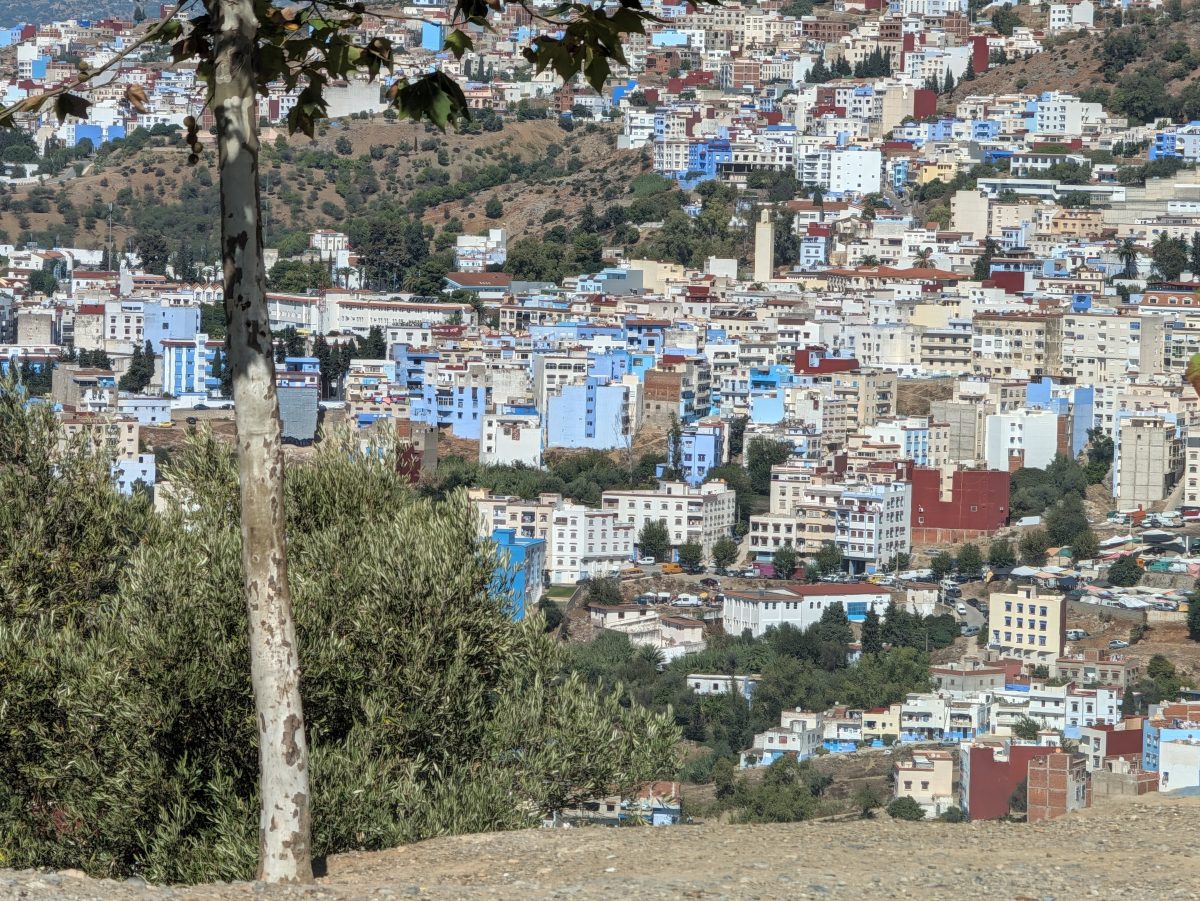
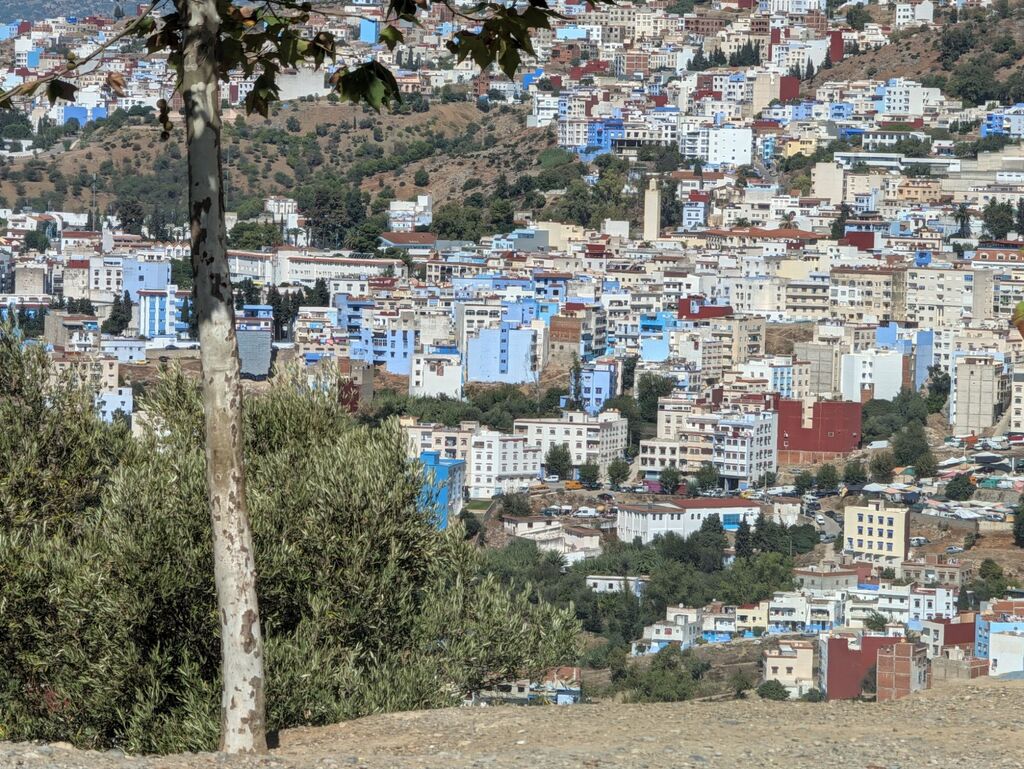
A long overview of Chefchaouen
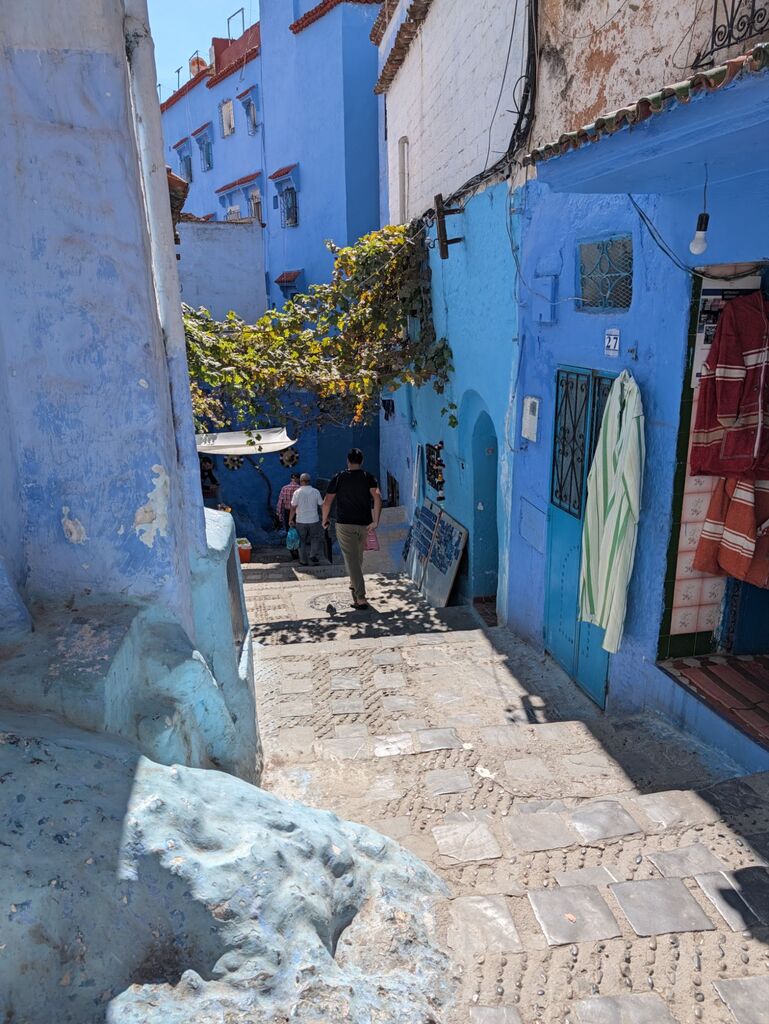
The second stop was at a scenic overlook. For a city that advertises itself as blue, there are a few different colors for buildings. And then once we got there, we were just dropped off to wander on our own and meet back up at 4pm. I tried walking a random promising looking direction, and I was gently redirected toward a specific path to enter the old medina. And indeed, almost all of the old medina was blue. Very photogenic.
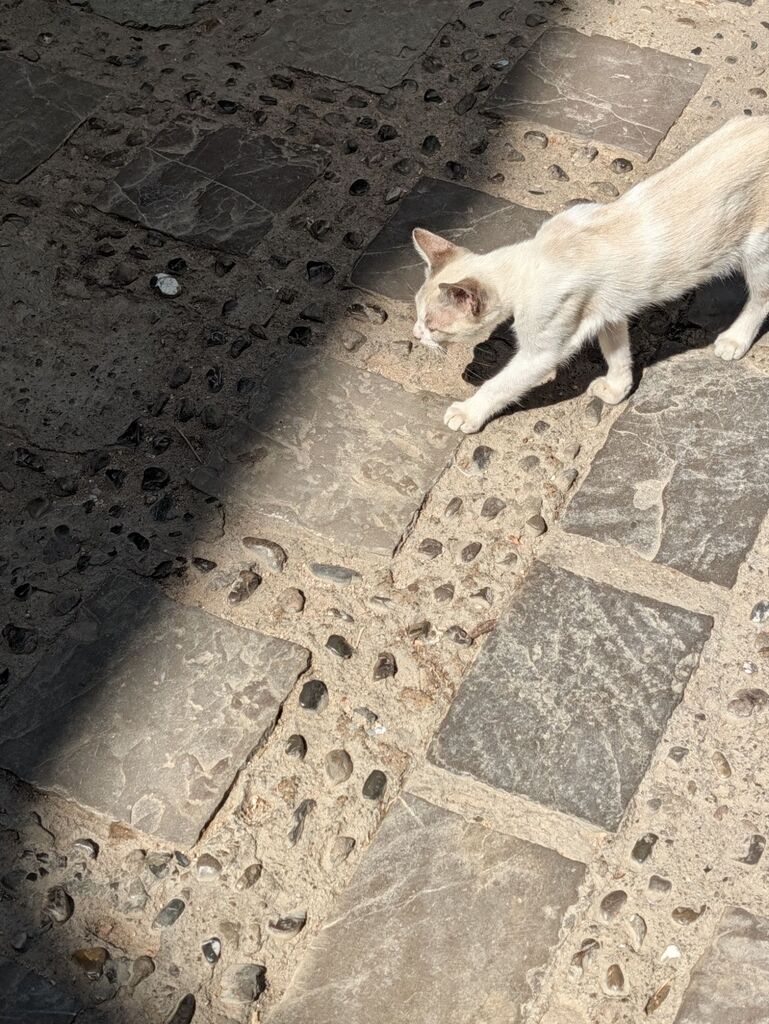
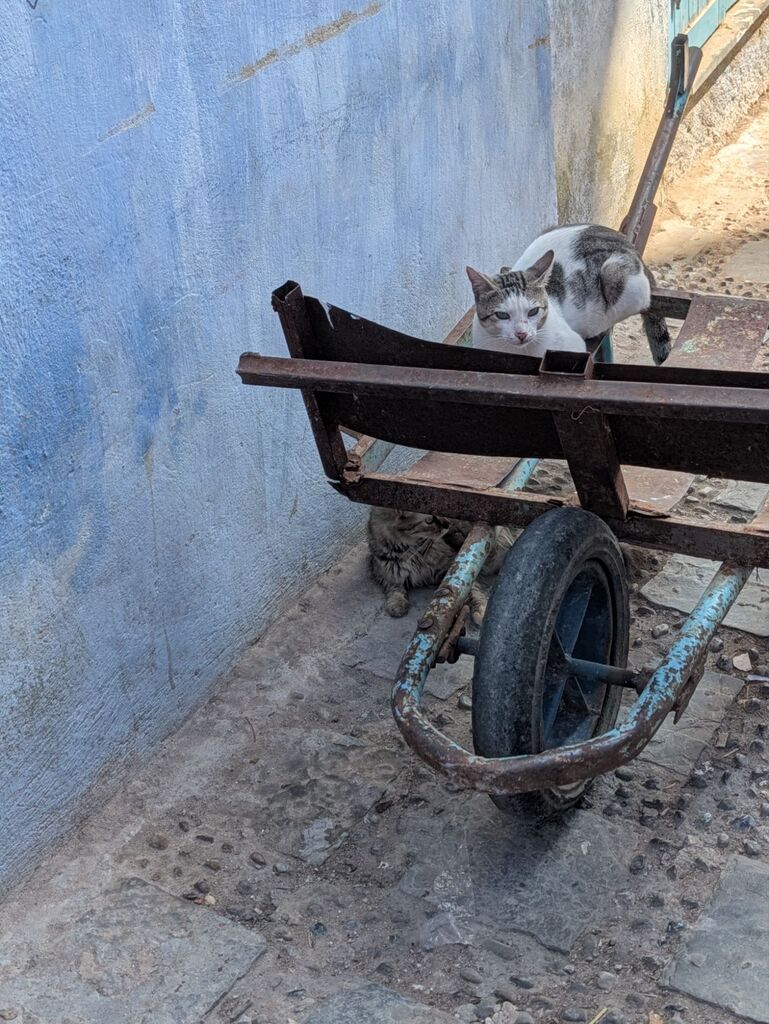
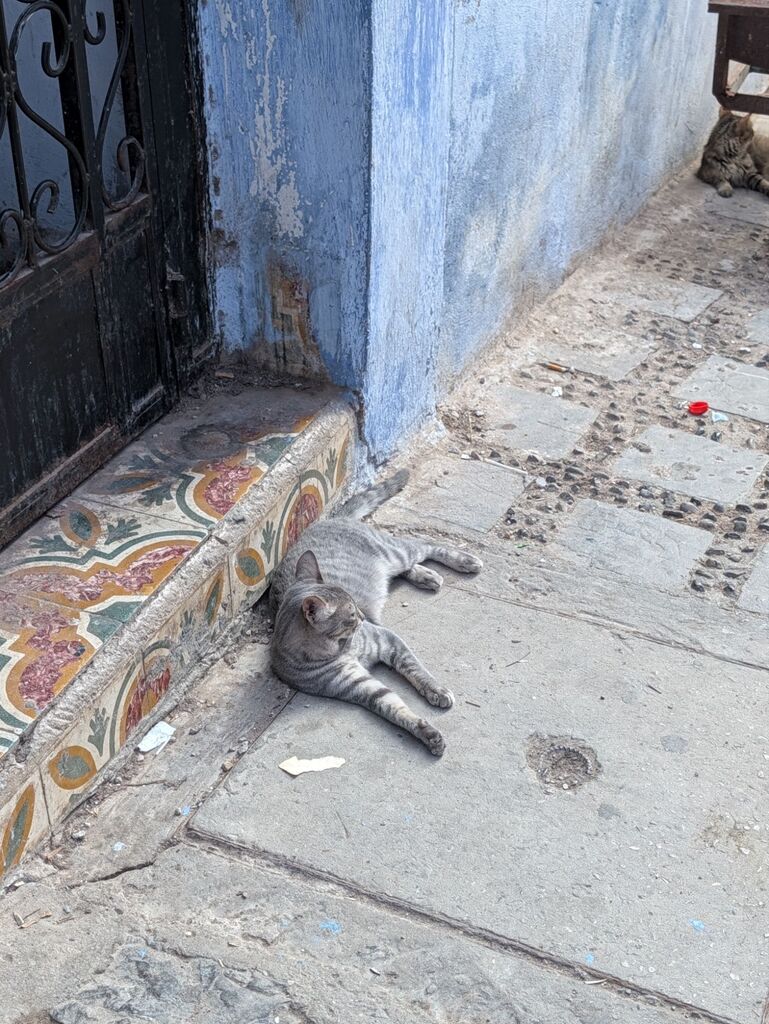
Step narrow blue street with a hill so steep it needs stairsAnd I took pictures of cats! Also look at this neat combination of larger stones and pebbles for tractionA wheeled cart with one cat in the cart and one resting in the shade it providedCat resting in front of a doorstep with gorgeous tiles
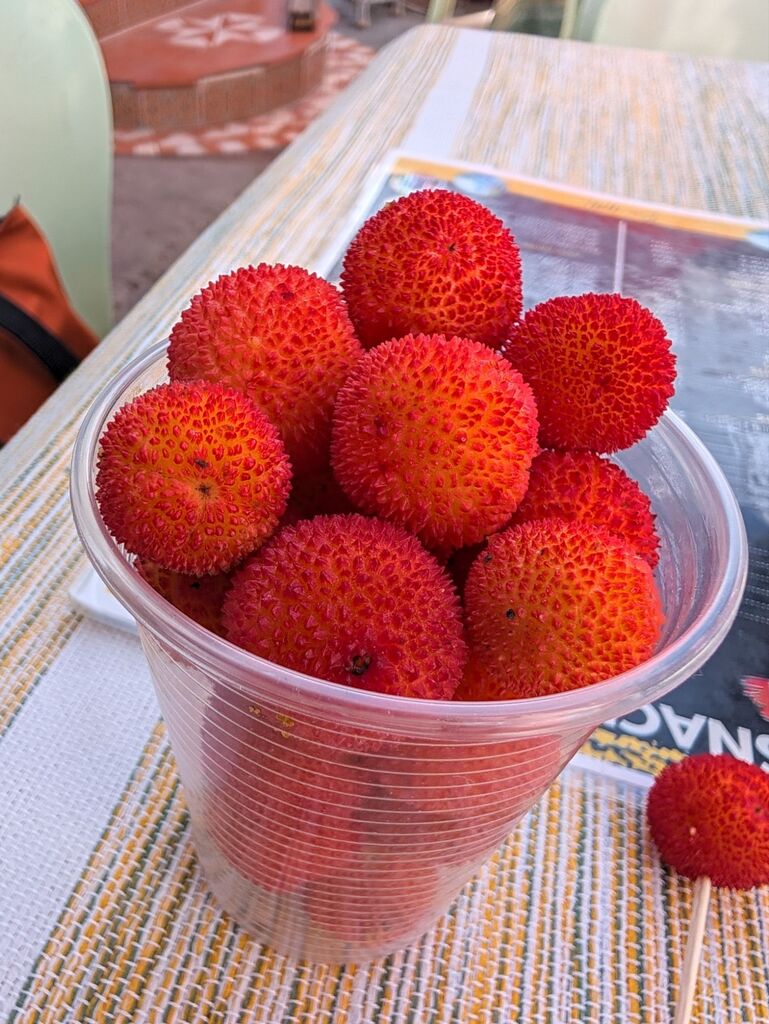
But I did not want to spend 4 hours climbing up and down narrow passages in search of the perfect store from which to buy souvenirs. So I found a cafe. Oh, and I also found a street vendor with those in season berries I was not familiar with! She named too high a price, but I did not feel like bargaining and she seems like she did need the money. Anyway, now that I’ve tasted the fruit, I can say they have pretty much no flavor, so that’s why they don’t get mentioned much. But I have learned.
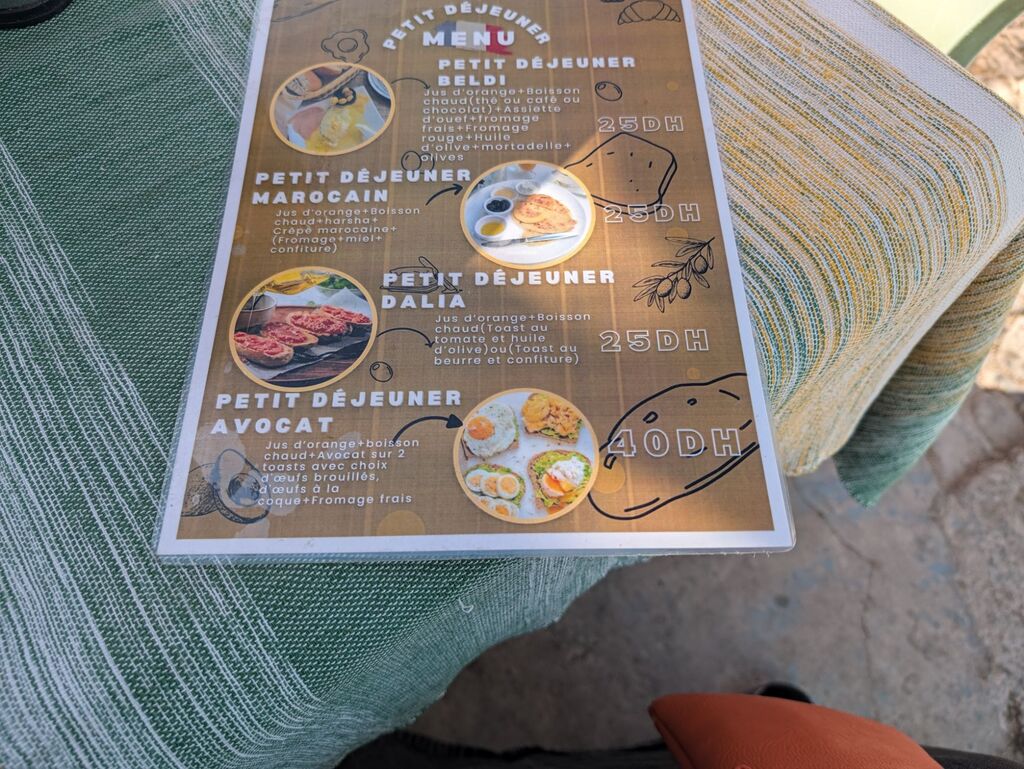
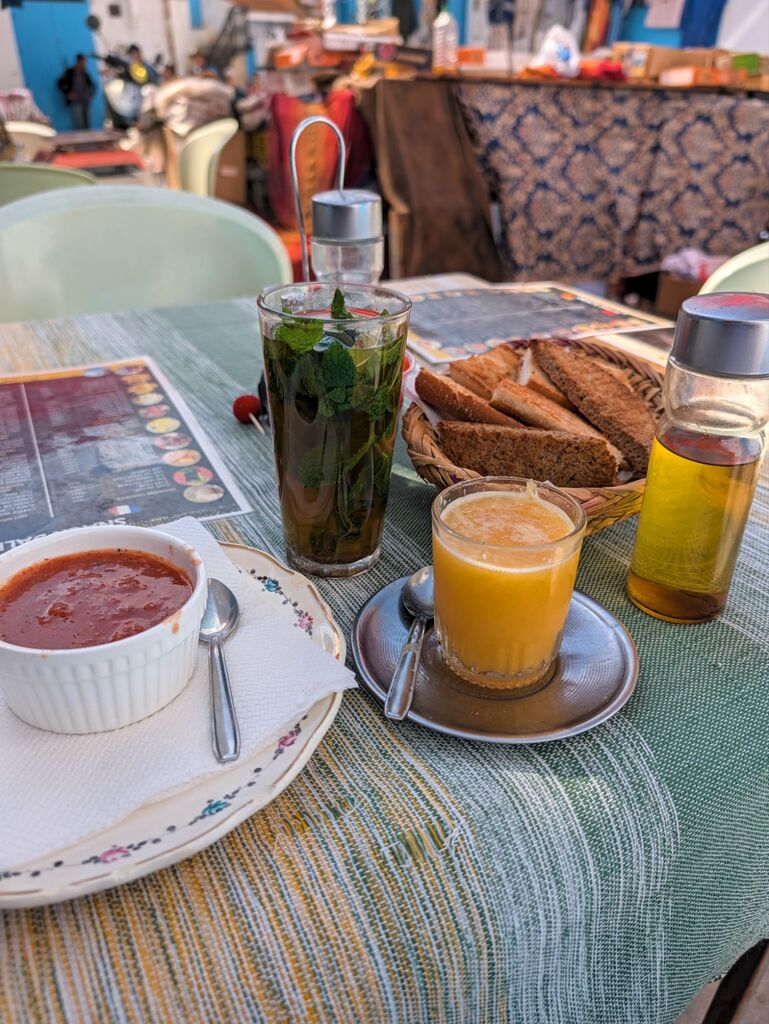
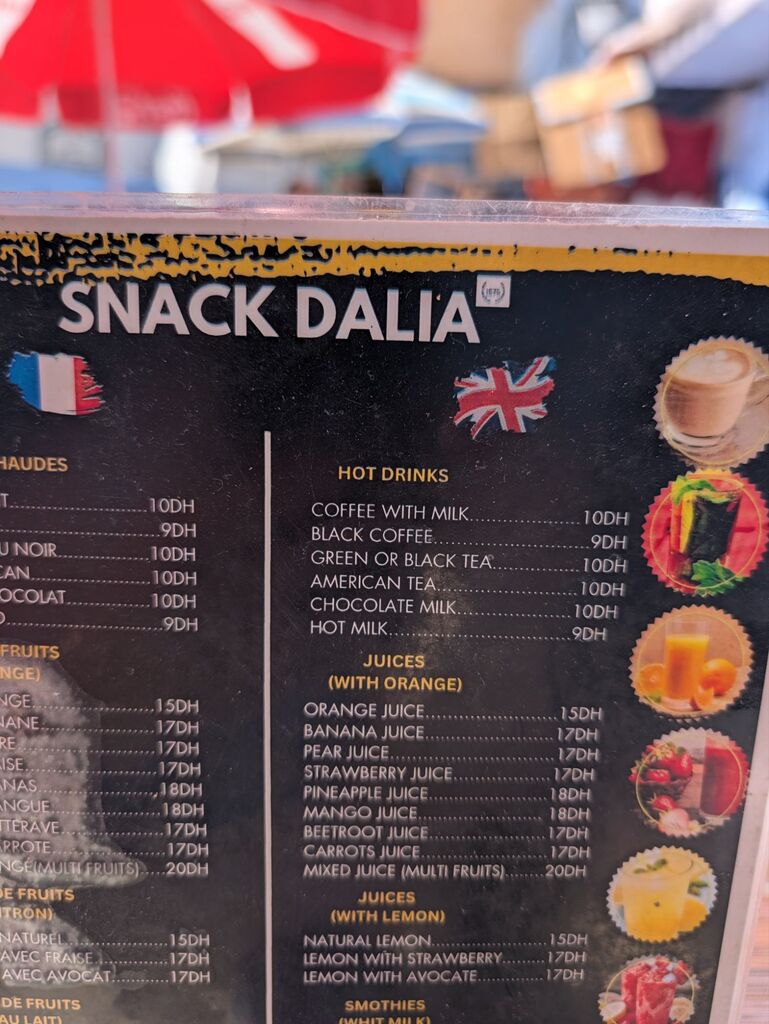
Berries?Bwah! The breakfast menu has avocado toastSecond breakfast of tomato on toastAmerican tea
So I did the thing I usually do when I have extra time – I found a cafe. I was looking for more tomato things to eat since Morocco seems to have the good tomatoes everywhere – and I’d been looking for plain tomato toast in Madrid and only found it with additional stuff on top. I had also been looking for American Tea, which I had the last time I was in Madrid. Even if this is a different country, at least I have documented that it exists.
And then I realized that no one could stop me from leaving that party of the city and going to the newer parts.
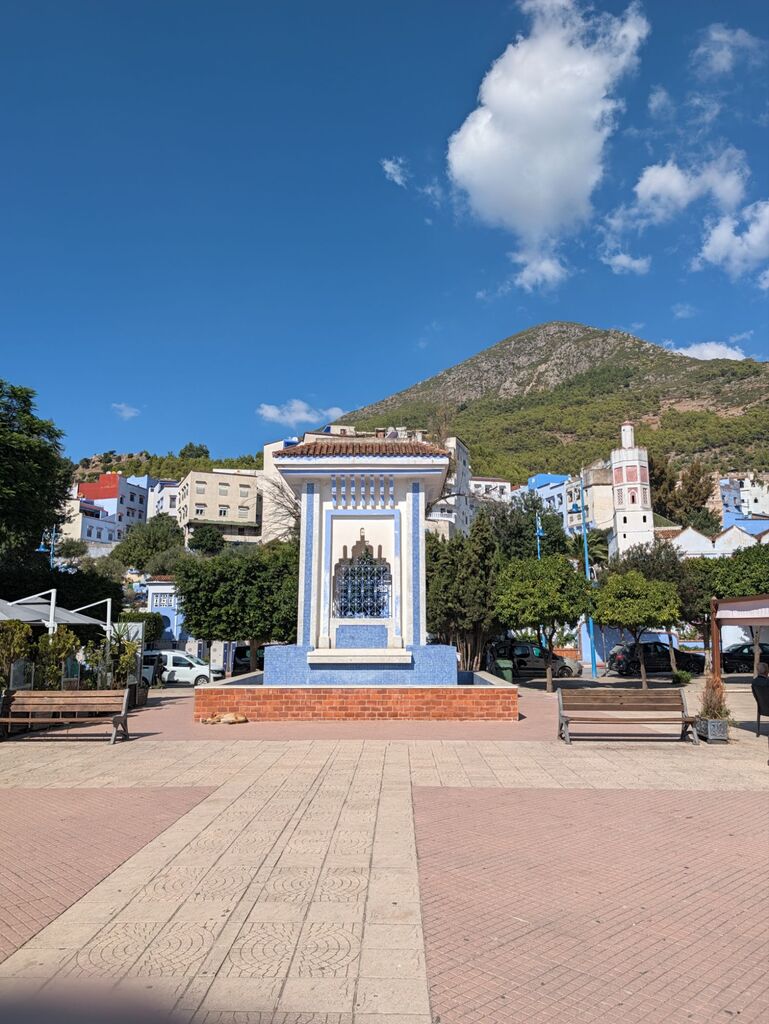
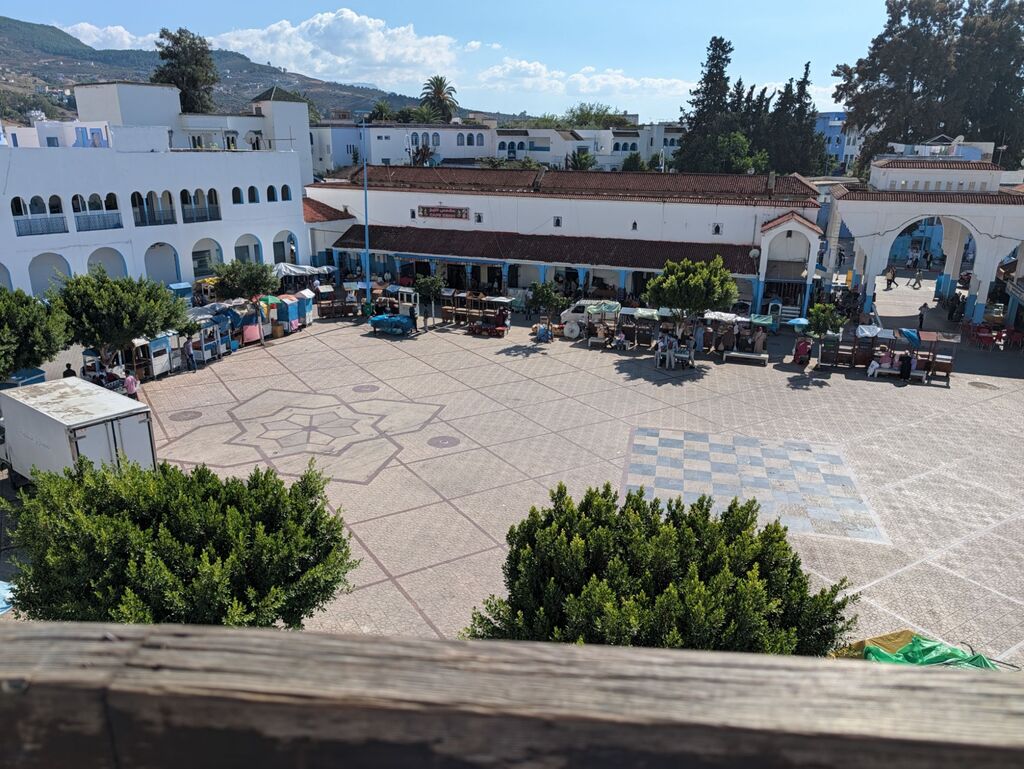
A blue fountain between two restaurants near an overlookIt looks out over a square with an open air market.
The most promising direction looked like it would be down some stairs. I also realized that set into the steps and under the fountain there was also a farmers market with meat, fish, and vegetable vendors.
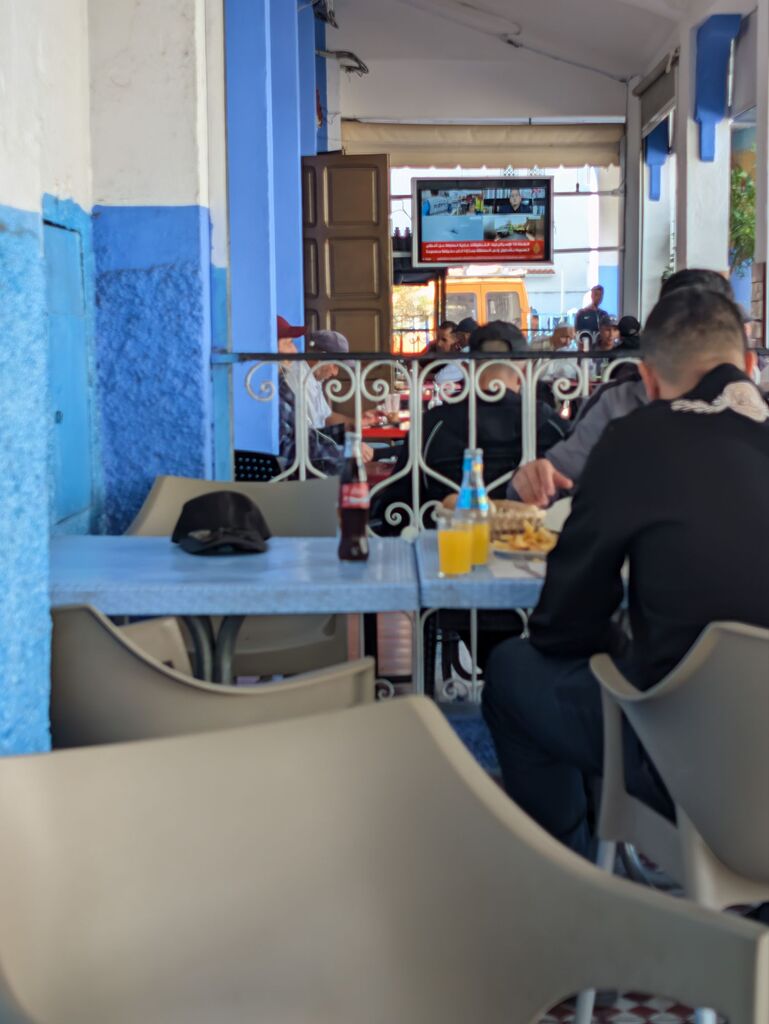
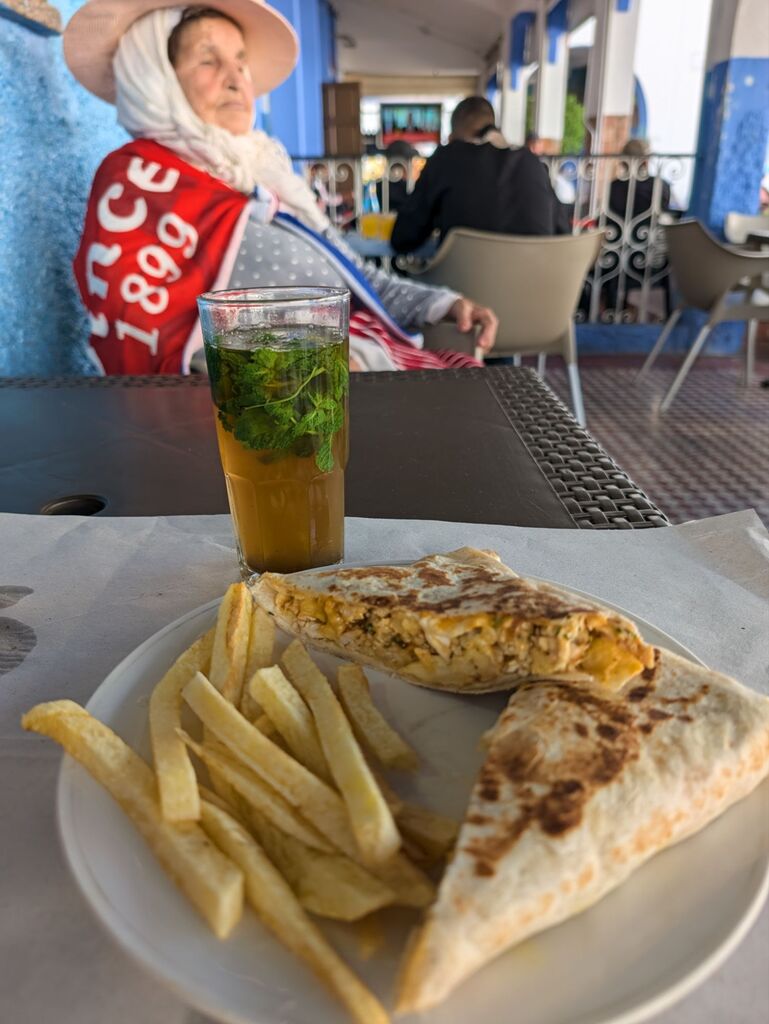
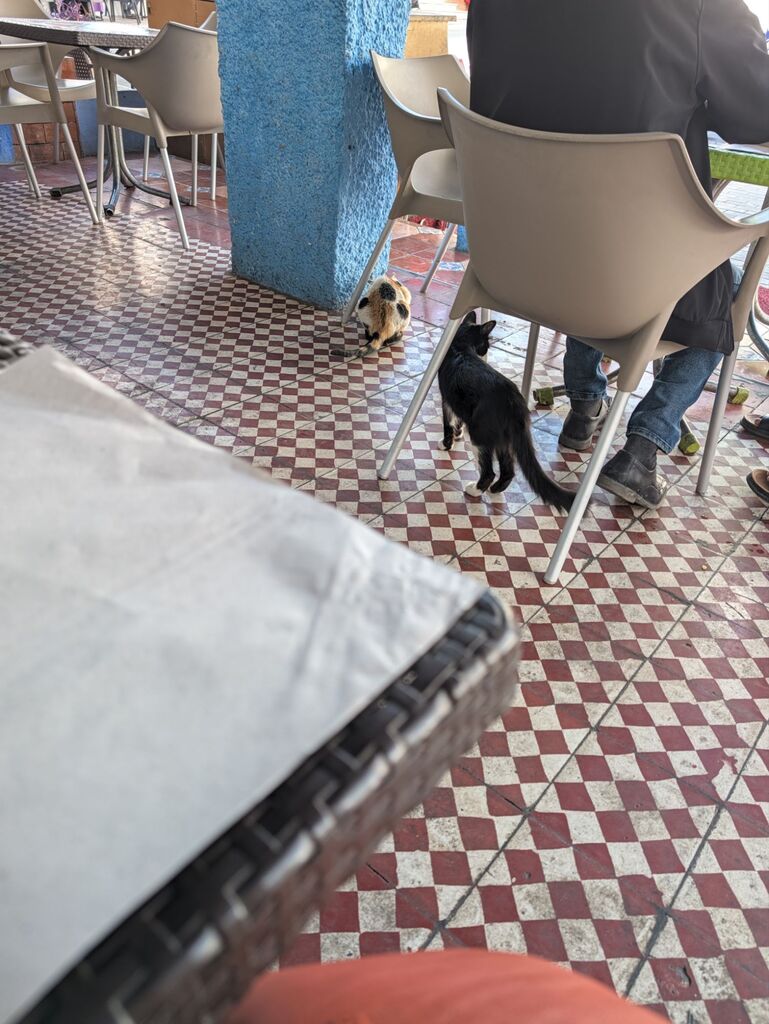
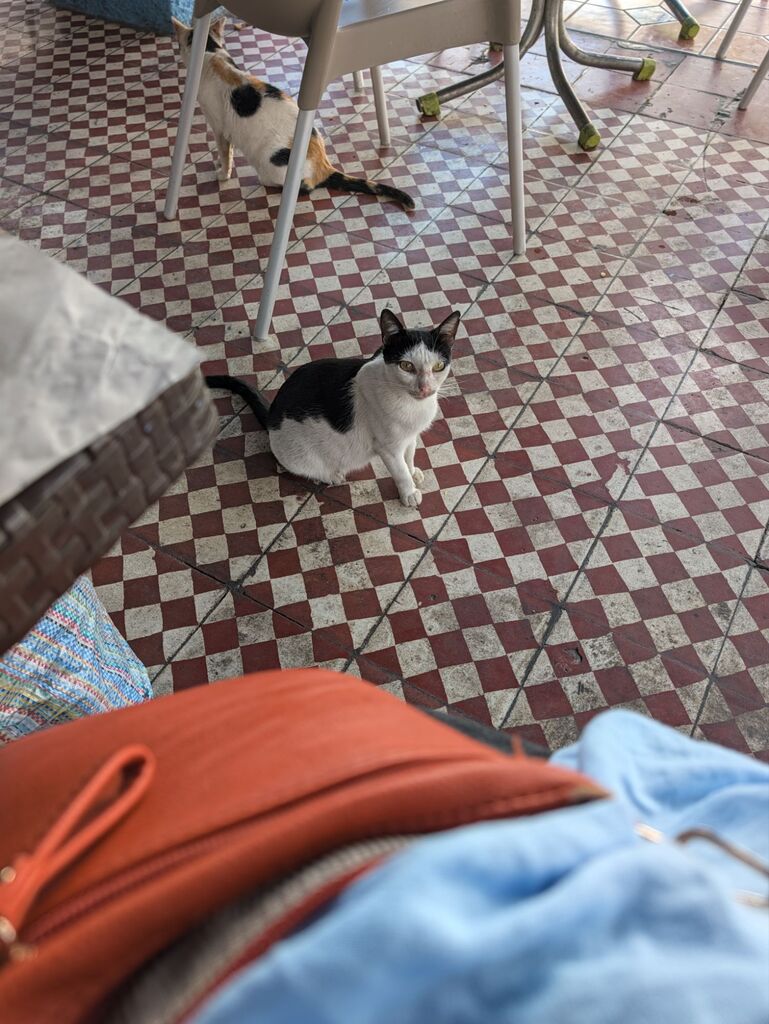
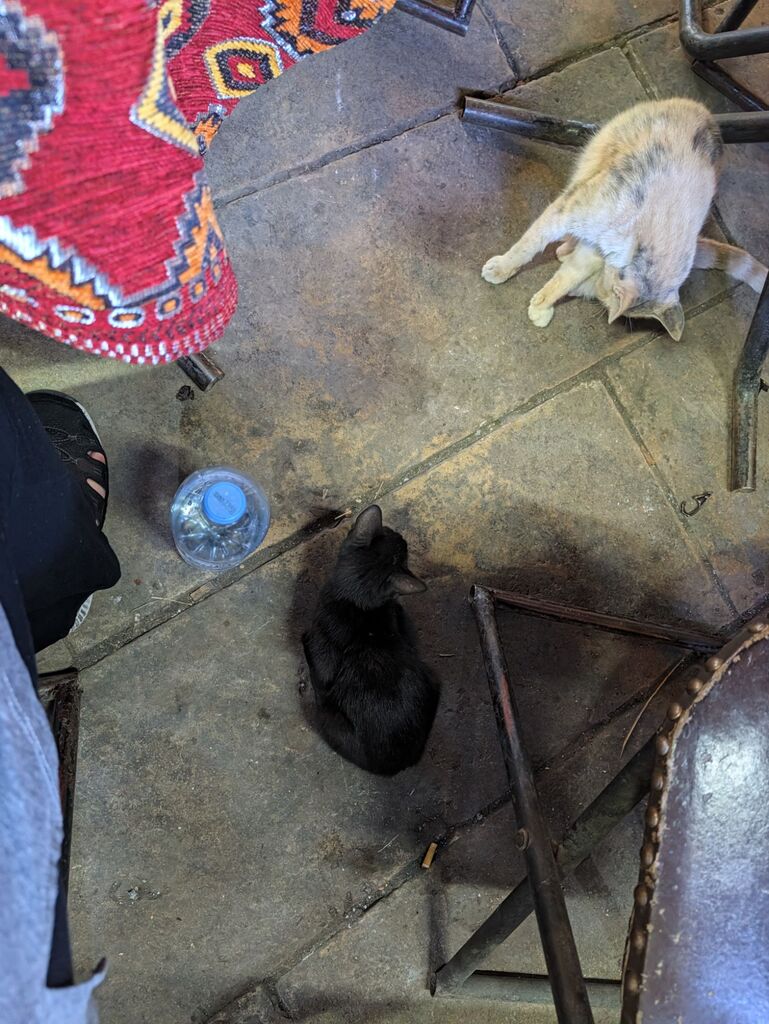
This cafe has mixed gender patrons; the cafe next door only had menI knew I wanted chicken here because that was the meat visibly being cooked, but I randomly choose the taco option and ended up with this thick quesadilla And yes, they had catsThis one got some of my chicken (on purpose)Kitties!
And then I spent most of the rest of my time in Chefchaouen people and cat watching.
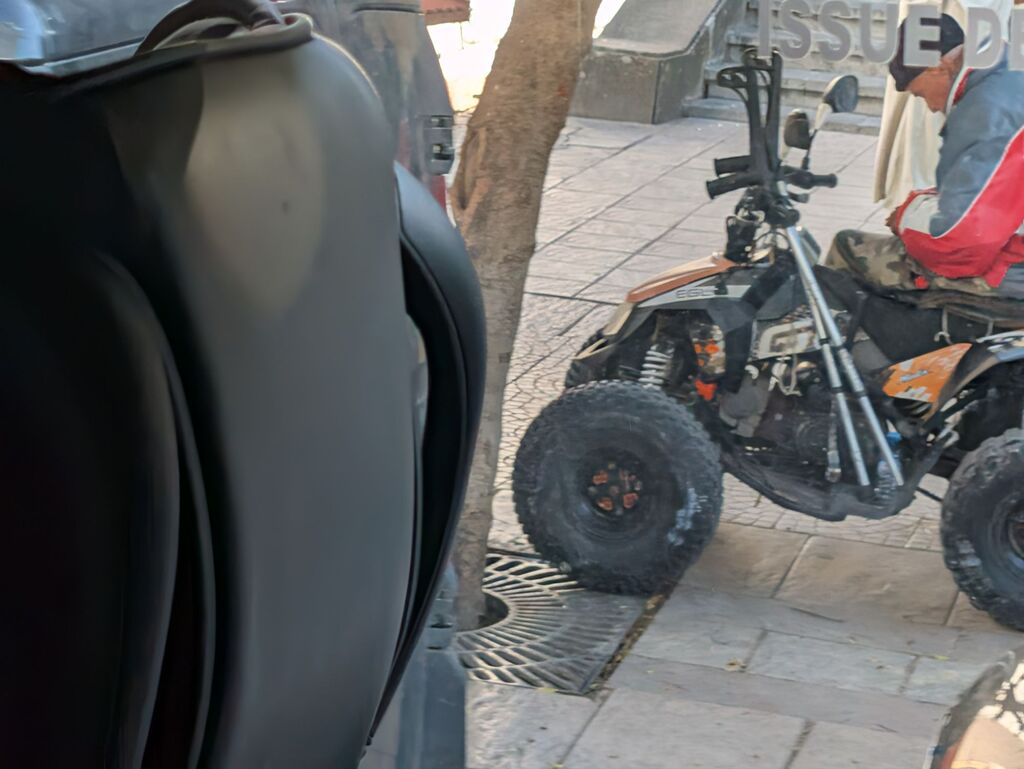
I did finally figure out how people manage wheelchair accessibility in these steep cobbled streets – look at this guy with wheelchair controls on an ATV!
Looks like an ATV, with hand controls like a wheelchair.
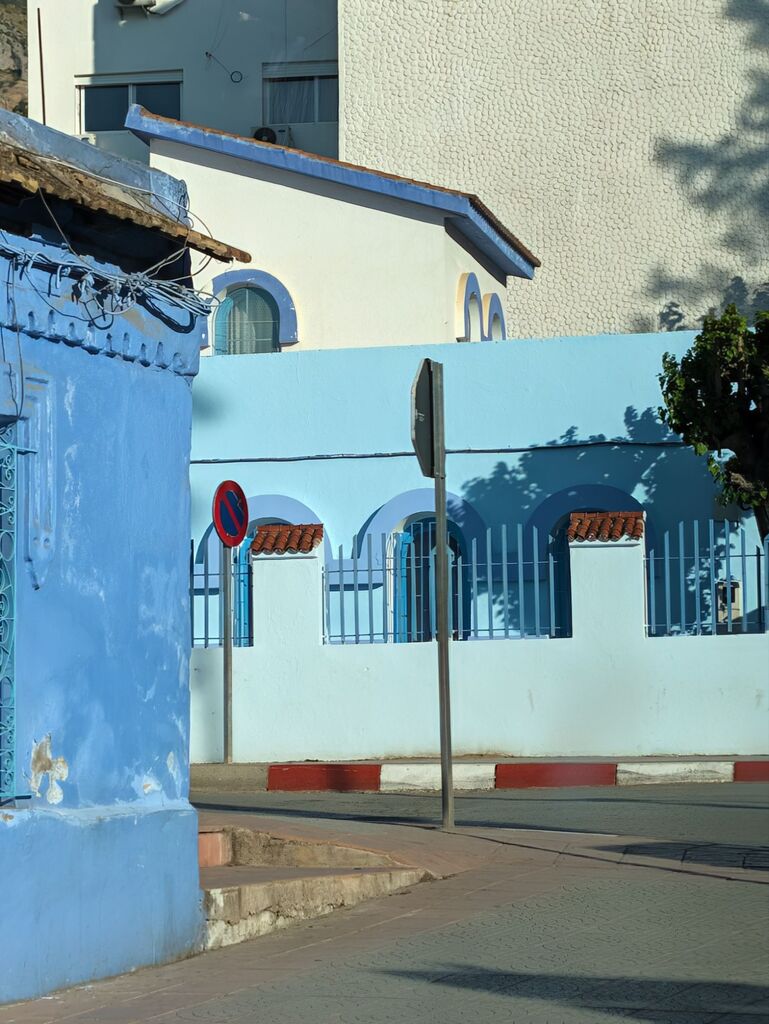
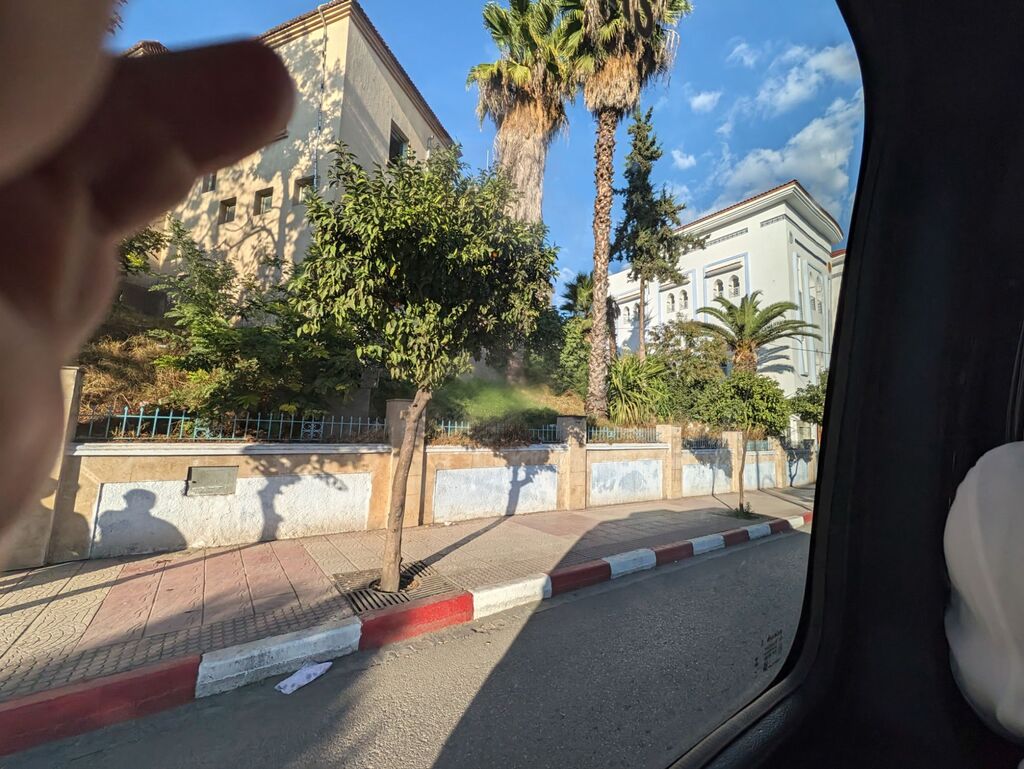
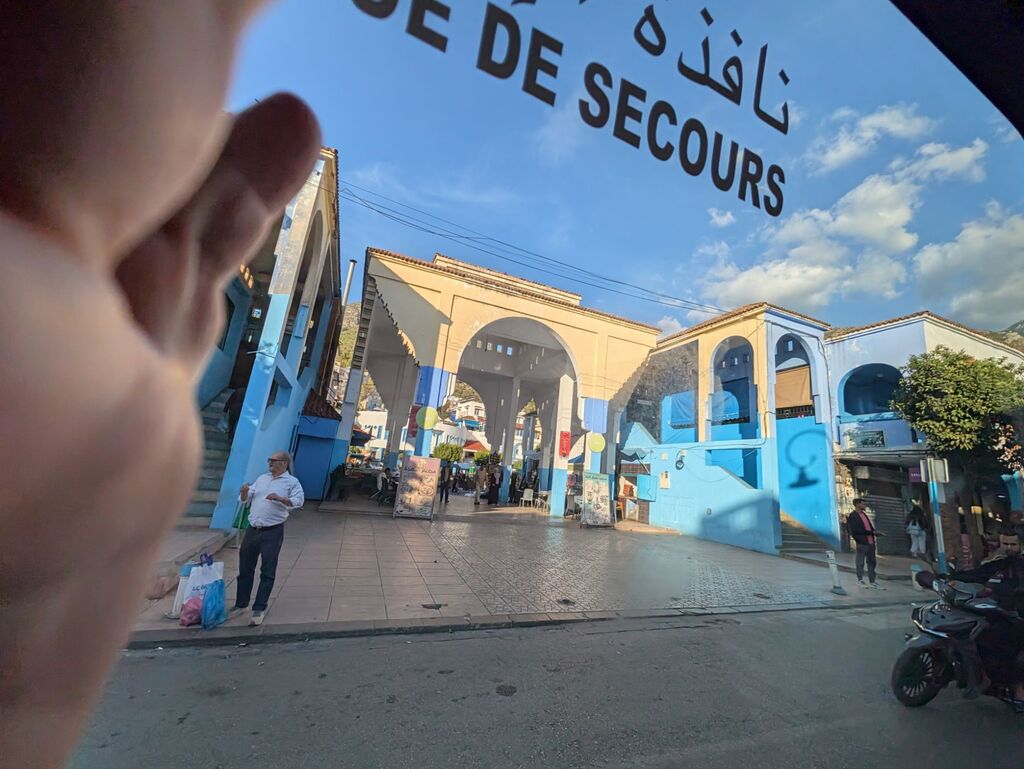
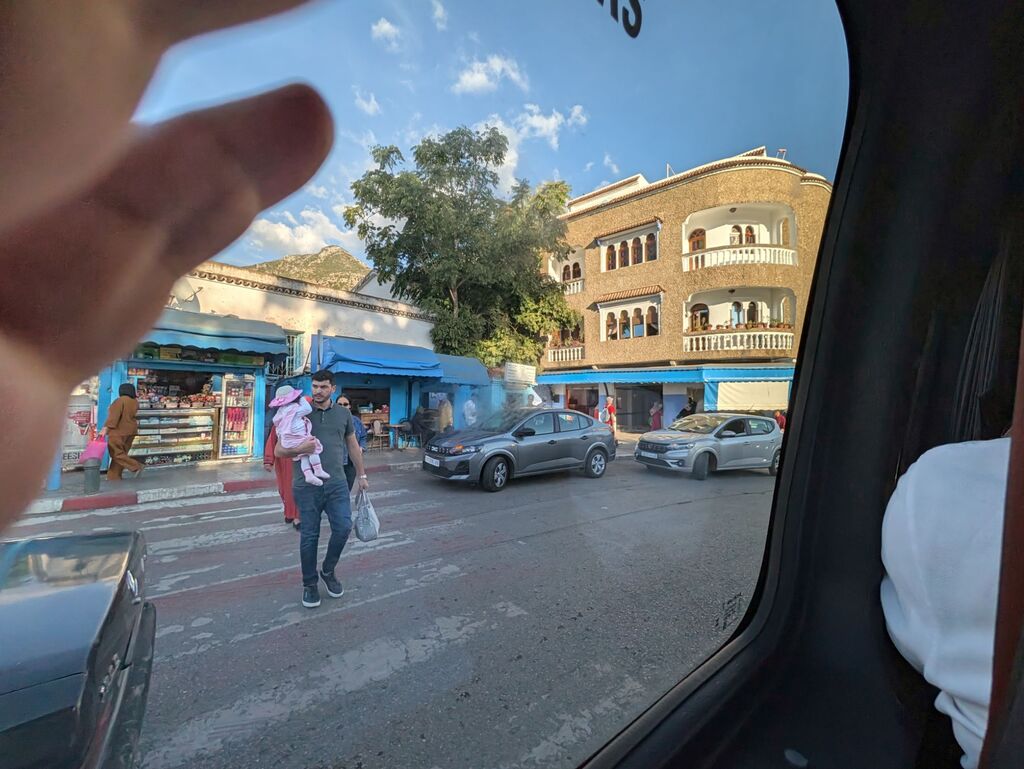
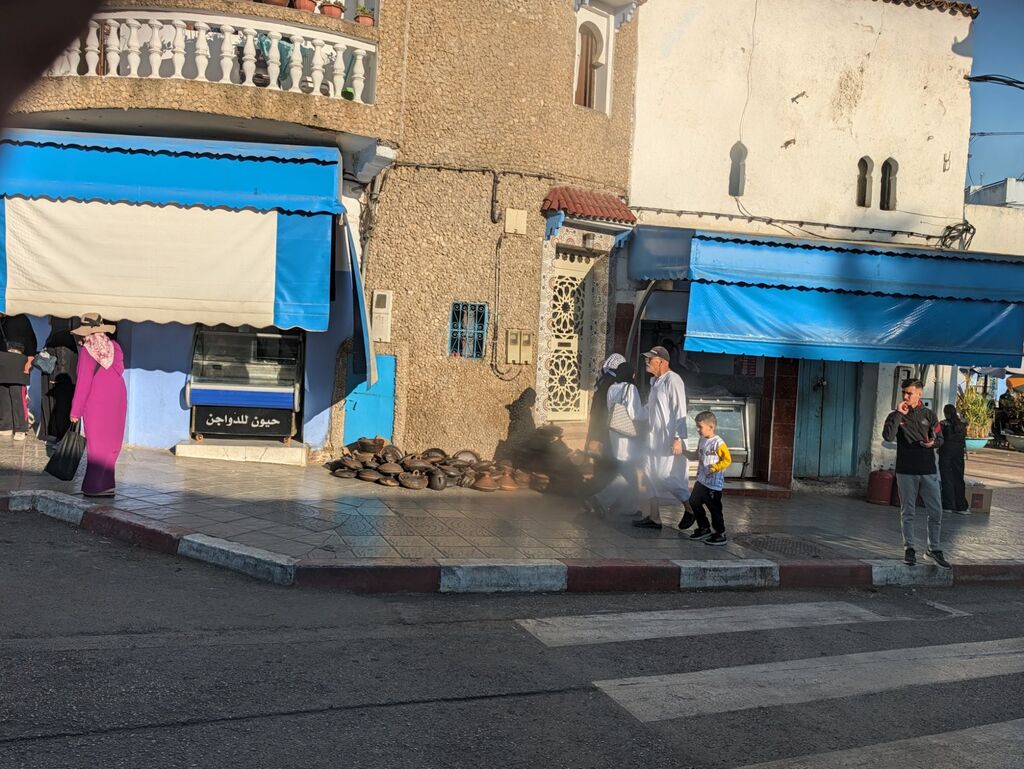
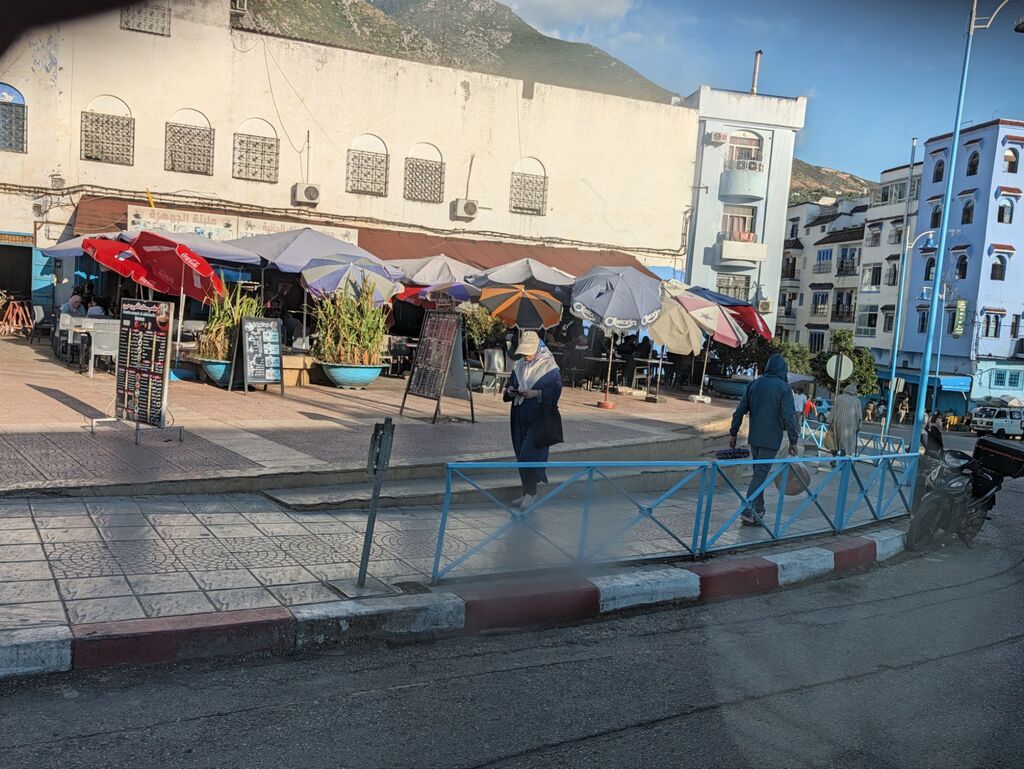
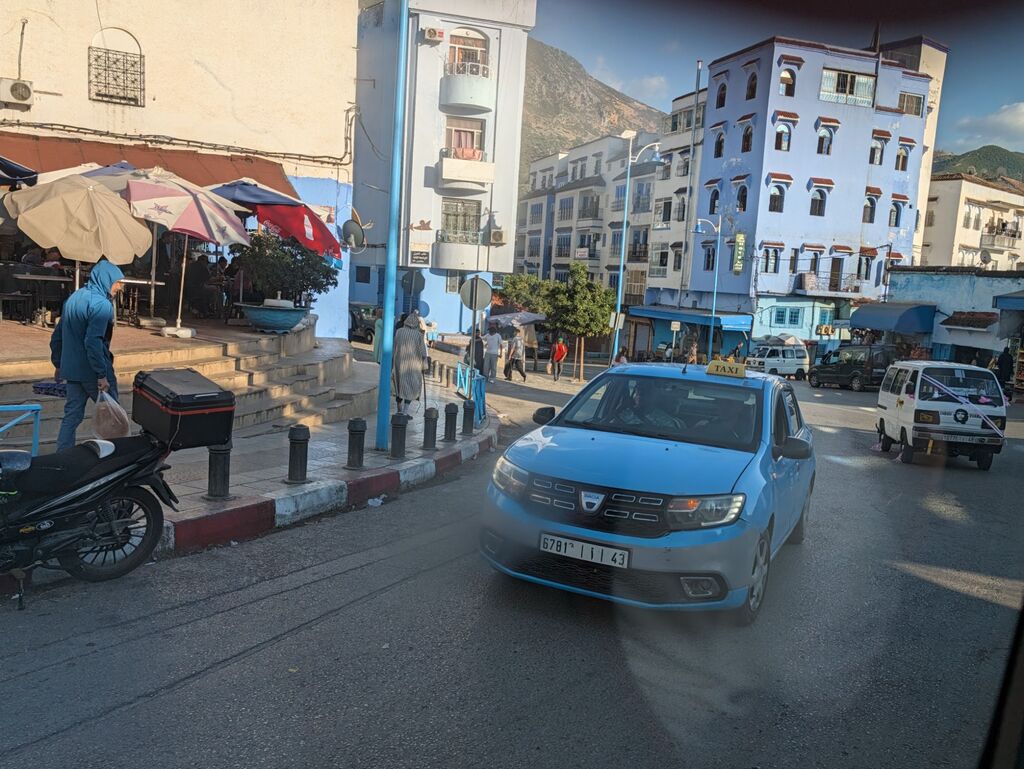
And here are a few more shots of the city on our way out
Do you think all of the taxis have to be the same shade of blue?
And then on the long bumpy ride back I was chatting more with one of the other people on the bus, and I need to remember to pester him for the name of his family’s hot spa hotel in Türkiye.
When we were less than an hour out, I texted my host asking for a recommendation for which restaurant between the Blue Gate and home had the best soup. Perhaps “Don’t you just have something simple? Like soup?” is usually code for, “I like boring food.”
Anyway, I’ll make a separate post for the results of that recommendation.
I really do love Fes. I know the old medina has an artificial antique patina to encourage tourism, but I enjoy it. I love that it’s not just one street, but a whole town’s worth of the city that is completely pedestrianized. There may be some hills, but I don’t have to walk up them quickly. Since the last time I was here, electric scooters have invaded, but there are still not that many.
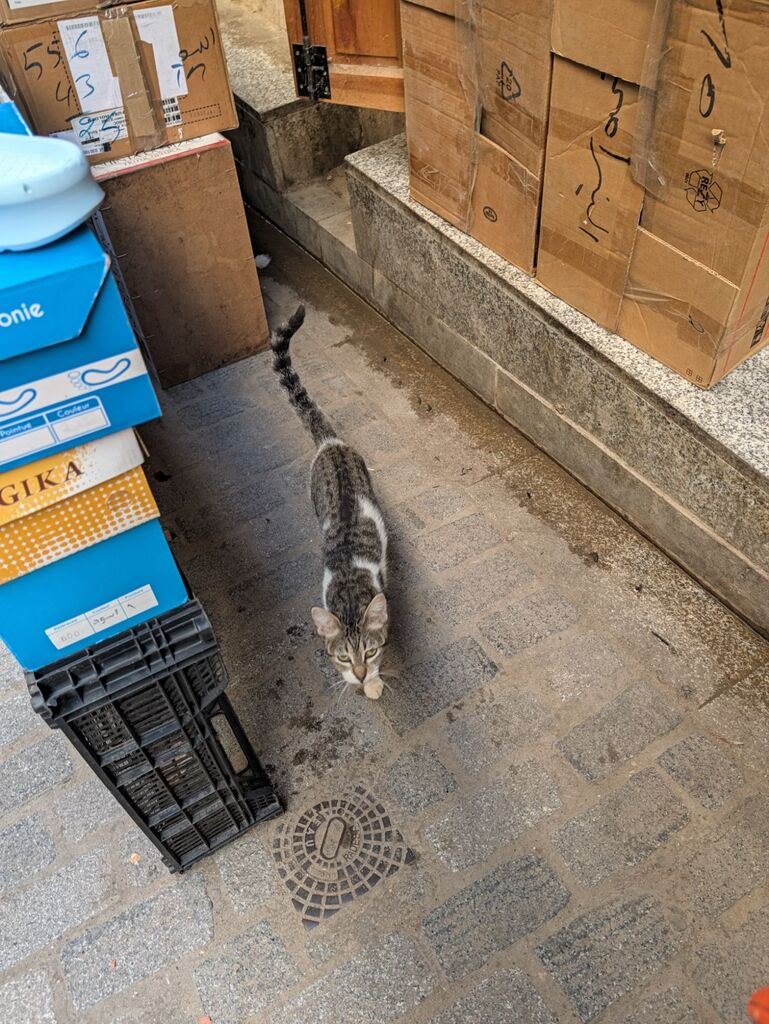
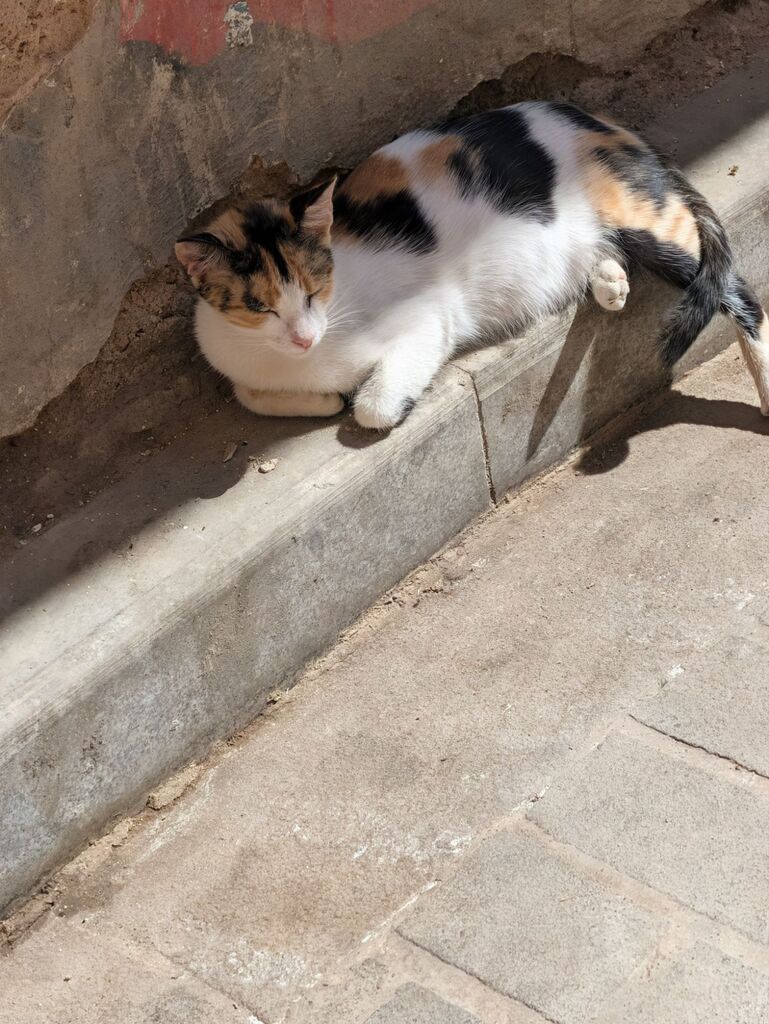
Also it’s a city of cats. There are so many cats here, and I have yet to see anyone trying to push them away. People put out food and water and sometimes even cushions for them. It’s up there with Istanbul and Beirut in the great cities for cats, and that makes me feel more warmly toward the place.
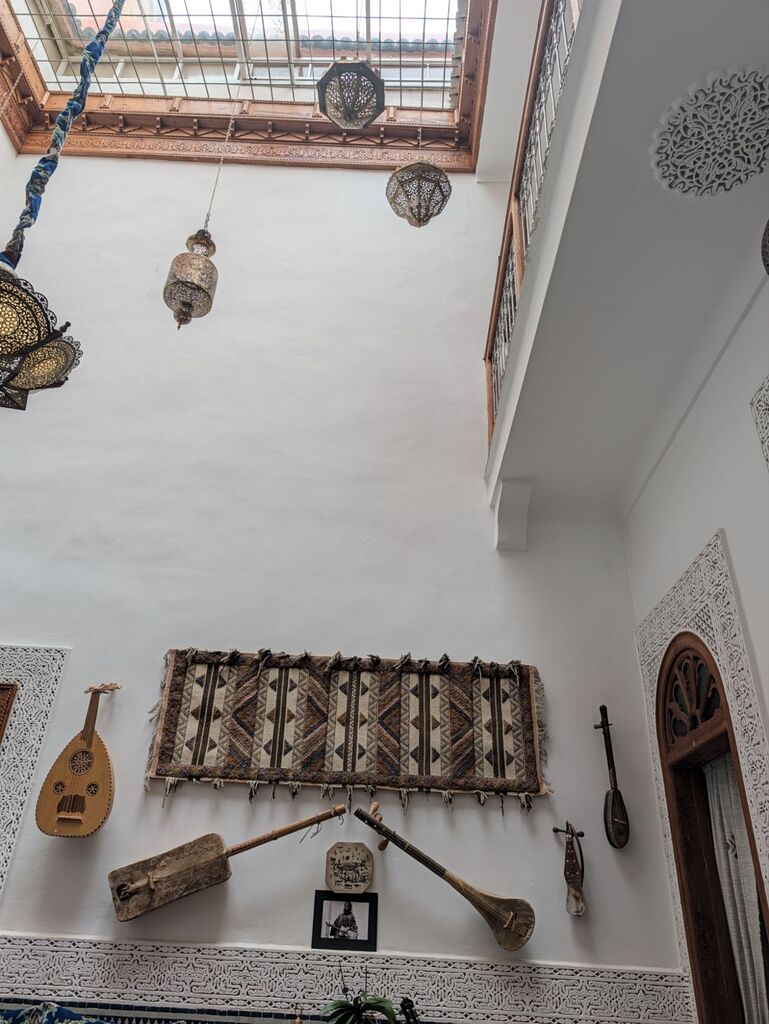
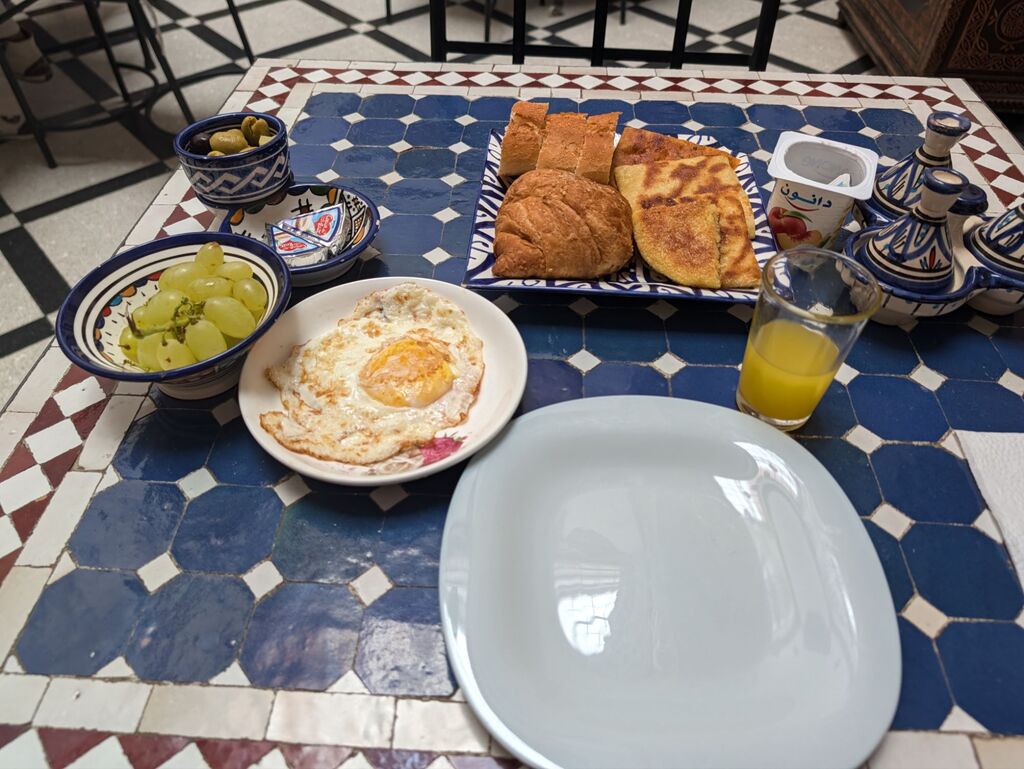
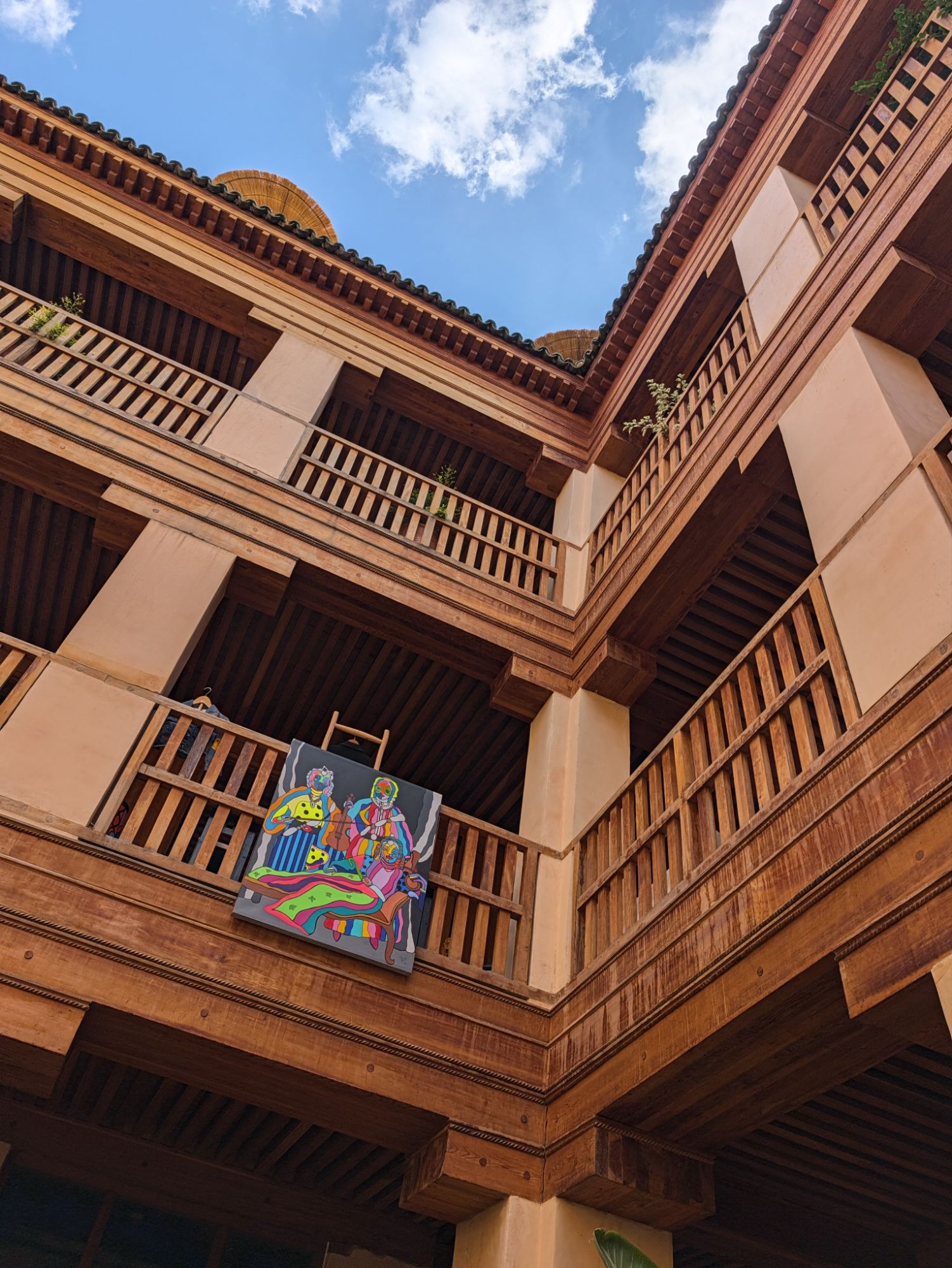
Looking up from the courtyard where I’m stayingComes with breakfast!Dar Hayati
Apparently if it’s just one house built around a courtyard, it’s a Dar, but if it’s multiple families it would have been called a Riad. The breakfast at Dar Hayati is a lovely cultural sampler. The trio of mini tajines is for condiments and has two kinds of jam and some honey. There’s also a double bowled ceramic with olives and soft cheese, but you can lift out the olive bowl and have another bowl below it for your olive pits. The fruit in season right now seems to be grapes. The market carts also have some kind of berry, but I haven’t had small change at the right time to stop and buy those. What else? There’s a fried egg and a whole sampler of many kinds of bread. Two flat fried laminated breads – one just bread and the other with scallions and maybe a red/orange spice. Then there were semolina? griddle cakes, a chocolate croissant, and a white bread that wasn’t too crusty.
Just starting down the steep streetI used so many connection for 10 years to try to find these for my friend’s child, who is now too grownI ducked out of the way of faster walking traffic and found a kitty!There was a sunbeam, and so another catTala’a Kebira
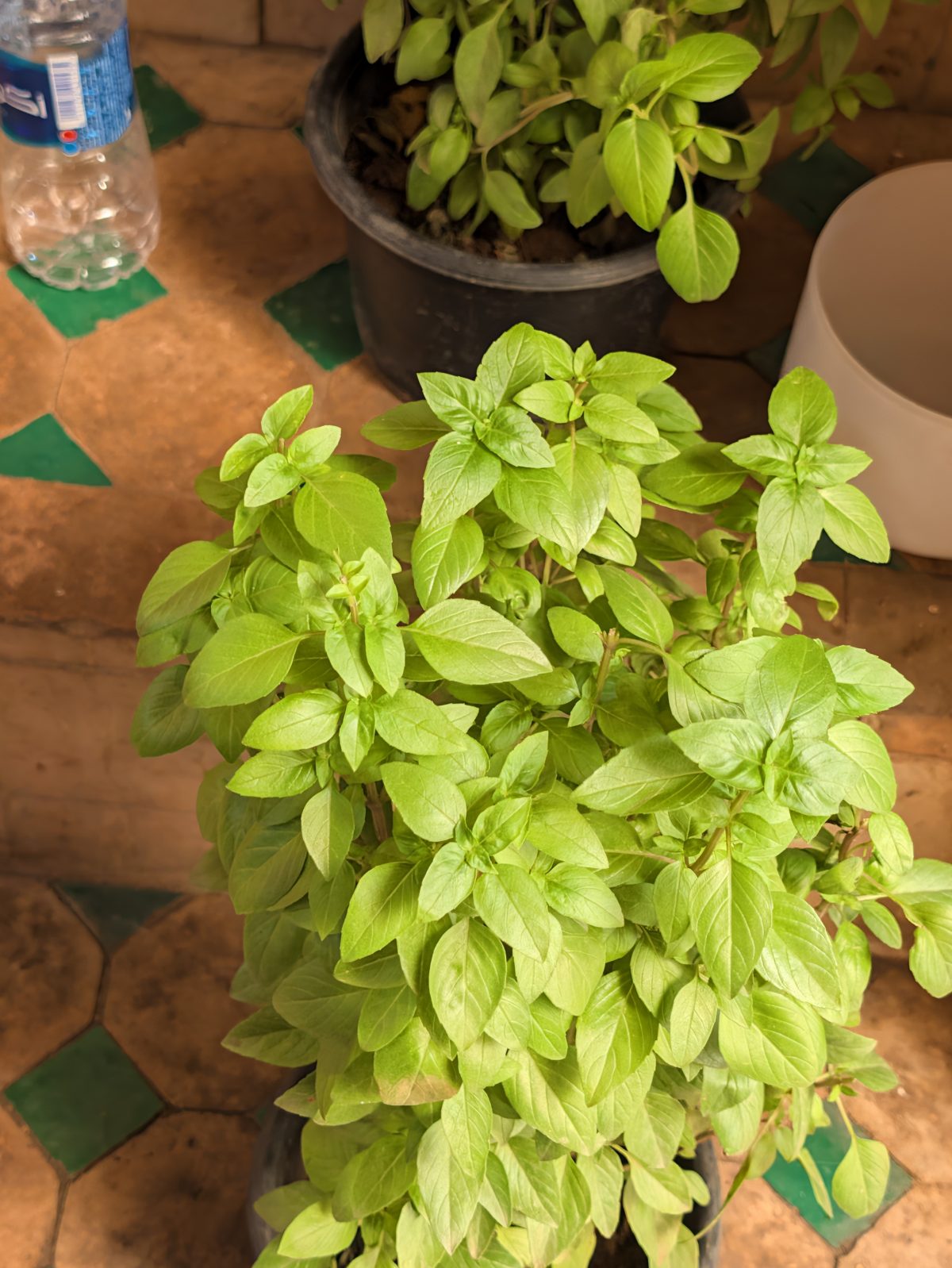
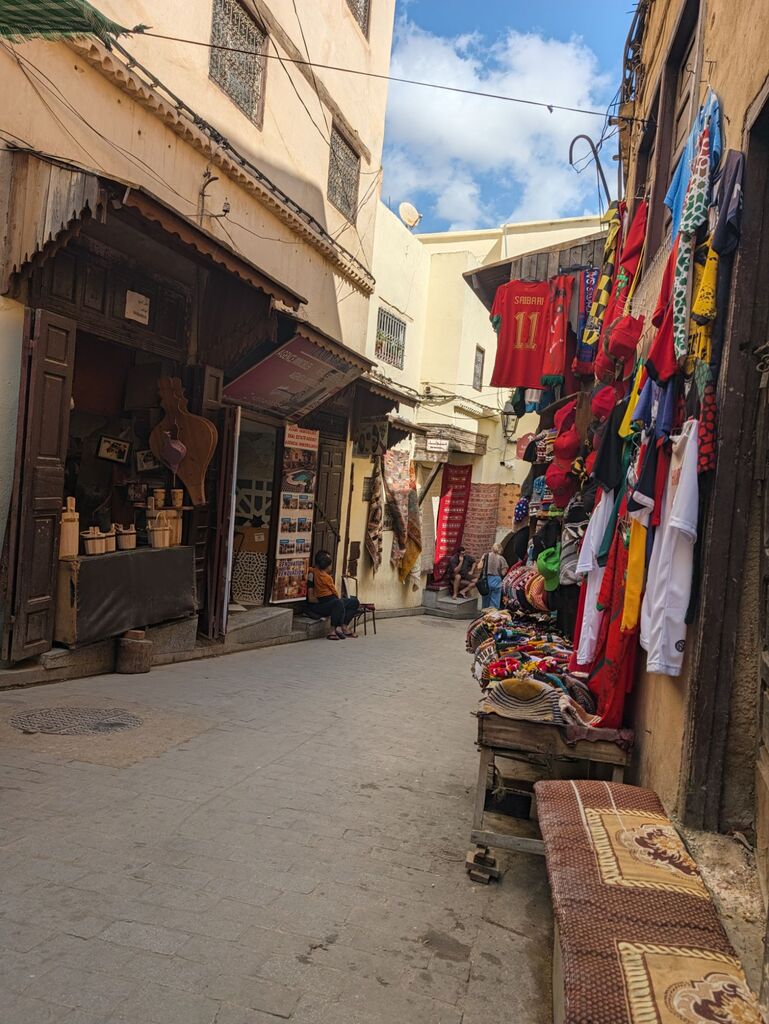
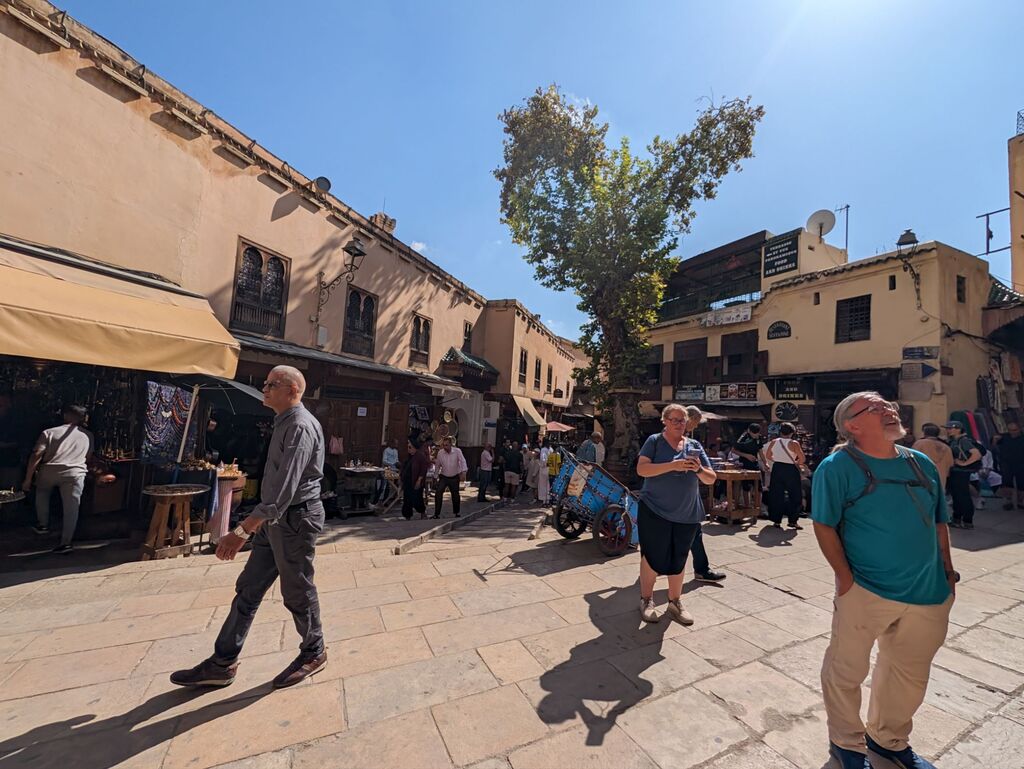
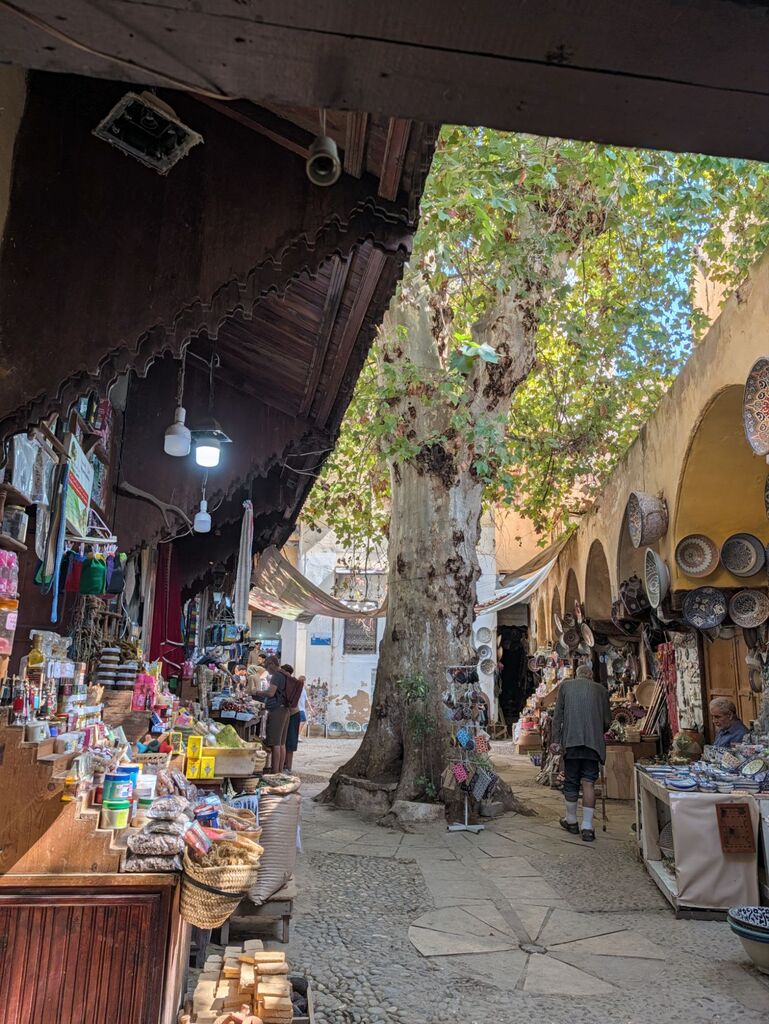
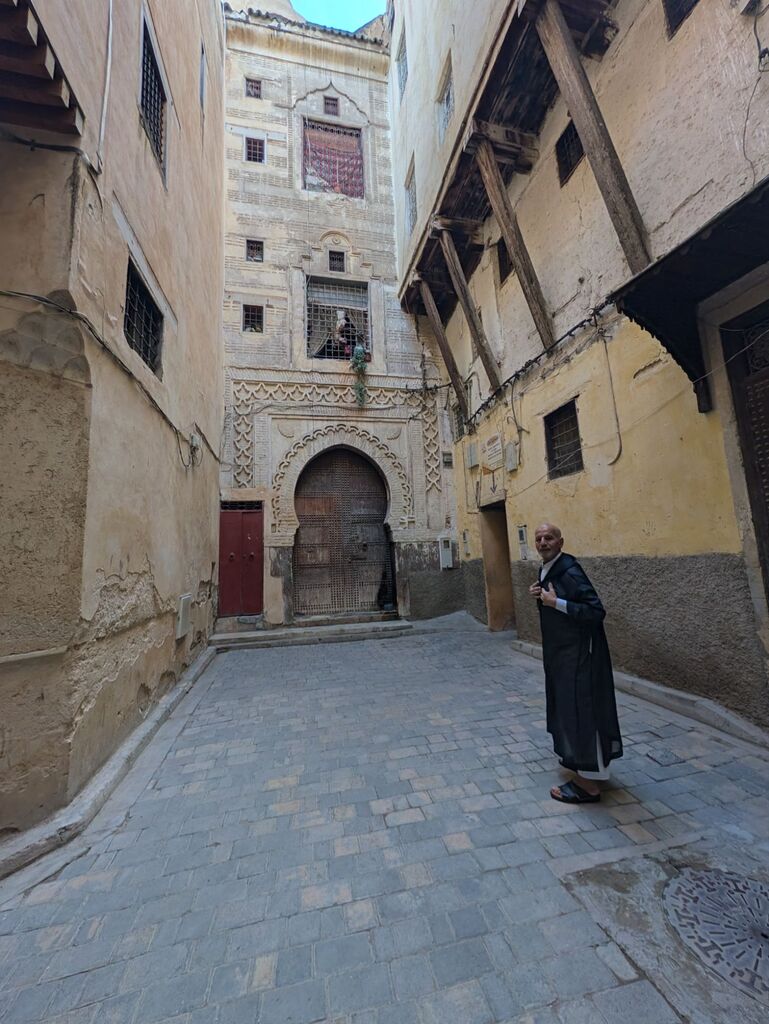
The place I’m staying is just a short walk from one of the main streets of the old medina, Rue Tala’a Kebira. And it’s right about in the middle. Yesterday I explored toward the right, so today I went left. Most of the streets are pretty narrow, but here are a few spots where things opened up around trees and was particularly sunny.
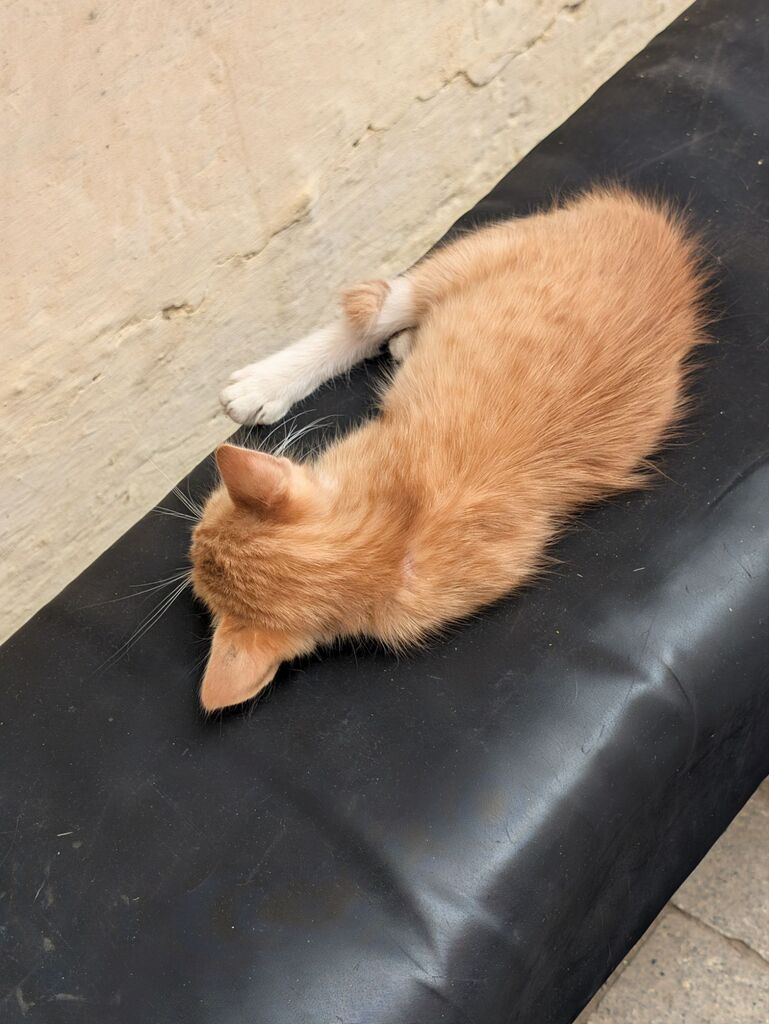
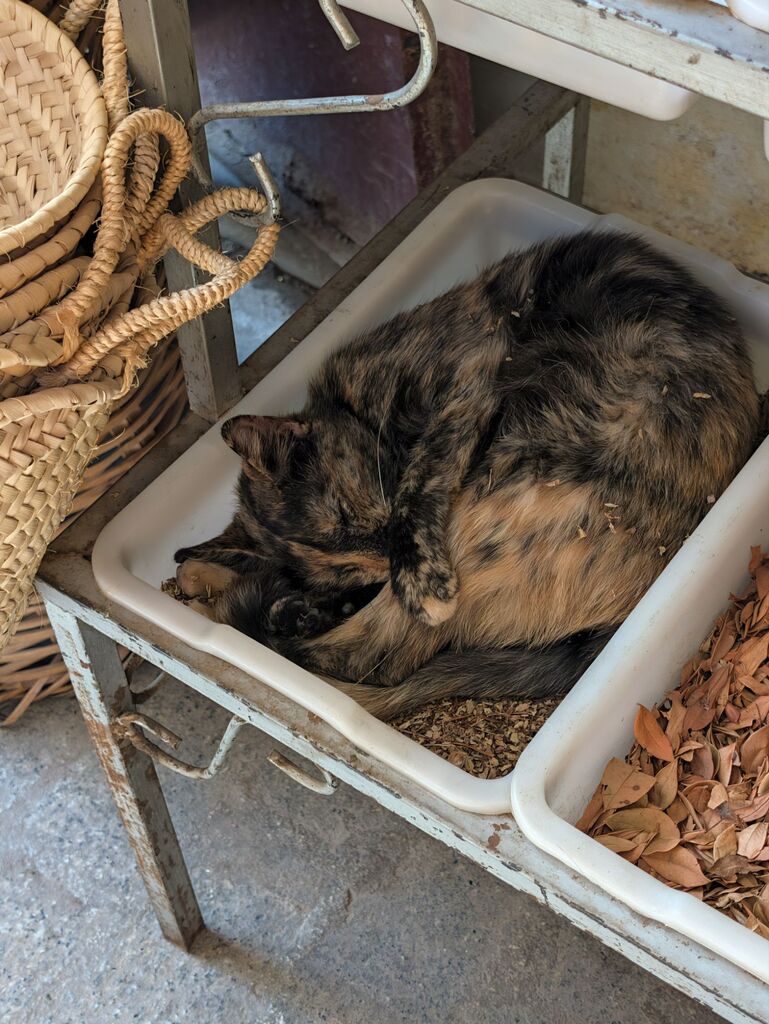
Three streets meet near the copper centerThis tree is so old the street seems to have grown around itKitty on a bench near the old tanneryThis cat is in a some herbal shop’s wares, but it’s comfy and deserves to be there
Last time I was here, there was a custom made shoe place in the eastern side where the walkways have wooden ceilings, but I couldn’t find it this time. And none of the premade show merchants accosted me to show they were willing to try to find something for my wide feet.
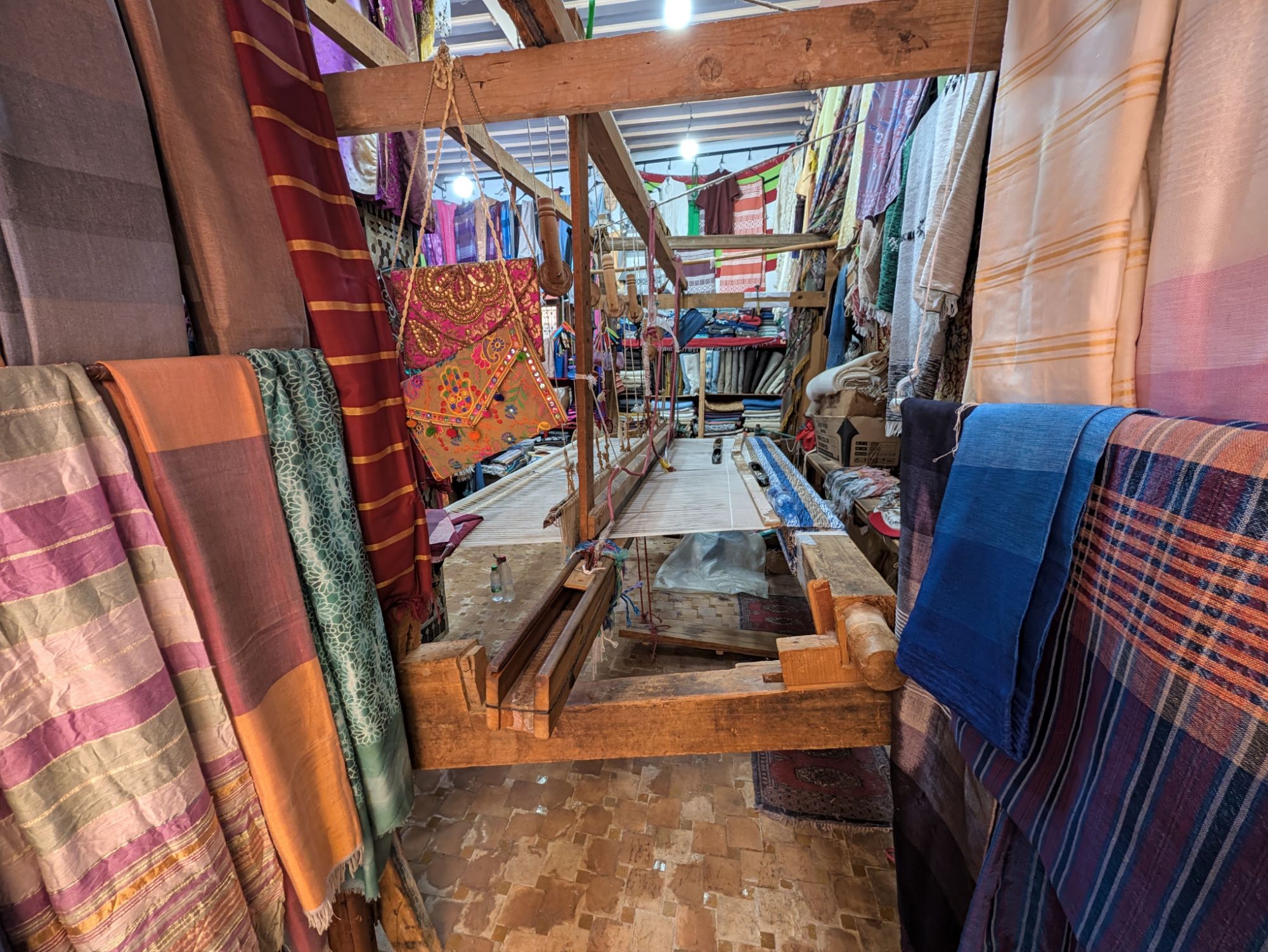
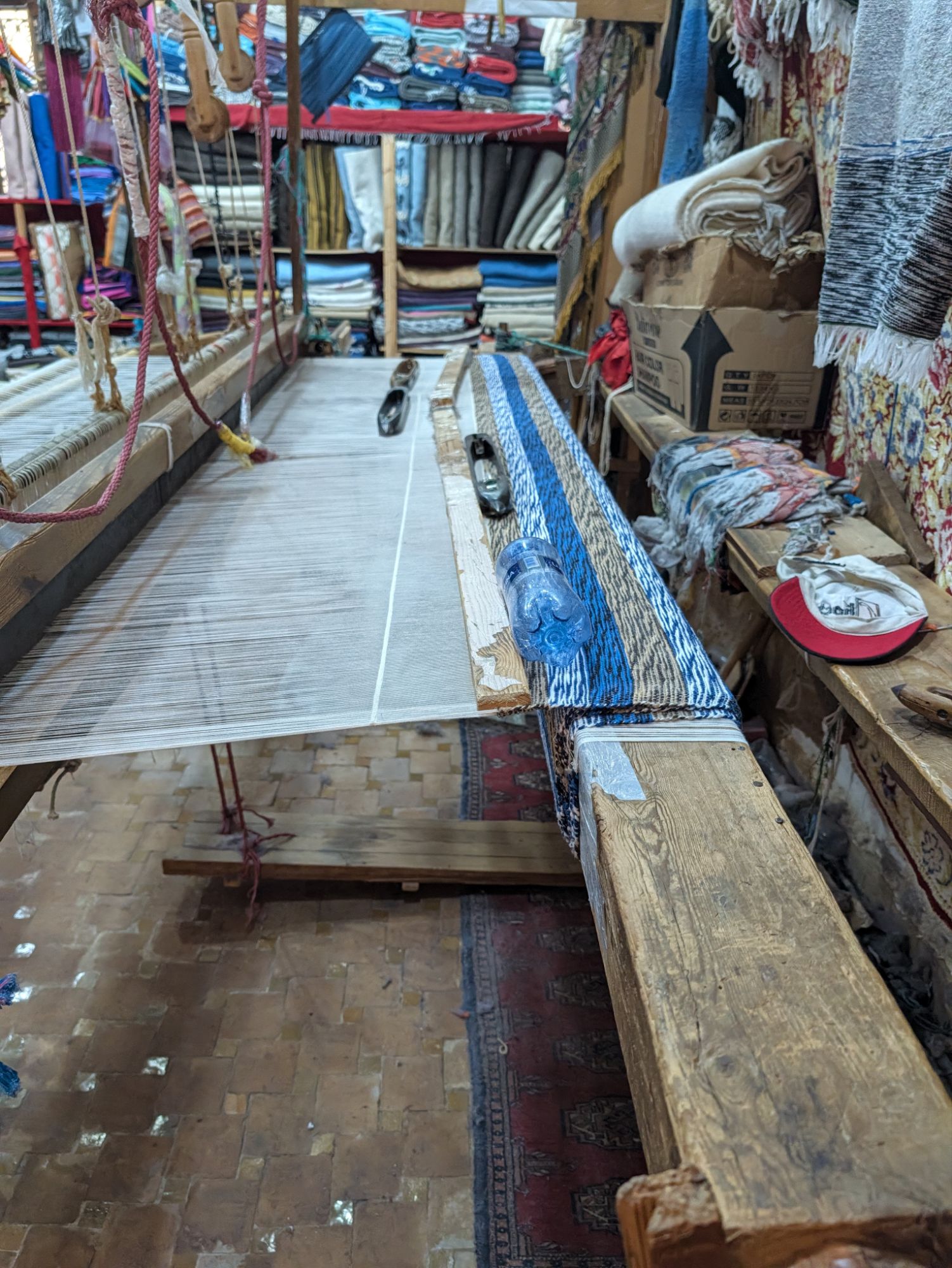
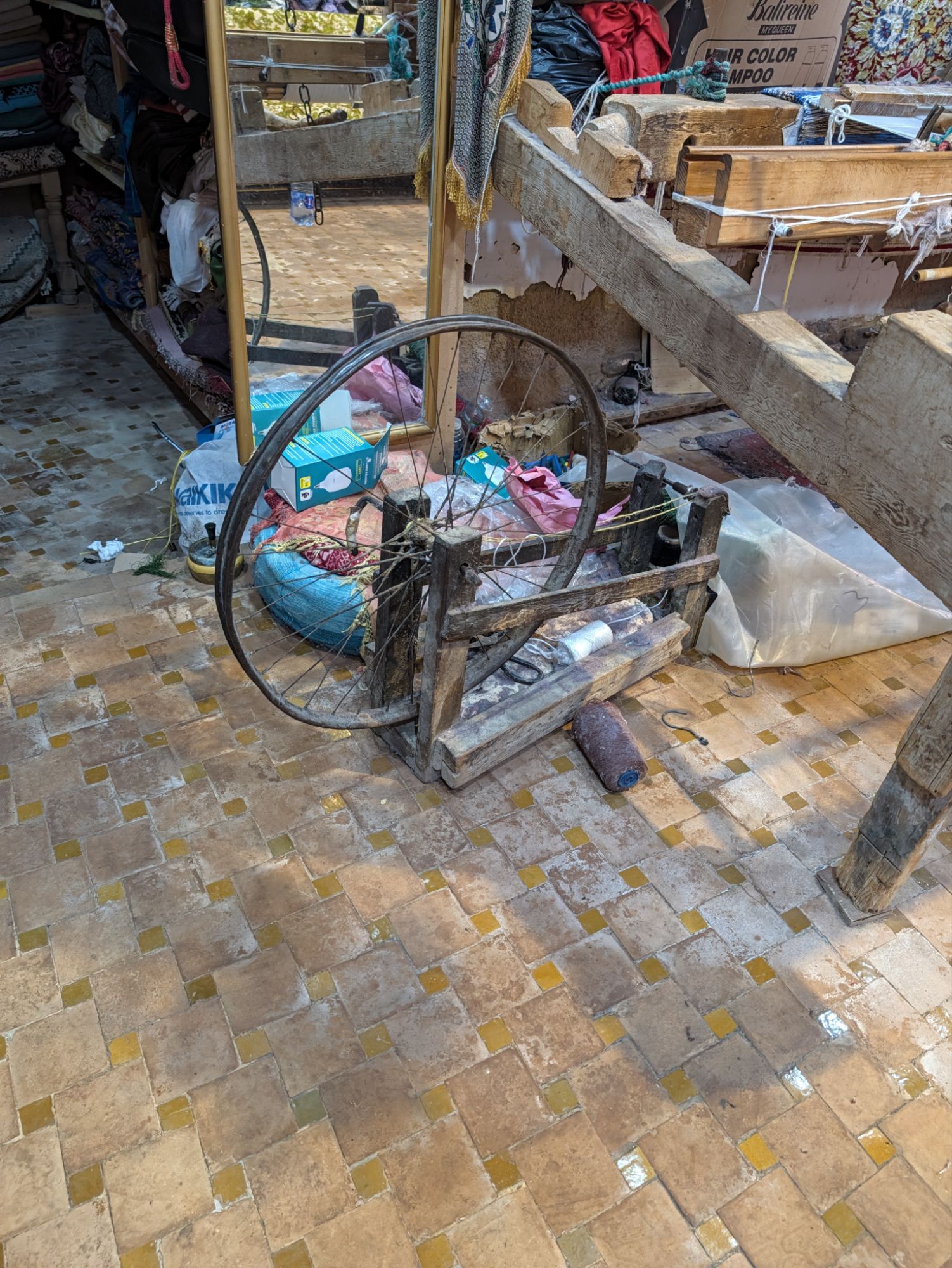
But I did find a weaver. He was pleased when I knew cactus silk was sabra. This store had woven works in camel, wool, and cotton fiber as well, so I suspect the loom was just for decoration.
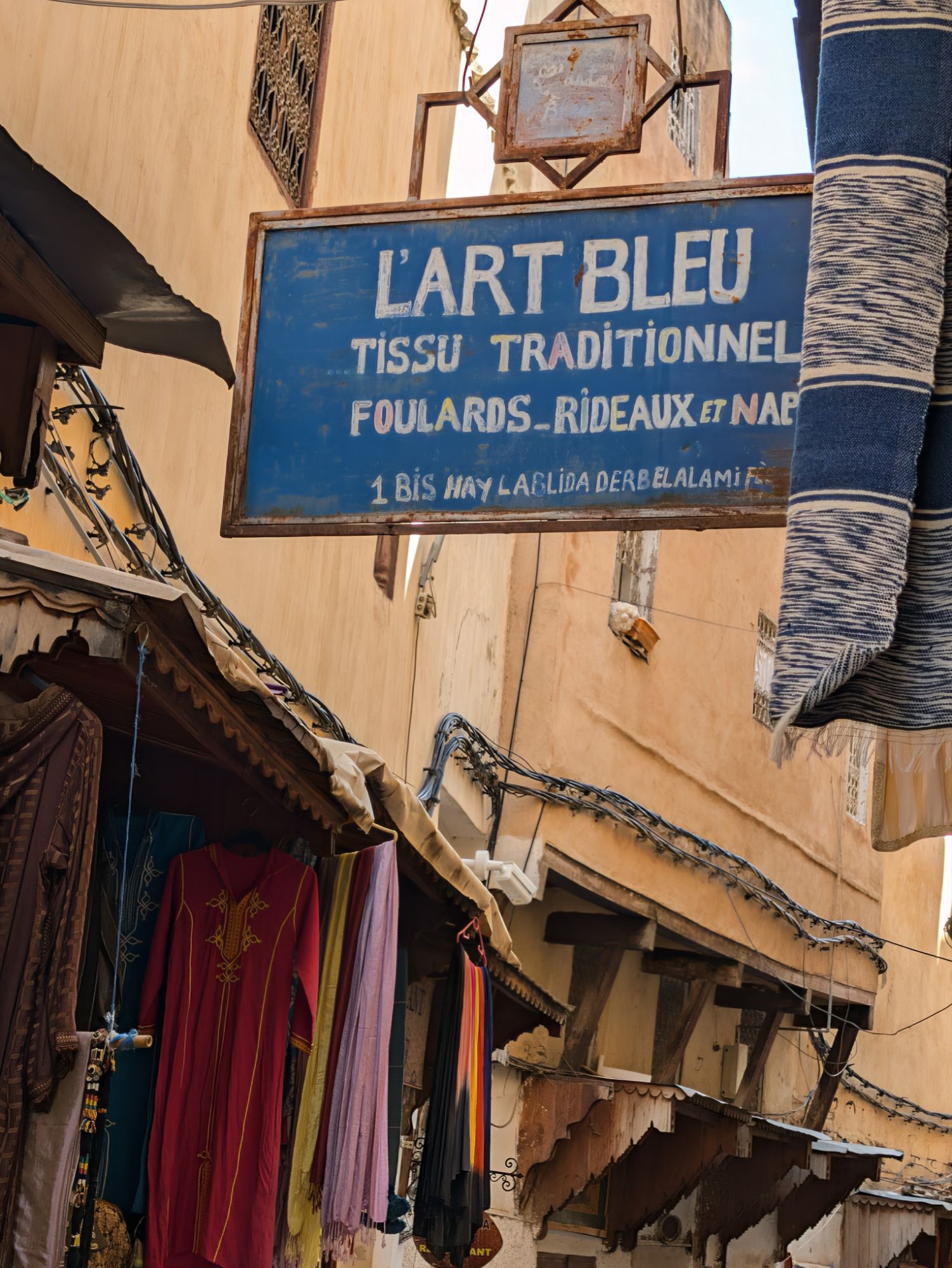
I took a picture of his loomAnd he invited me closer to take a more detailed pictureI don’t know what you spin on this wheel configuration.Since I left without buying anything, he wanted me to take a picture of his signAcross the street he also sells carpets, but he made sure that I knew that he didn’t weave the carpets. Those are woven by women.
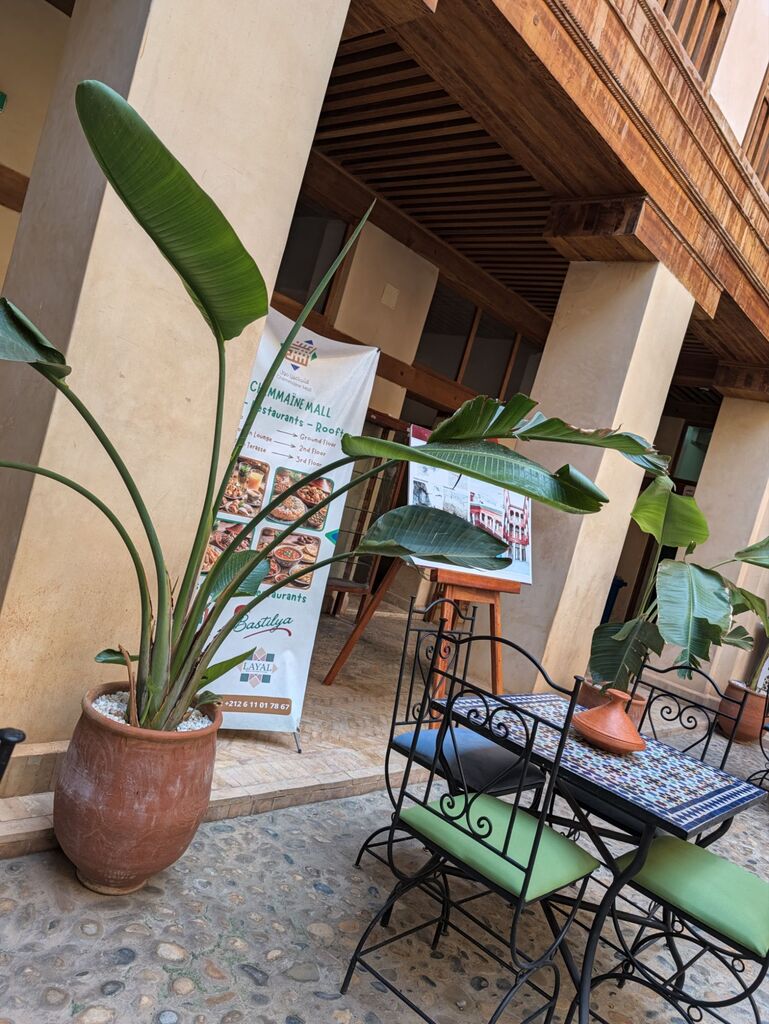
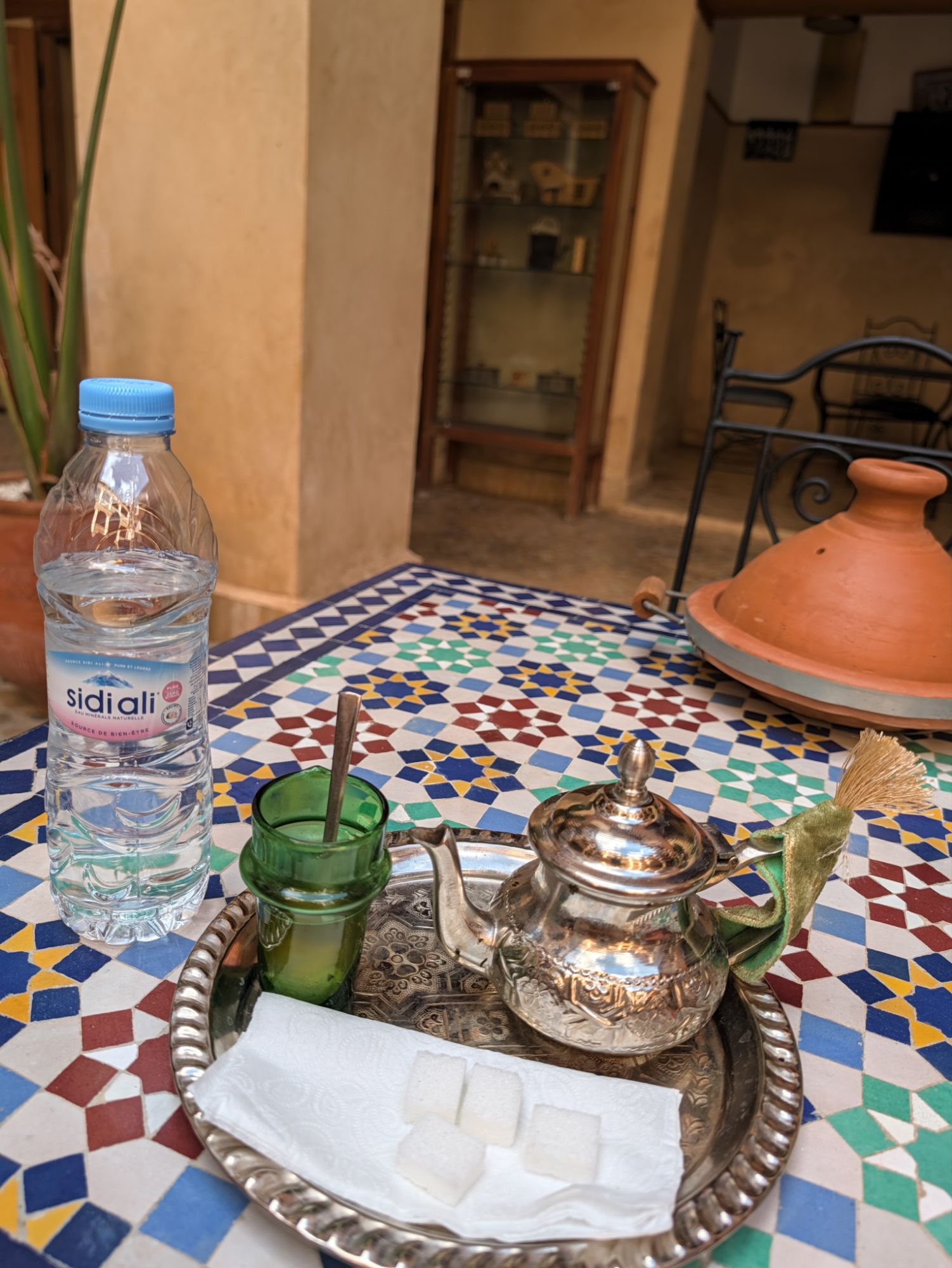
About this time, I was looking for a spot to sit down and drink some fortifying tea. And I spotted this bright place down a corridor, and it ended up being an interesting establishment called Chemmaine Mall.
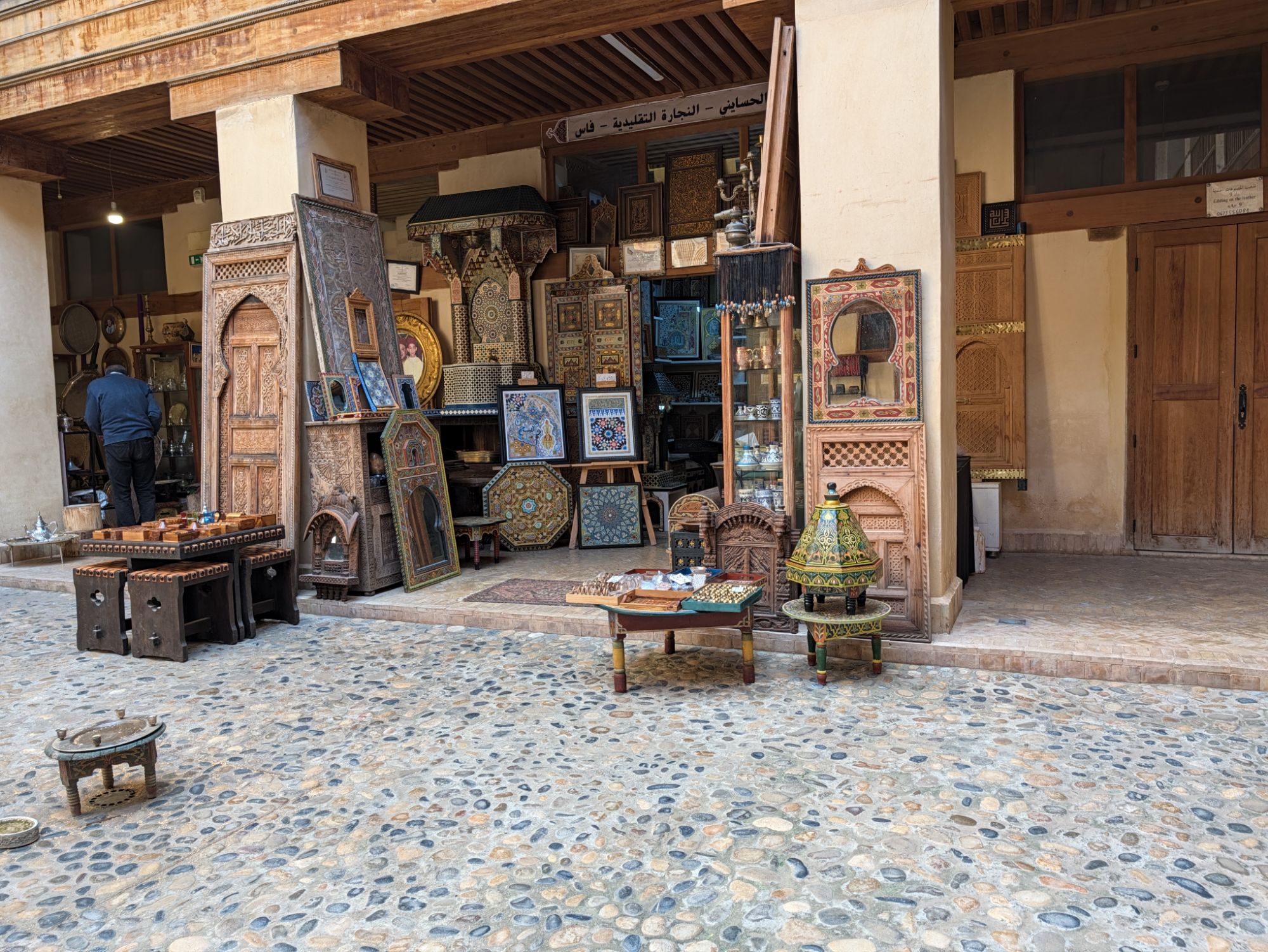
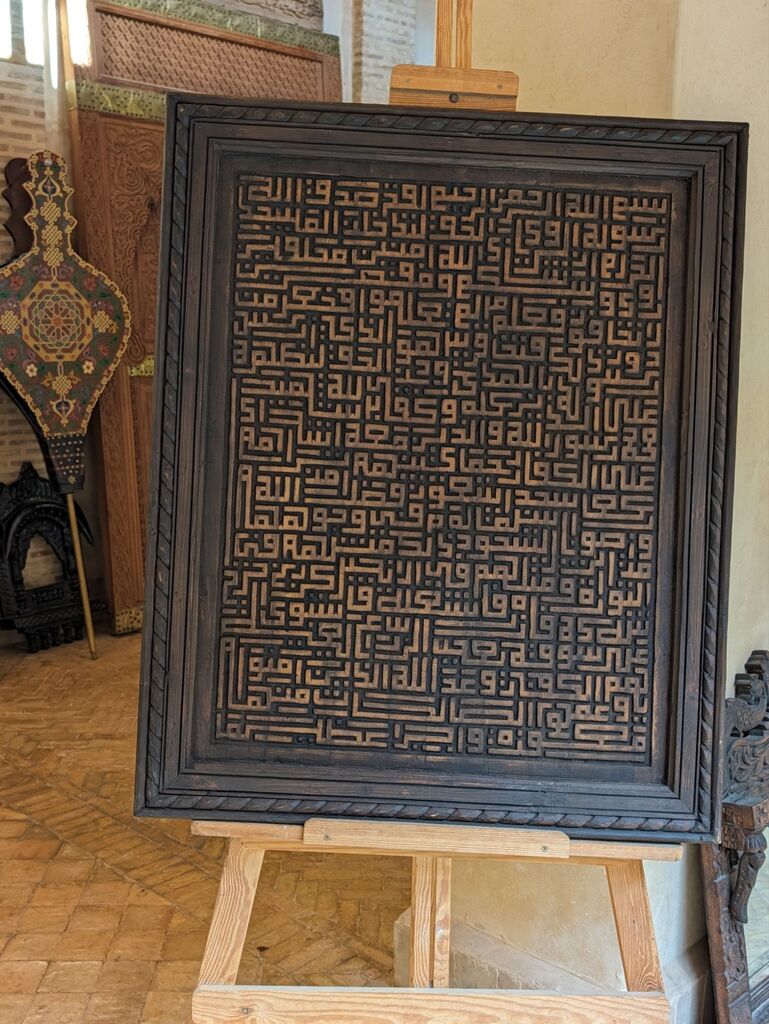
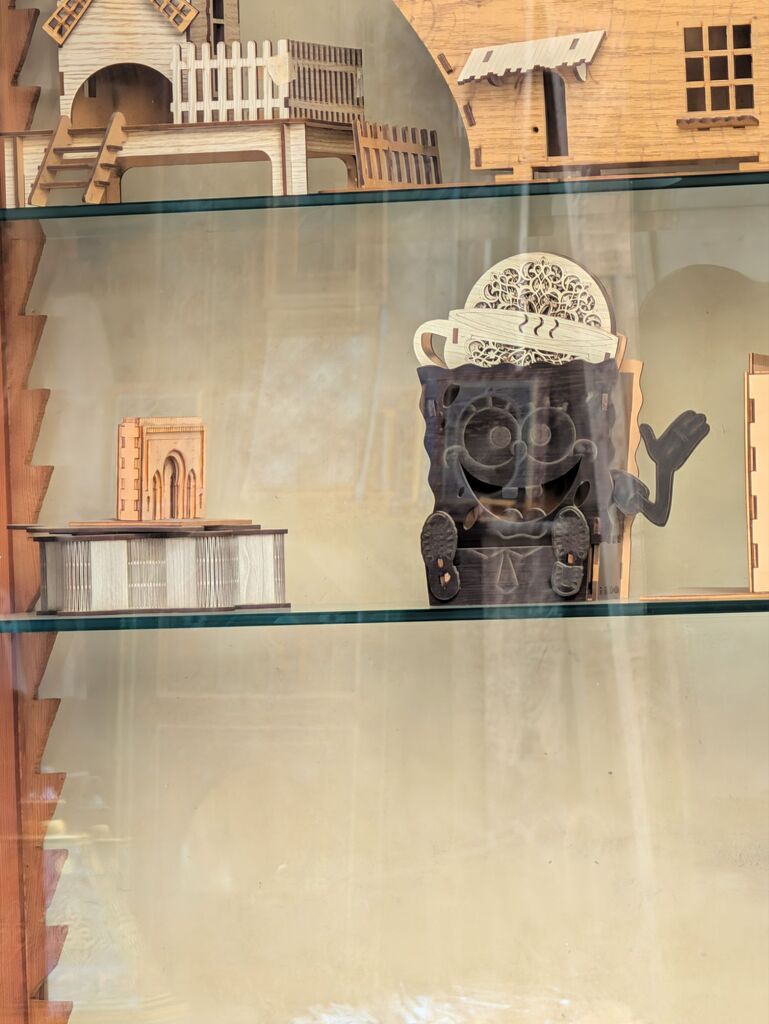
They have a sign for the restaurant and one about the renovation they did on the building.The tajine is just for show. I had some lovely hot tea.This riad also has traditional craftsAnd modern artistsThese letters are relief carved in woodThis SpongeBob is lasercut with a CNC
As best I understand this riad complex (3 adjoining courtyards?) is owned by the restaurant that has seating on all three levels from ground to terrace, and then they also lease shop/studio space to local craft people. When I was ready to leave, I was led around by my arm to visit the shops in the main courtyard and over to the area with the women’s crafts. In the “women’s” area there was a guy making musical instruments, a guy who did his very best to sell me perfume and argan oil, and another guy who was selling in a shop for a woman who designed exquisite couture dresses. Neither the guy selling nor the guy leading me around had any doubt that I could wear these dresses (of which there was only one of each model and they each had a story, another symbolic or an origin story).
No sooner had I escaped then I carelessly got lured into a rug shop
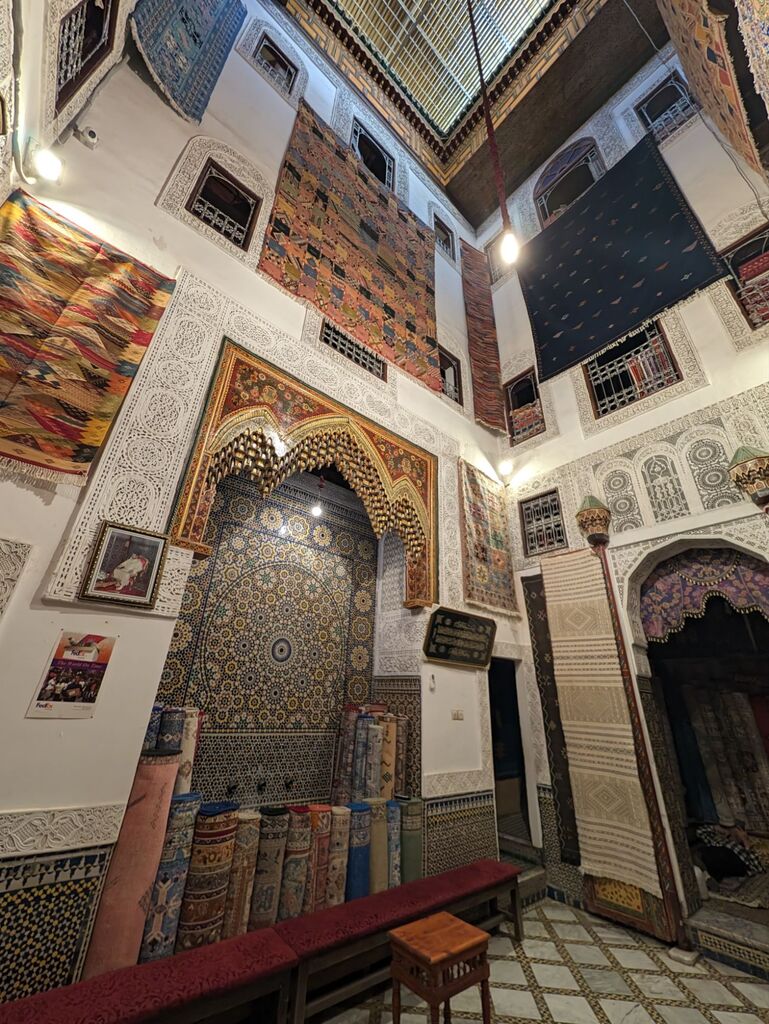
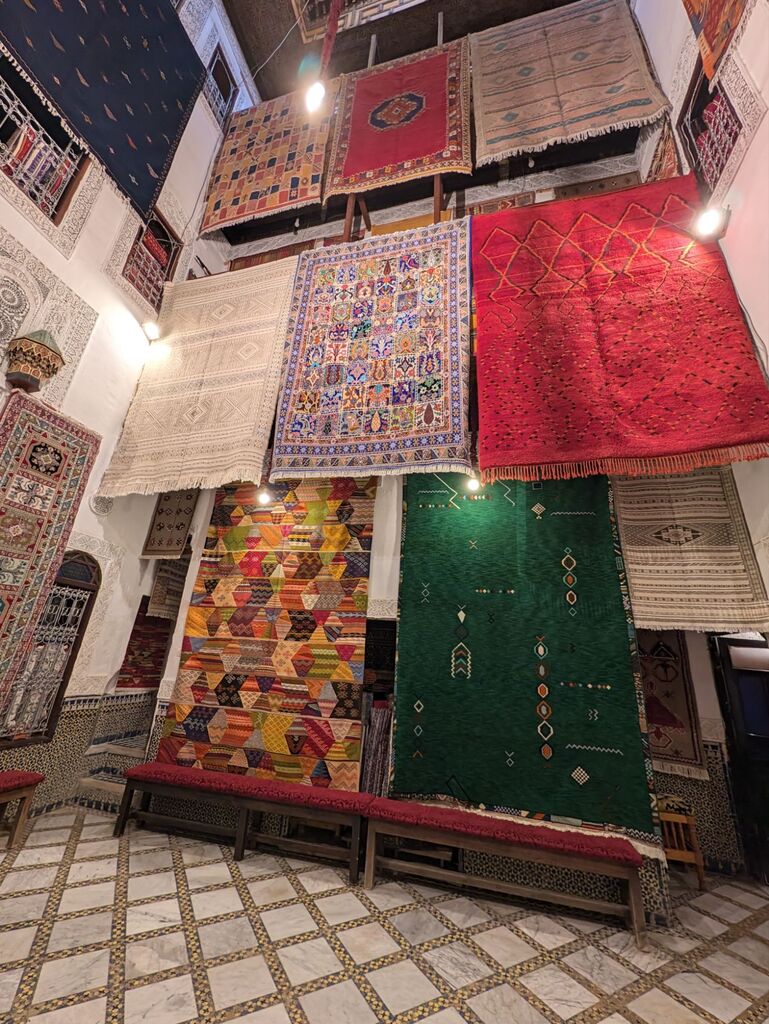
Come look at the fine artisinal handicraftsLook at the pretty architecture and the mosaicIt’s a rug store!
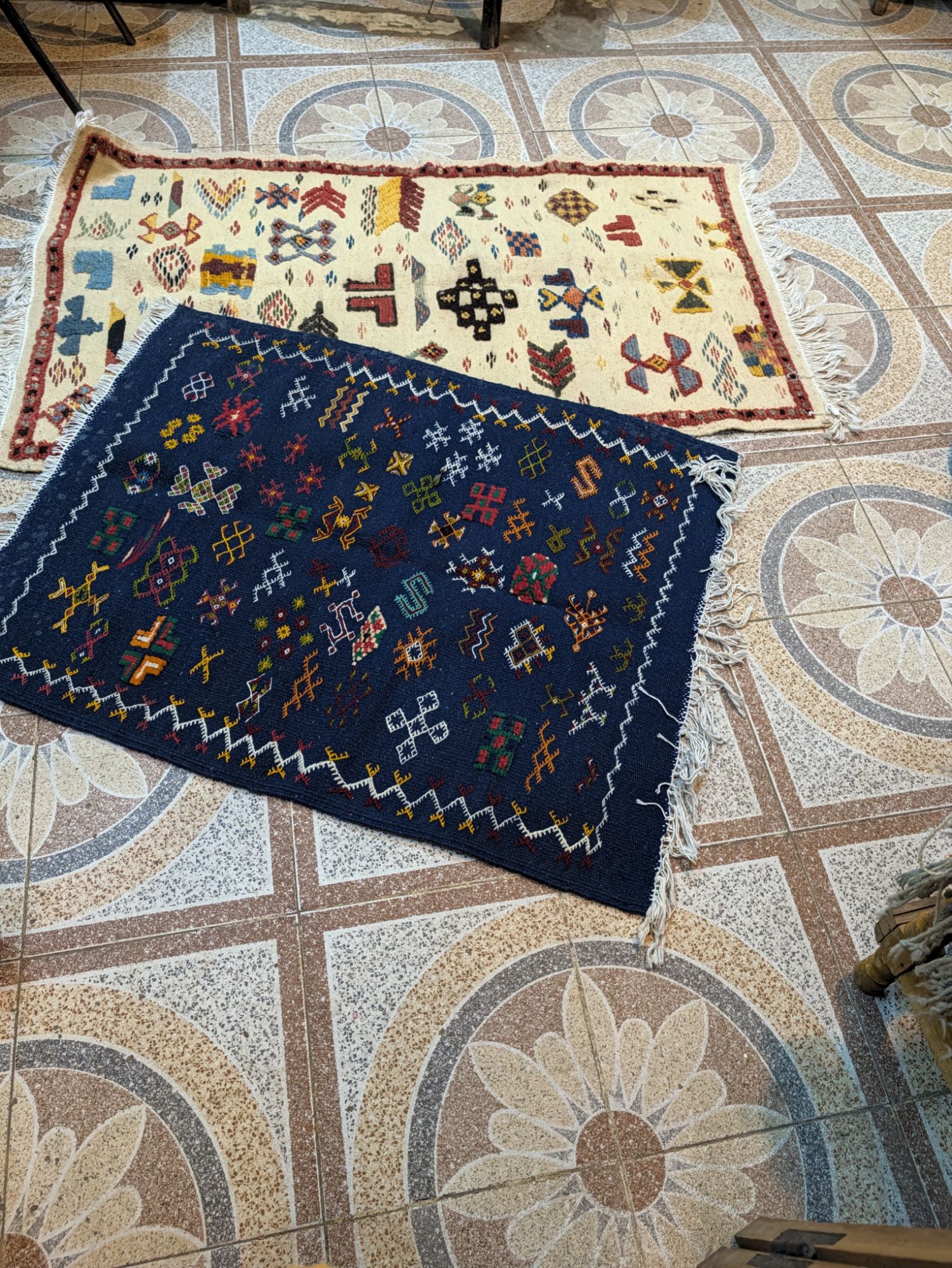
I did not take any pictures of the rugs I was being shown because I didn’t want to encourage them or show enthusiasm. But I was talked into a very pretty rug that goes with none of my existing interior decorating. But it was an exquisite design that was woven so that both front and back looked equally finished, supposedly with all natural dyes that would also be colorfast with hand washing at home (both claims have a little side eye from me). And I thought I’d done a pretty good job negotiating the price down, but he was so pleased that he skipped over to the neighboring store to buy me a bottle of water. Ah well.
So then I started slowly walking back up the hill. I was a bit peckish when I was getting tea but decided that I wanted to wait so that I had a good excuse to stop and relax partway up.
The first place I stopped had gorgeous comfy couches. But then I noticed that I’d been given a menu without prices. Luckily I asked because their prices were almost double what other places charge. Possibly their portions are also larger, but when I’m traveling I appreciate the smaller portions because then I can try more places. Anyway, I excused myself and continued up the hill.
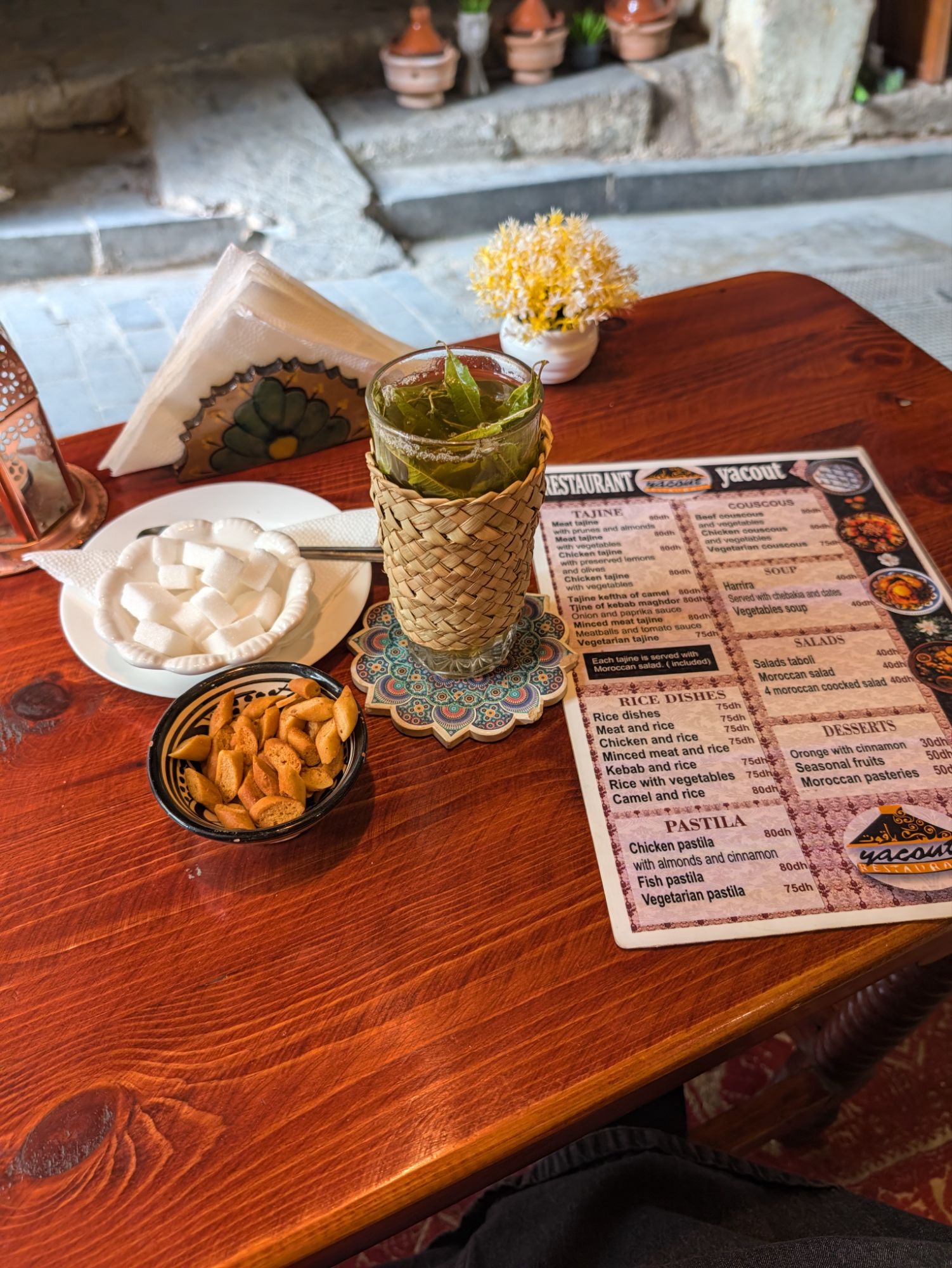
The next place that had sturdy seating on level ground ended up being great.
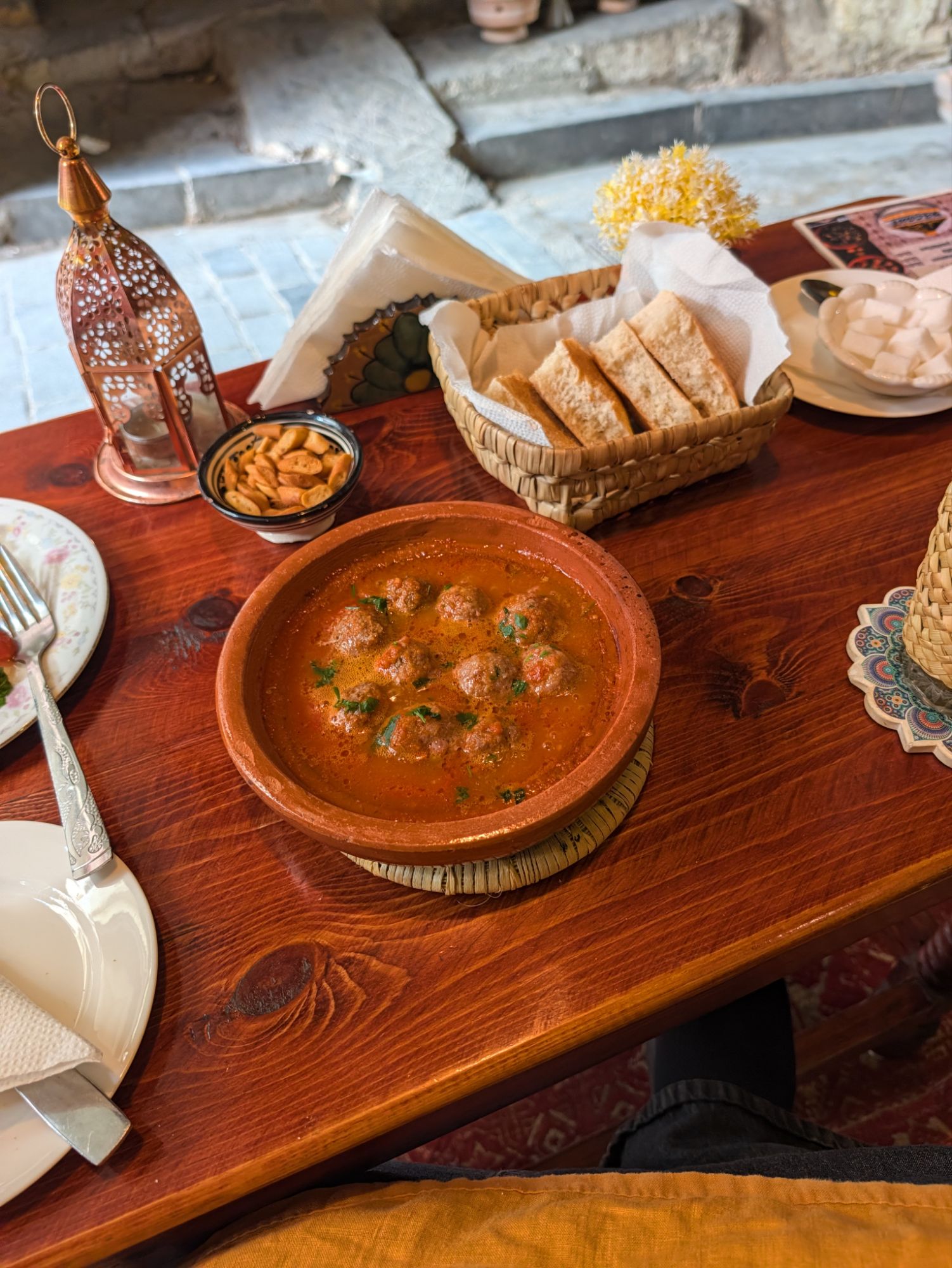
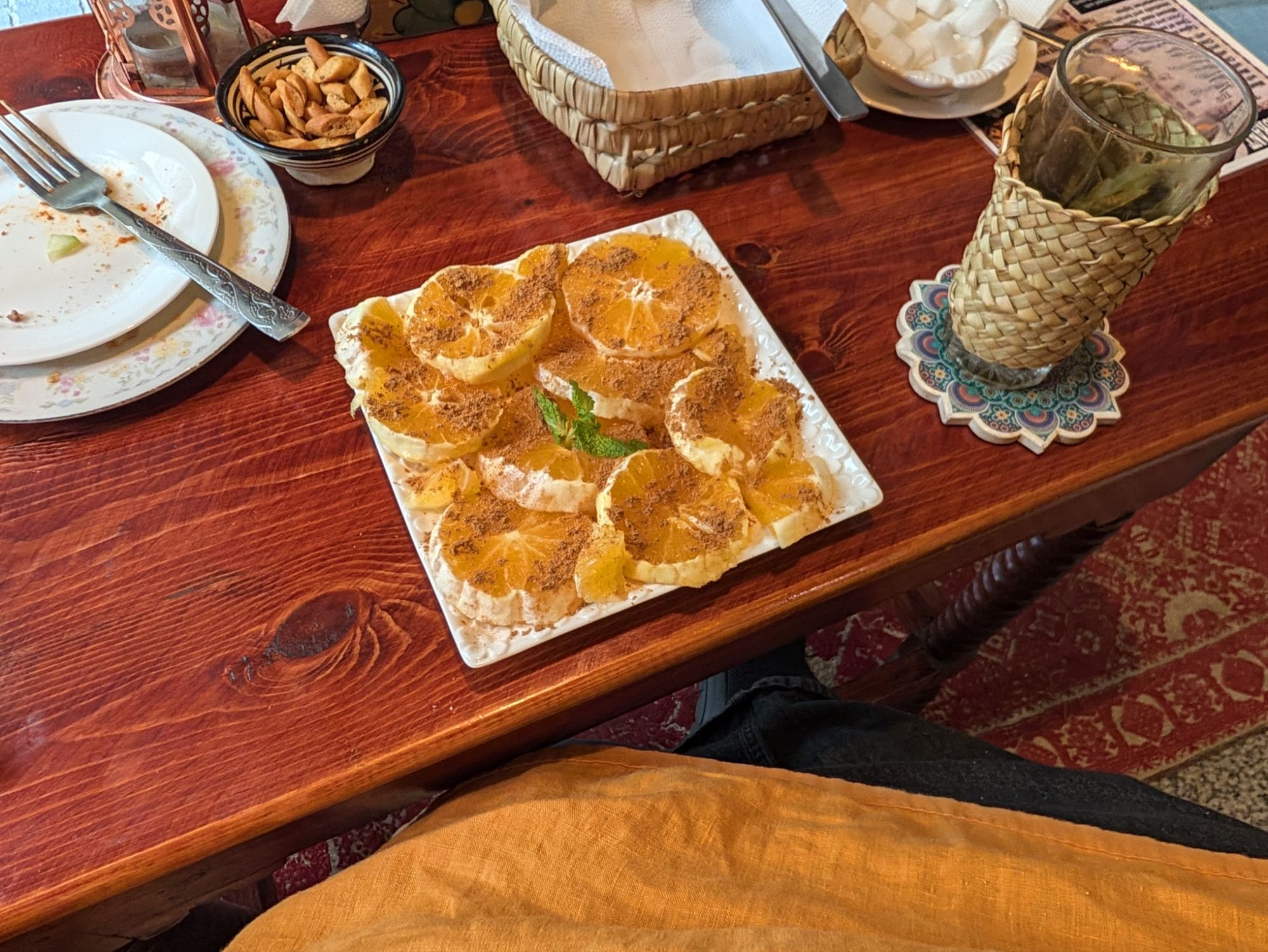
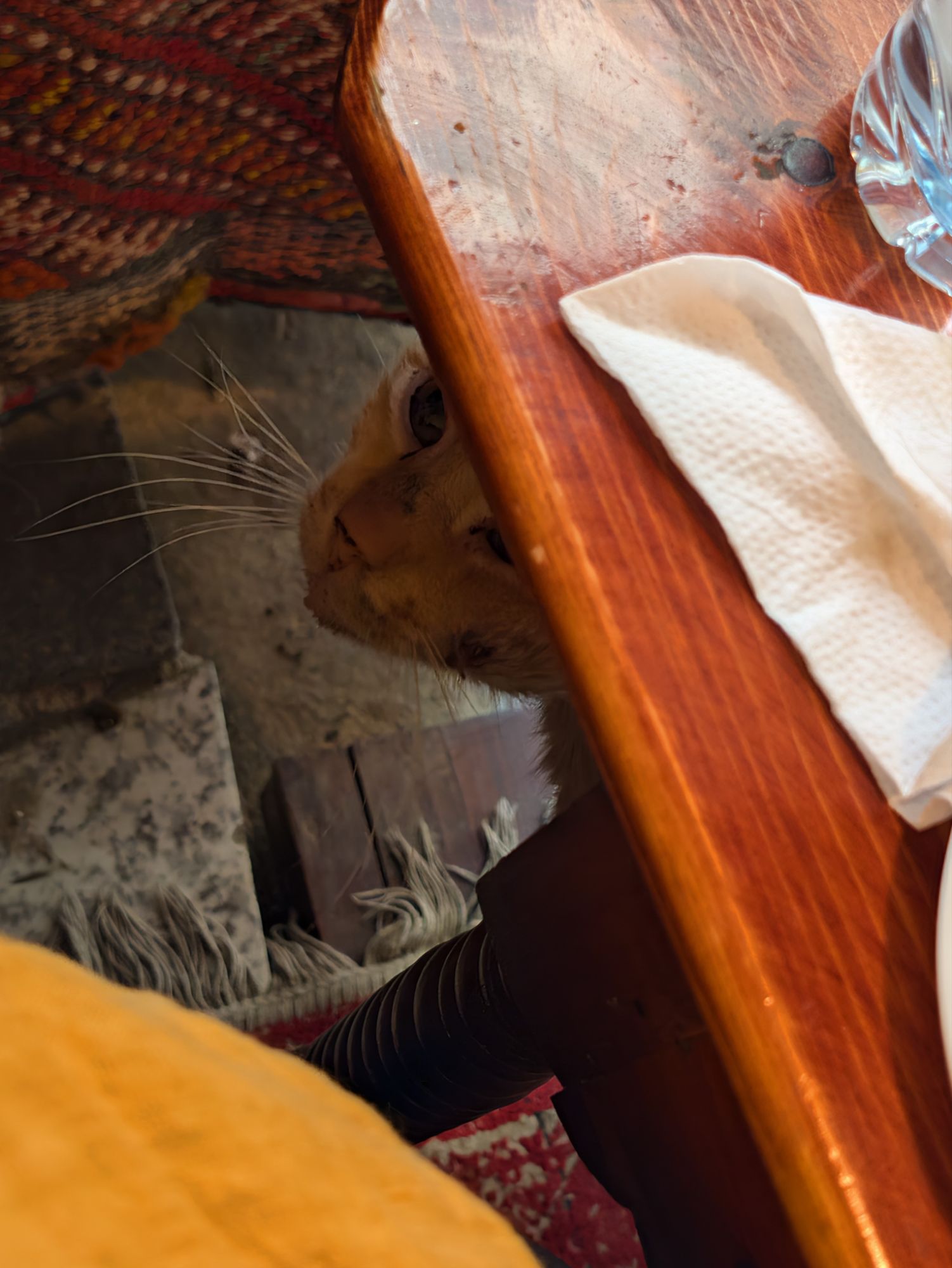
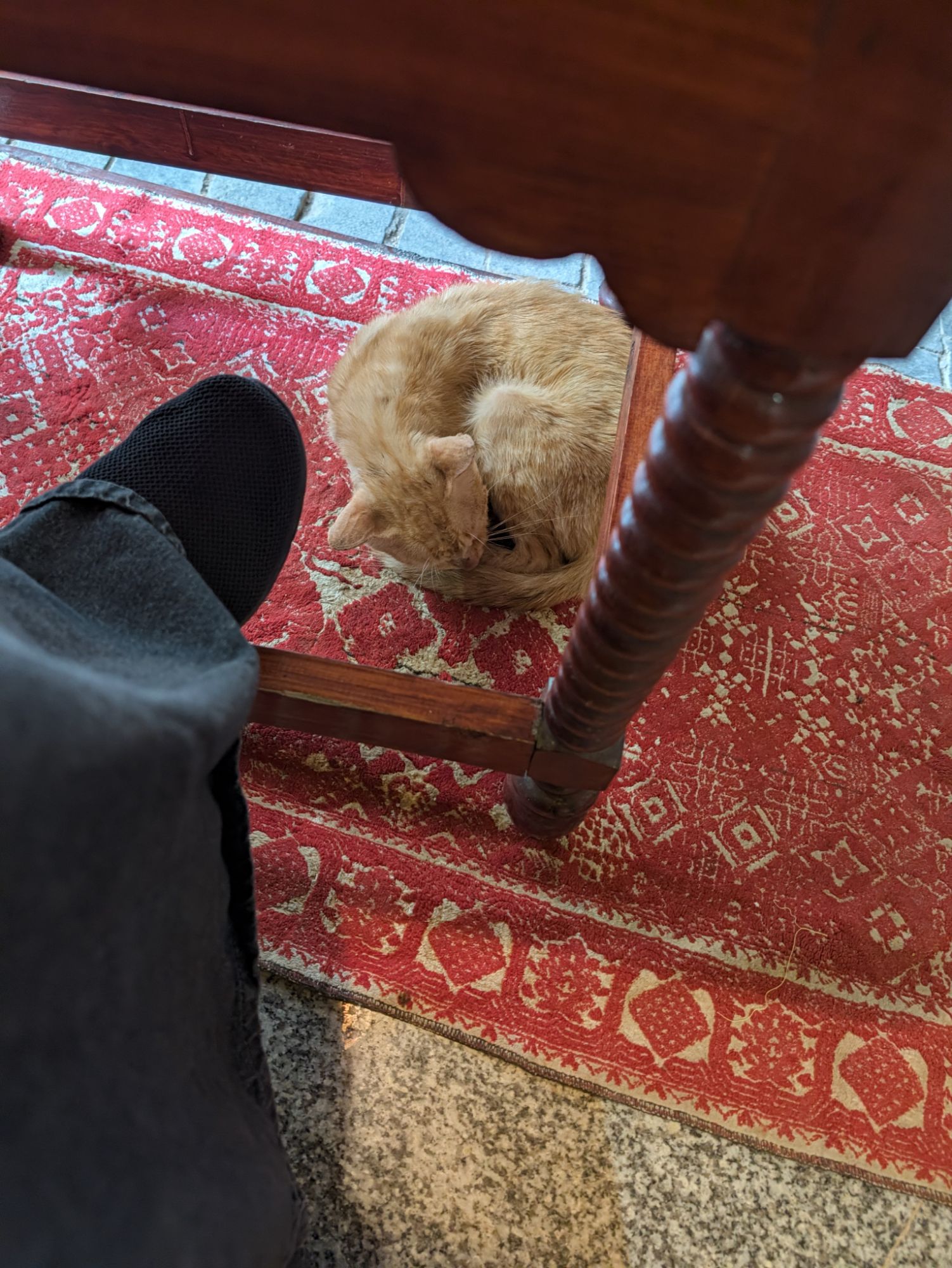
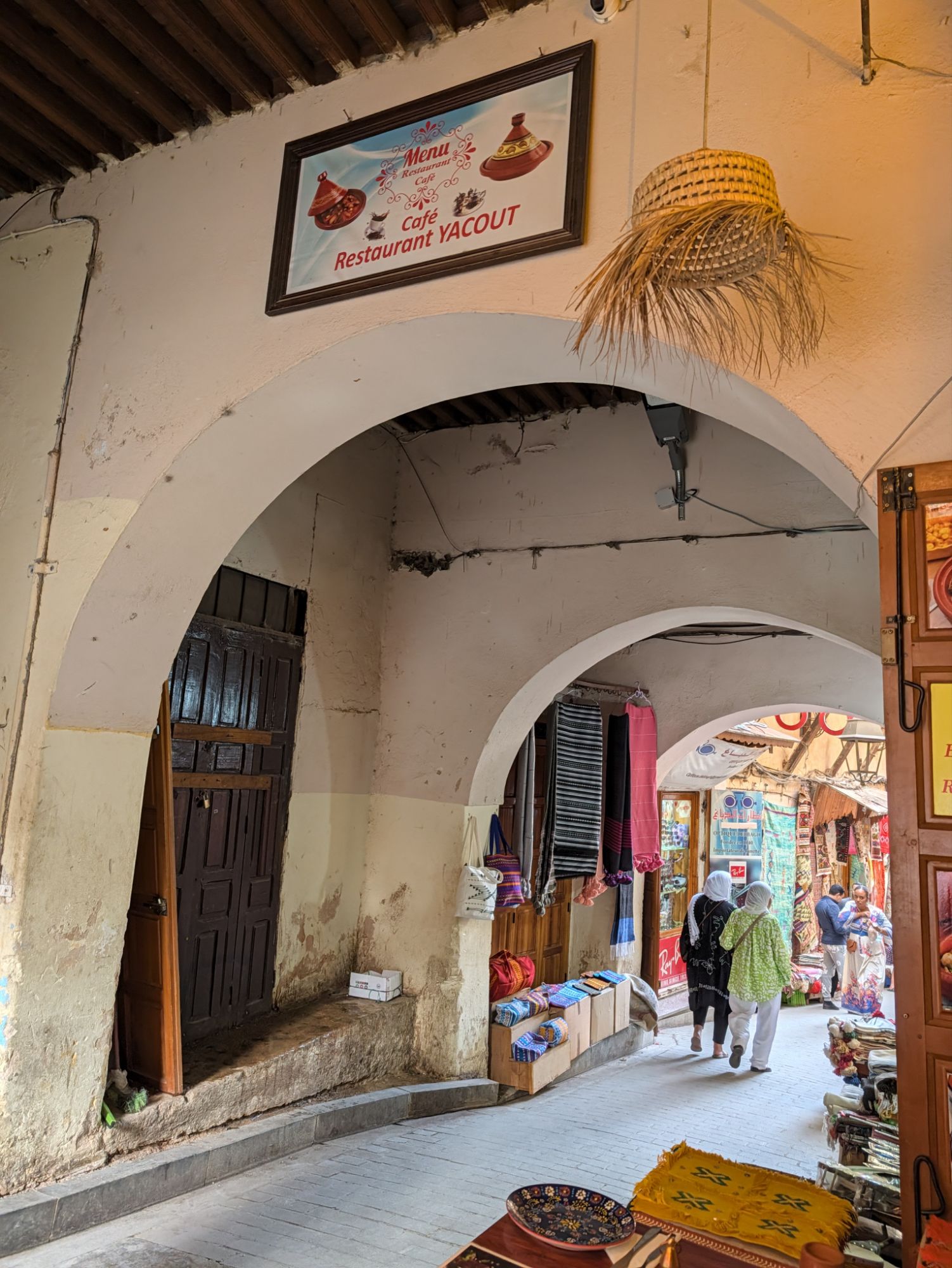
I switched it up with some Verbena TeaBut I’m still grumpy about this year’s low tomato crop, and then tomatoes in Fes have been tasting like garden tomatoesMeatballs in tomato sauceOranges with cinnamonToday’s kitty friend looking dainty and hopefully from under the shadow of the table.Same kitty being very well behaved and patientRestaurant name – Restaurant Yacout
When I was chatting with the server, he told me that his family has more than one home. They are living near the old tannery, and they also have a riad further uphill. I asked if they rent out the road if they’re not living there, and he told me they just have one person living there who is the cook who makes all of the food they serve.
Everything was very good. Verbena is a lightly citrusy herb, and the tea was refreshing. Refreshing sounds astringent – it was not that, but I was trying for a more informative description than yummy. The meatballs were yummy! The spicing was on point and rich without being overwhelming. There was a cat curled up under the table, but I had to wait a bit before offering food to her. But I started right away – dipping bread into the luscious sauce before the meatballs could be approached. Don’t not worry, though, the cat still got one and a half meatballs.
And then I finished with the oranges with cinnamon. I don’t know what I was expecting, but it was peeled and sliced (and maybe with seeds picked out as well) and cinnamon just generously on top. The only trick was to not inhale the powder as you were taking a bite, but it was a great combination.
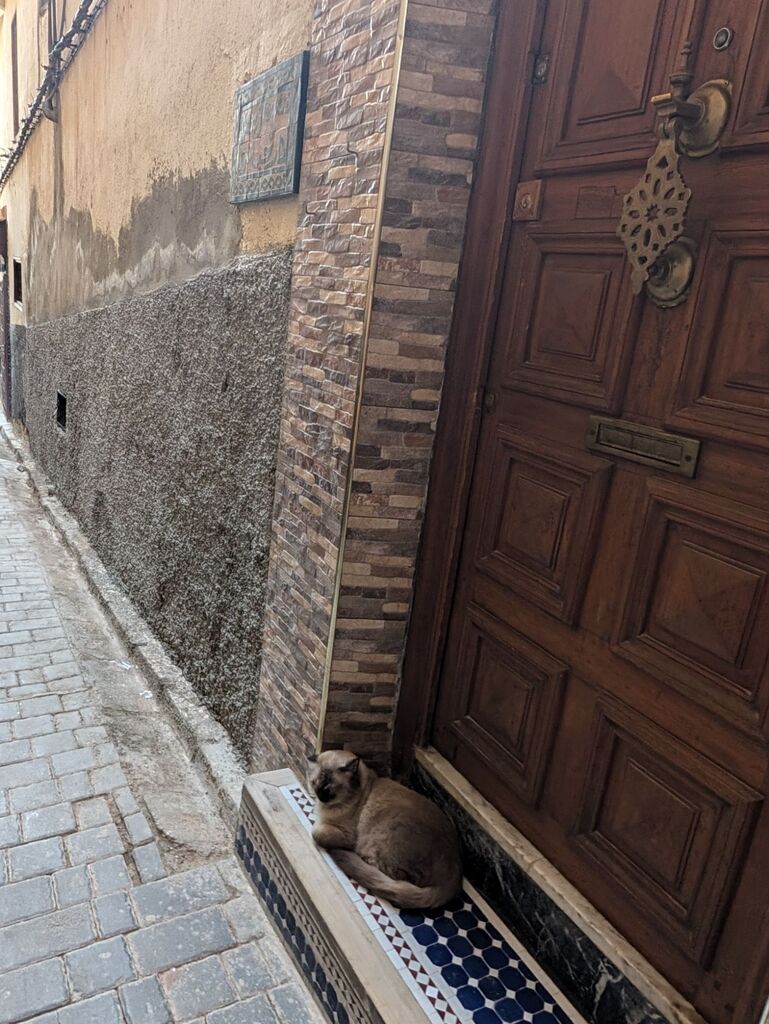
Doorstep cat
And then when I got back to where I was staying, there was a cat resting on the doorstep! And so unbothered! I unlocked the door and stepped around, and the cat didn’t even twitch. Nor did the cat try to sneak indoors. But I did!
Woke up, checked out of the cute AirBnb, and went to find breakfast.
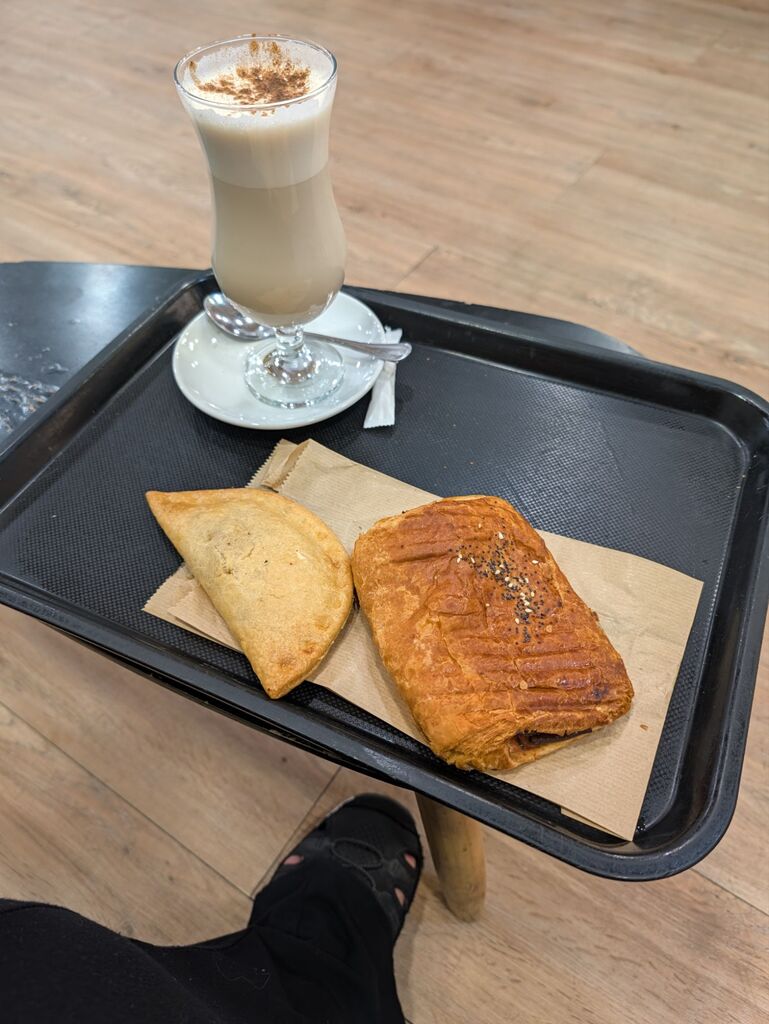
Two pastries on a tray with a fancy frozen drink cocktail style glass with chai latte and extra cinnamon on top
Cafe Belsot was just a block away from the Metro stop in the direction I hadn’t been yet. I got a ham and cheese turnover and three vegetable empanadillas (the other 2 I didn’t have them heat up and tucked them in my bag for later. And that fancy beverage is just a chai latte. The two women working there were delightful.
And then I spent way more time in the Madrid airport (maybe just one extra hour, but also maybe an eternity) than planned. It turned out that our boarding was delayed because their mobility support took forever to show up to help a passenger from the previous flight deplane.
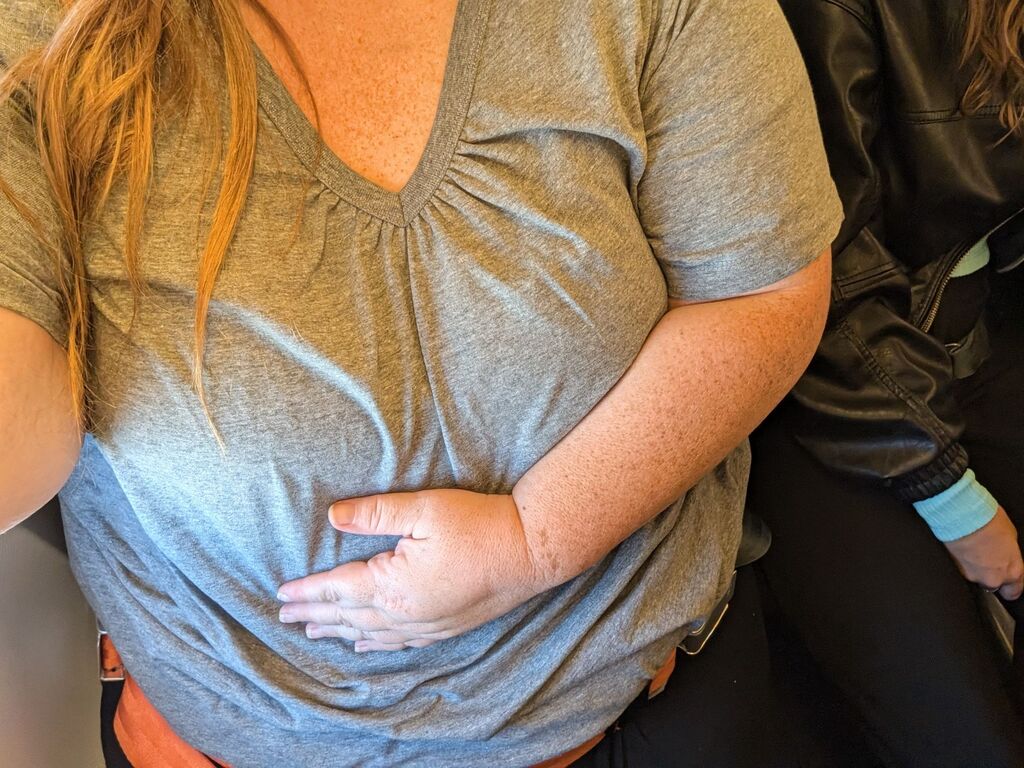
My torso in a plane
I always forget to take the Flying While Fat selfie. RyanAir did need a seatbelt extender but the armrest went down and there was minimal touch with the (luckily skinny) person in the middle seat. It was only an hour flight, so I can’t really judge the other amenities. I slept throught pretty much the entire flight
And then my Airbnb in Fes sent a driver to pick me up at the airport. I was worried I’d be delayed in passport control because I’d lost the Morocco ID number that was in the passport that was stolen a few years ago, but they just looked it up and found it in their computer. Honestly getting that thought out of my brain was one of the main reasons I decided to go to Morocco on my first trip since then.
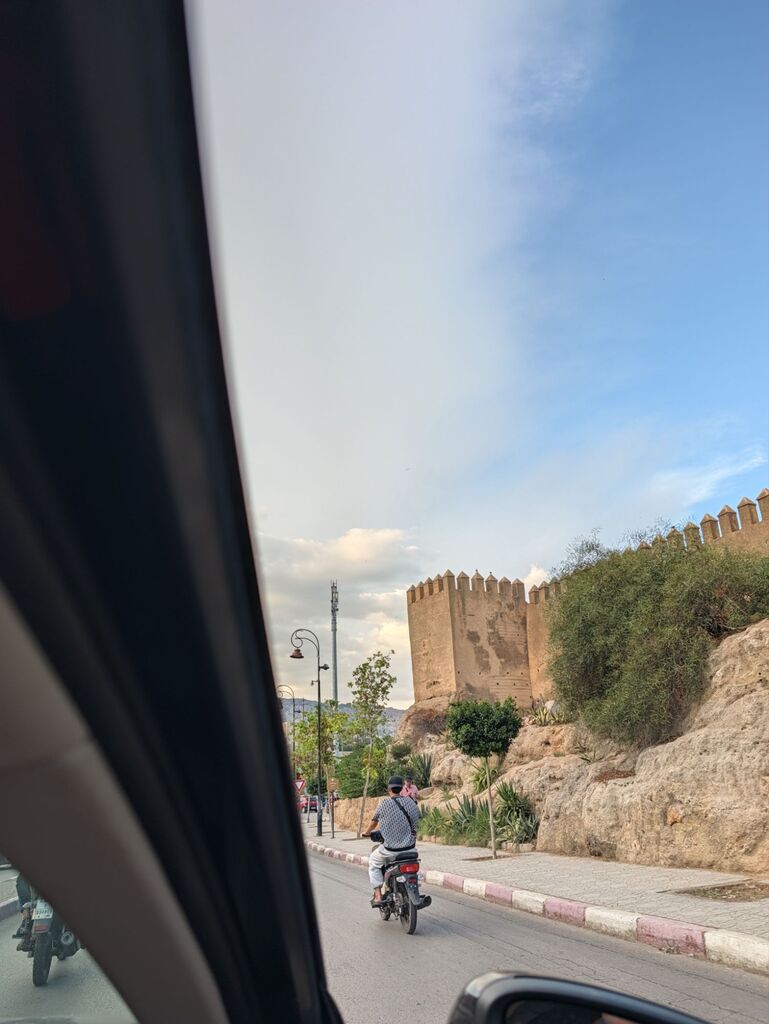
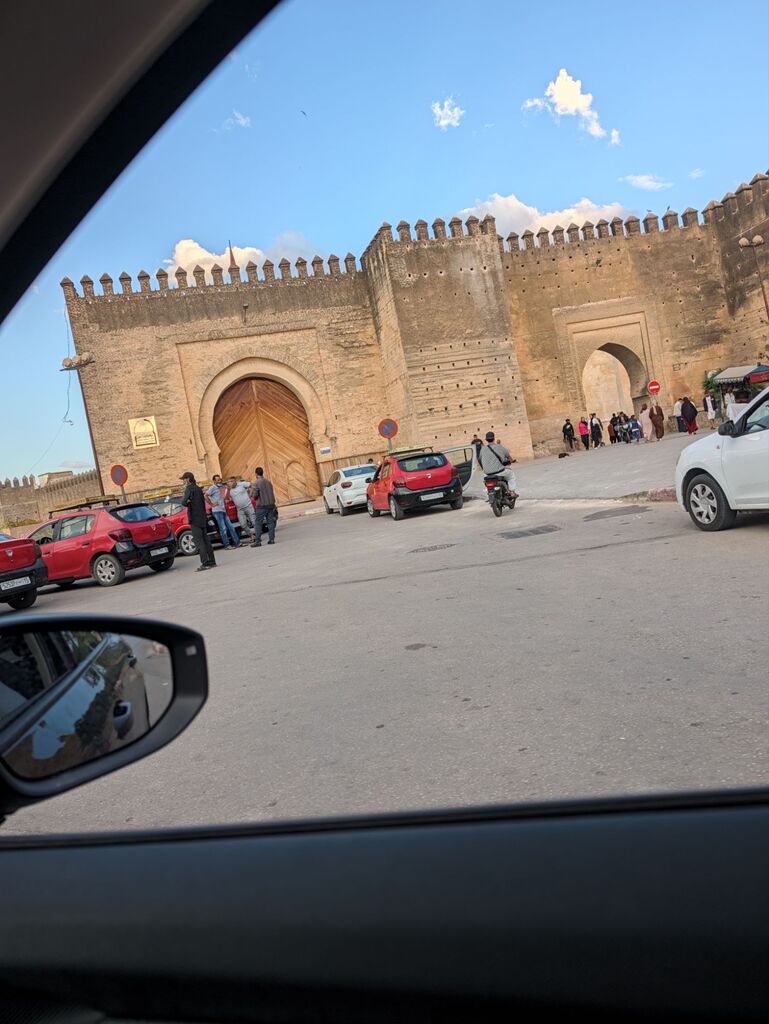
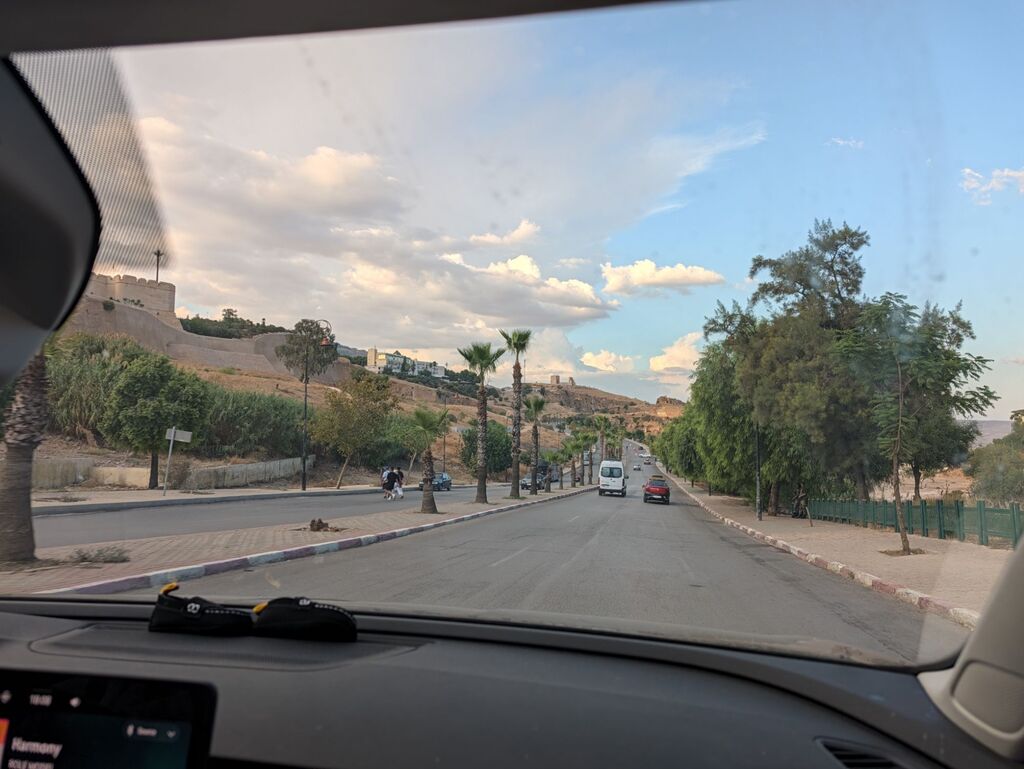
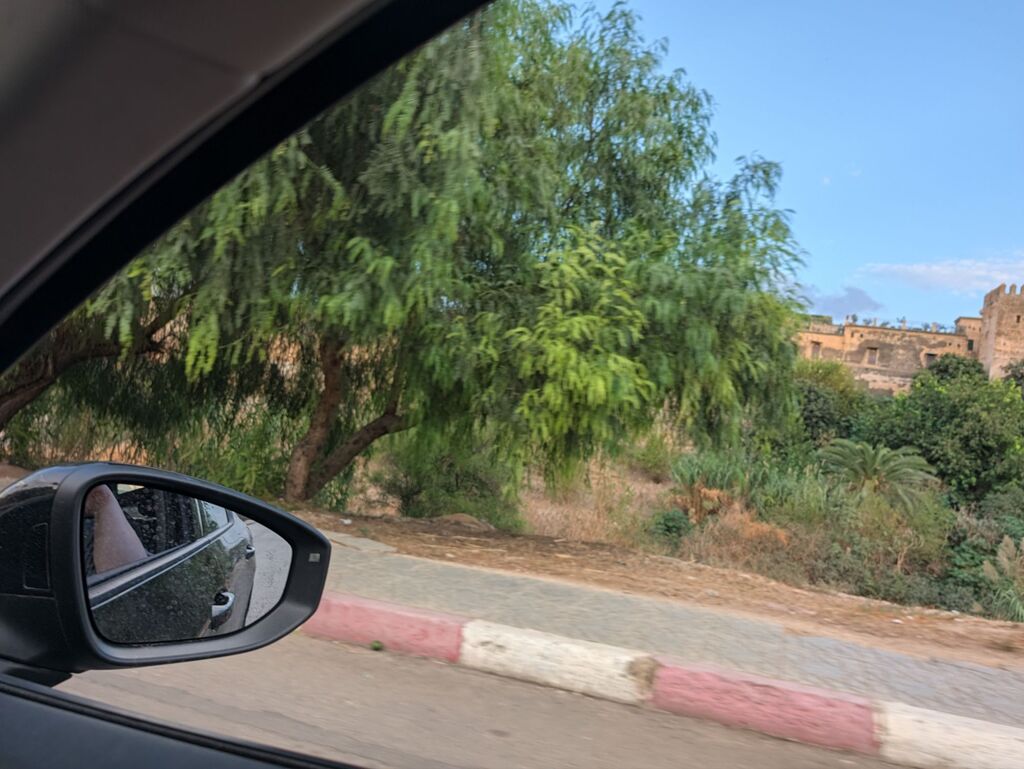
Images from the drive to the old medina
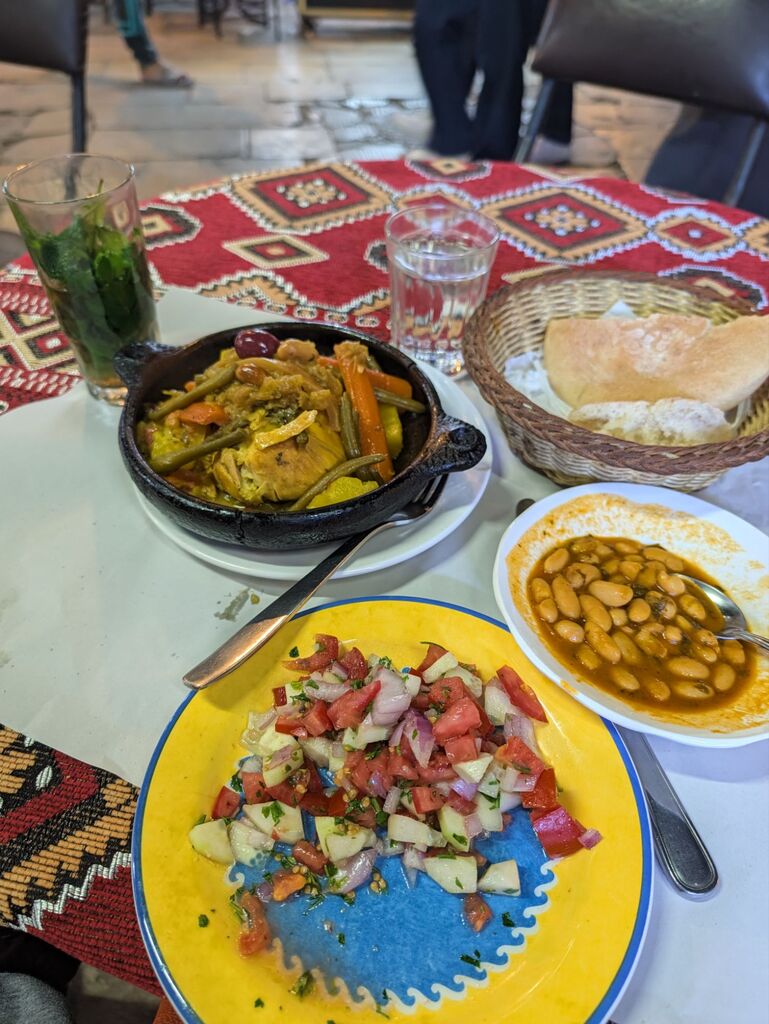
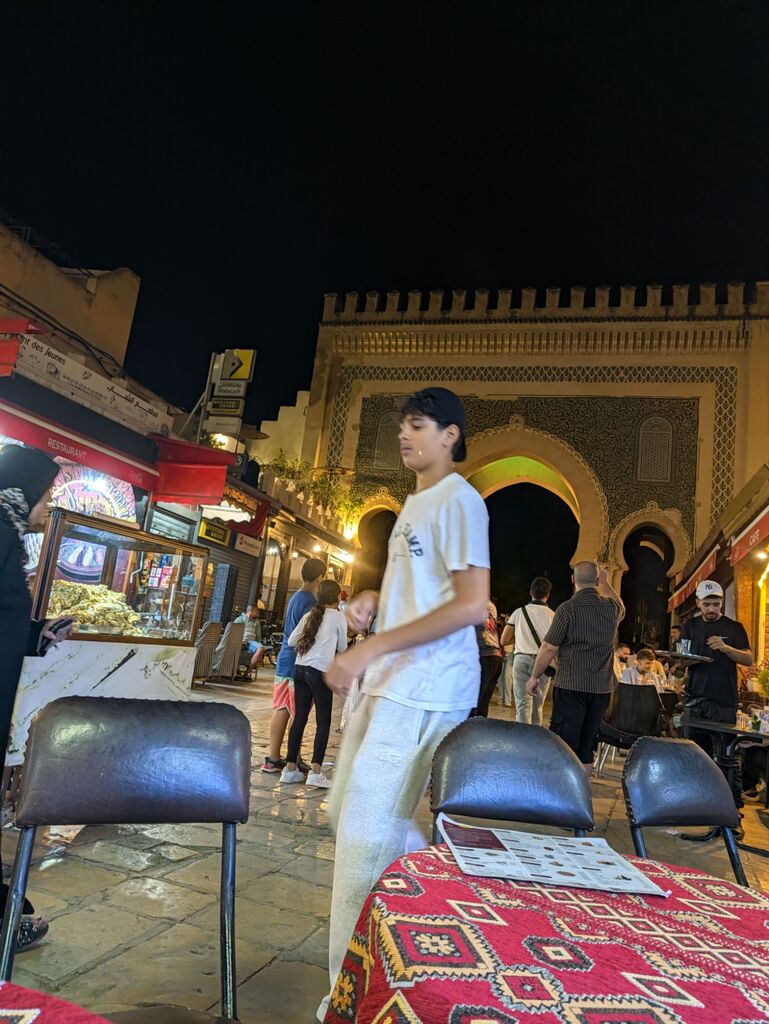
And then my host came out to meet me and walk me to Dar Hayati where I’m staying. I checked in, drank some tea, and then went back out to look for food and an ATM. Not in that order. There are only like three ATMs in this part of the city, so I went to the Blue Gate one, and then let myself be chatted into a restaurant near there. I went for a place with street level outdoor dining and refused their kind offer to climb up 8 million stairs for the panoramic view.
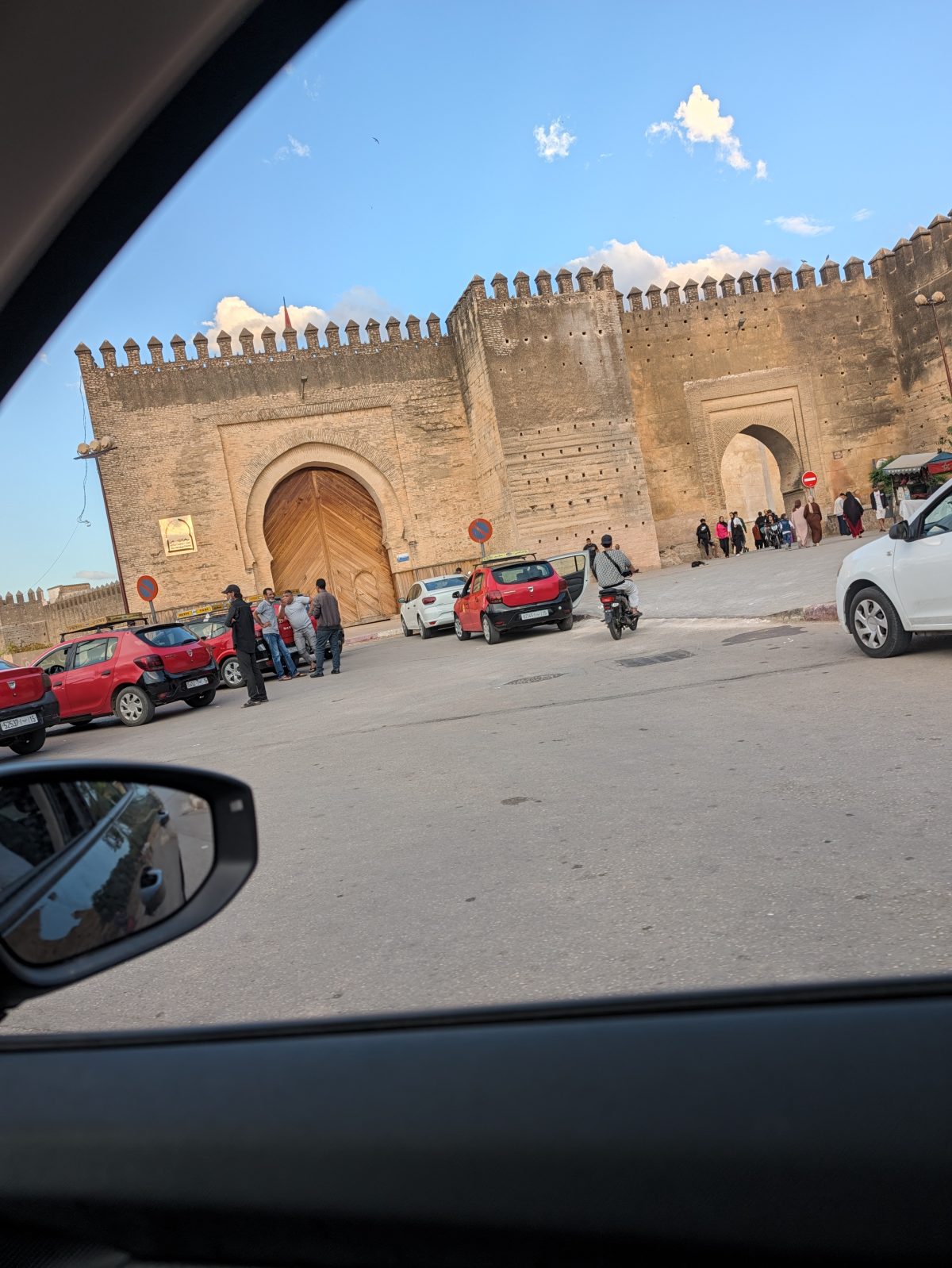
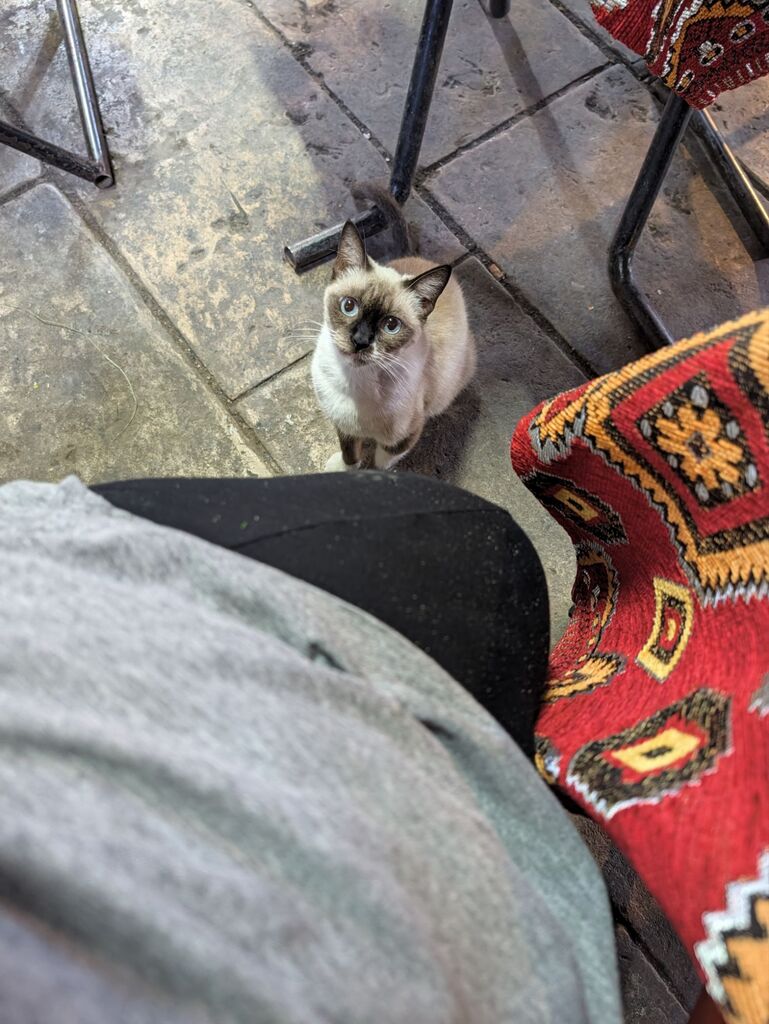
Bread, chicken & vegetable tajine, beans, and a cucumber and tomato salad.Blue GateI made a friend! Her name is Maya.Two more cats offering to make friends
One of the hazards of picking a place by whether it has a chatty guy is that you then end up having to chat with him. And he decided that he would very much like to marry me or at least take me dancing or to a mixed hamam. But he at least he took my refusals with good grace and it was all fairly fun flirting.
I am (so far) finding it easier to navigate Fes this time. Partly because I’ve spent ten years thinking about the layout; partly because phone map technology has improved since then; partly because traveling alone means I can’t rely on someone else navigating; and also because I can walk slower and not have to mind my fellow travelers’ fears of being accosted.