It was rainy tonight, and I was trying to think of something to do with the four zucchinis I’d bought (because that was the smallest quantity available). And I decided I wanted it melty with ground beef and a brown sauce that wasn’t tomatoes.
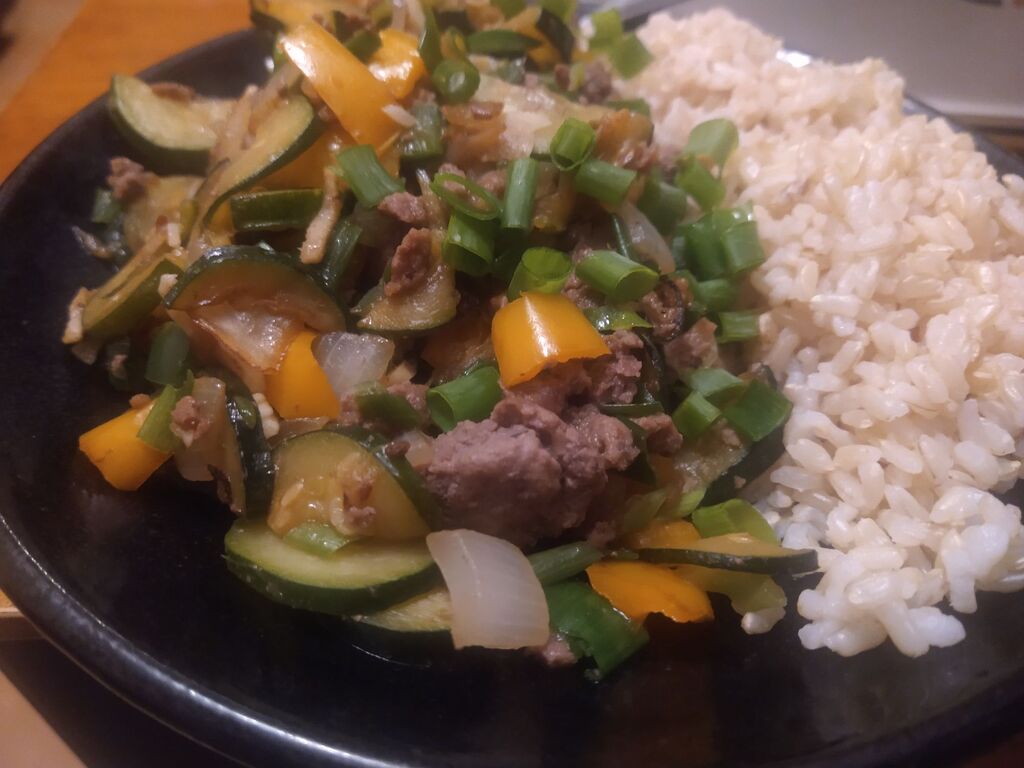
On the left of the plate is a bunch of vegetables, especially zucchini, cooked with ground beef. On the right is brown rice.
I picked a couple peppers and some green onion from my porch.
So I started with the (small-medium) zucchini and sliced it lengthwise and then cut it into fine slices. And I tossed that into the pan with some olive oil. And I pulled out a quarter pound of ground beef from the freezer and lay that on top to thaw.
Then I pulled out a couple mini sweet peppers and a partial onion from my refrigerator, gave them a medium dice, and threw them in around the beef (which now was ready to be flipped to the other side while stirring everything around.
So that was my base. To that, I decided to add a generous drizzle of oyster sauce and some cooking wine. And then I finely cut up the peppers from my garden: a spicy purple one and a firm jalapeño. By now, the beef was fully broken up into small pieces and nearly cooked through.
So I still was puttering and decided to add some garlic and ginger. And I sliced the scallions.
Then I remembered to think about my starch. And I think it probably should have gone with noodles, but it was a little late to start them now. And I had a quart of cooked brown rice prepped already.
So I pulled about about a quarter cup of rice and warmed it in the microwave for a minute and threw the sliced scallions into the skillet.
On the side, I’m eating some daikon and carrots that I quick pickled in seasoned rice wine vinegar.
It is so good! And very satisfying. Would make again.
(this post doesn’t start vegan, but keep reading to the second attempt!)
I’ve been taking a class on food and culture in the Islamic Middle East, and my assigned country to research is Egypt. As part of this, I’ve been looking at Egyptian cookbooks.
I started with Egyptian Cooking: A Practical Guide by Samia Abdennour, published in 1984 by the American University in Cairo Press. It looked very sensible and traditional with bare bones recipes and no pictures. The cookbook inspired confidence that this is recording traditional cooking. There were 2 versions presented: one with veal and the other with beef, but all of the same ingredients and quantities for both. I figured I would give it a try.
Here are the recipes as published in the cookbook: MC 180 SANIYET BATATES, NAY FI NAY – Casserole of potatoes (1) 1 kg potatoes, peeled and sliced 2cms thick 1/2 kg beef 4-6 ripe tomatoes, peeled and chopped coarsely 12-15 garlic cloves, halved diagonally 2 onions, sliced thinly 2 cups tomato juice salt and pepper
Cut beef into bite-sized cubes. Put all the ingredients together in an oven pot, cover with seasoned tomato juice and cook in preheated moderate oven for 1-2 hours.
MC 181 SANIYET BATATES – Casserole of potatoes (2) 1 kg potatoes, peeled and sliced 2cms thick 1/2 kg veal 3-6 ripe tomatoes, peeled and chopped coarsely 12-15 garlic cloves, halved diagonally 2 onions, sliced thinly 2 cups tomato juice cooking oil salt and pepper
Peel and slice potatoes 2cms thick. Cut veal into small cubes. Peel and chop tomatoes coarsely. Peel garlic and halve diagonally. Slice onions very thin, keeping all items separate.
Saute onions, add tomato juice and cook for 10 minutes. Add [meat,] garlic and seasoning and cook for another 10 minutes.
Arrange sliced potatoes in lightly-greased oven dish, bury the meat mixture among the slices and cover with the cooked tomato sauce. Bake in slow oven for about 1 hour.
Now I didn’t have a full kilogram of potatoes handy and was only cooking for 1 person, so I scaled the recipe down a bit.
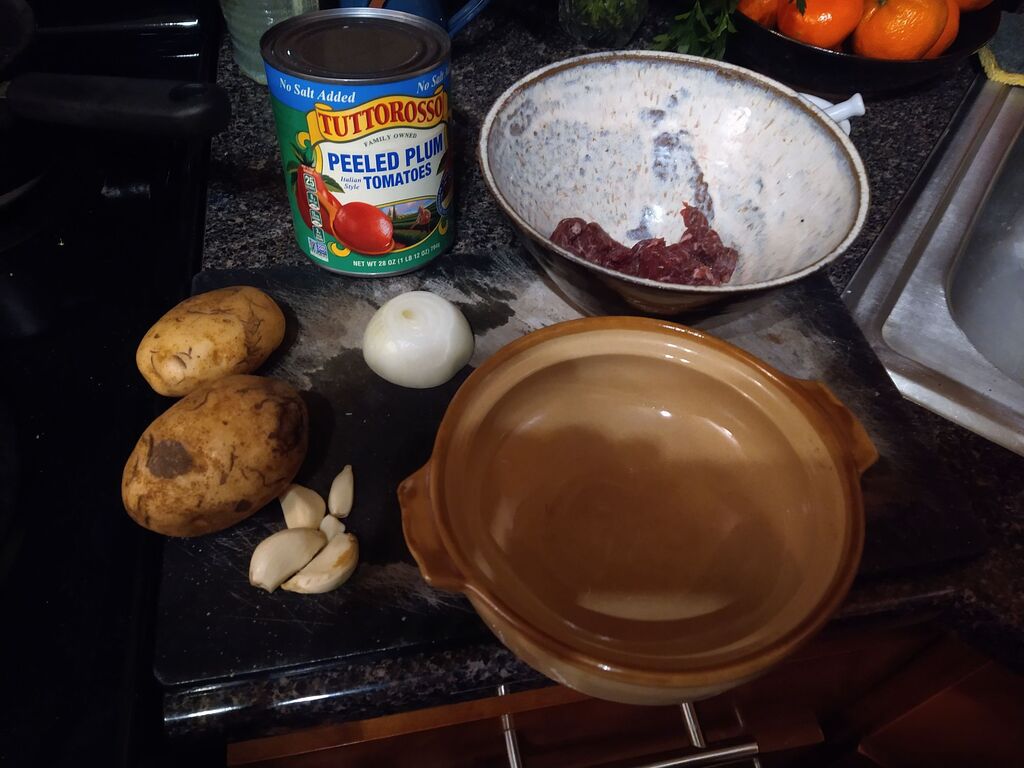
mise en place with an empty donabe, 2 sad potatoes, 5 peeled garlic cloves, 1 small peeled white onion, 1 can of peeled plum tomatoes, and a bowl with small cubes of beef
I had 2 russet potatoes that were not in great shape. (I had purchased them on delivery instead of looking them over in the store, and this batch was damaged. The delivery place gave me a full refund for the potatoes after I sent them a picture. Then I split up the bag with a few people so we could use them up before they went off. So I washed them and peeled them and sliced them into thick rounds and put them in the casserole dish. And this is where I had my first misgivings – when I’m building a dish like this, I usually like to put the onions between the bottom of the dish and the main meat (or in this case potatoes) so that there’s less worry about sticking and burning. But we’re trying to follow the recipe here!
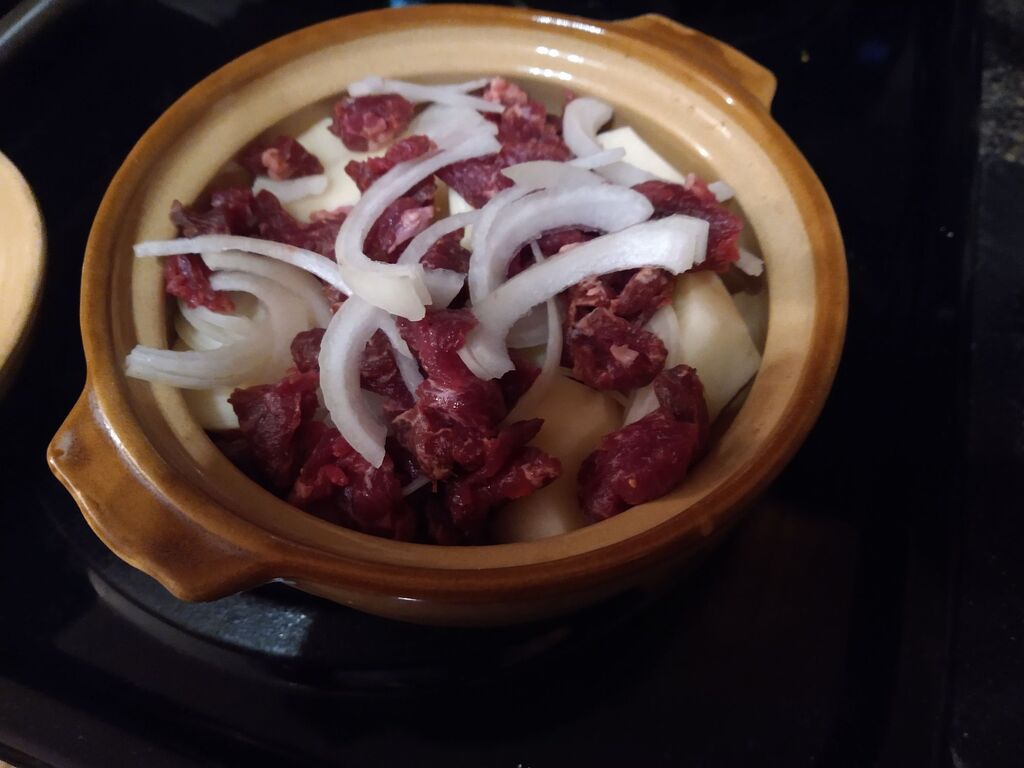
Donabe filled with potatoes with small beef cubes tucked all around and thinly sliced onions on top. There are also garlic slices in there, but none are showing in the picture.
Once I had a solid layer of potatoes in there, I started tucking the garlic pieces and the small beef cubes around the potatoes. And then I (foolishly!) decided to not get another pan dirty by precooking the onions in the tomato juice, like in the second recipe, and just add them directly the way the first recipe says/implies. I added the tomato juice from the pan and sliced some of the tomatoes on top. Then it went in the oven!
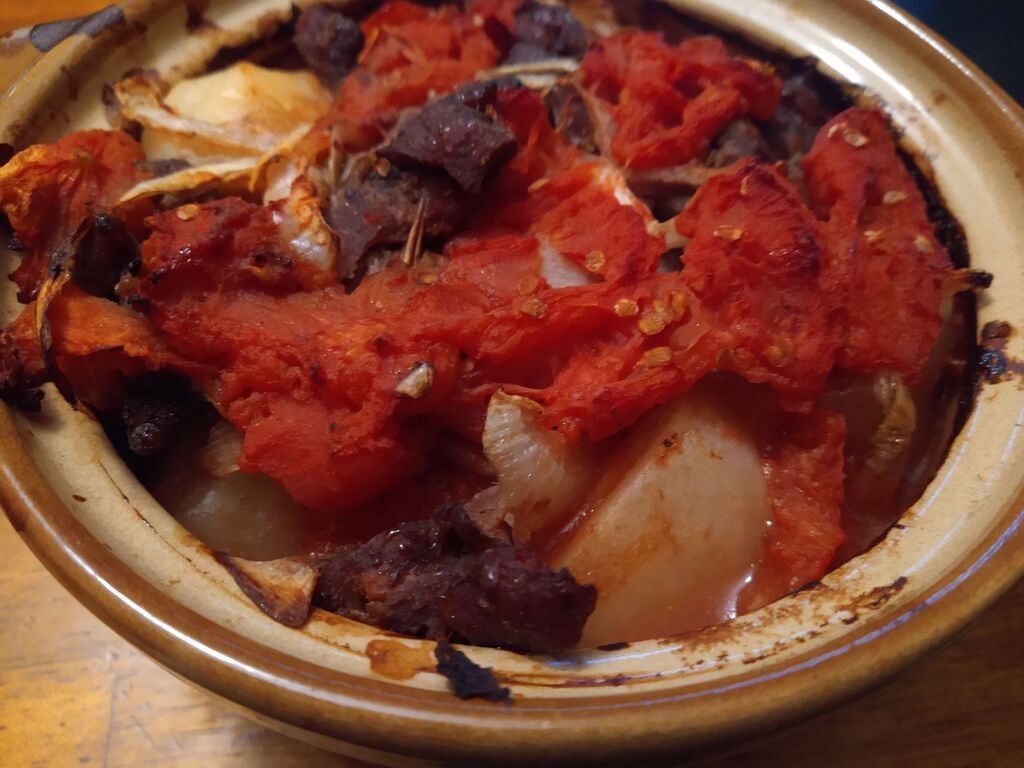
donabe with a cooked dish with potatoes in thin liquid and you can see the other ingredients – tomatoes, beef, and onions – looking a little dry and cooked with some small amounts of burning, especially right around the edge of the bowl where liquid bubbled up the sides.
After about an hour and a half, it was smelling pretty good and like food, so I gave the potatoes a poke with a fork – they were still fairly firm, so back they went for another half hour. Then I waited for the potatoes to cool enough to eat and I was very optimistic about this dish.
It was terrible! The potatoes might have been cooked, but they were not soft and none of the sauce had penetrated to flavor the potatoes. And the onions! I don’t know how, but the onions tasted even more strongly of raw onion flavor after cooking than they did before! Nothing went together and it put me off of using that whole cookbook!
But this should be a viable dish! It sounds so simple, stable, and reliable. So I went looking to see if it appeared in other cookbooks. Of the ones I checked, nothing particularly close appeared.
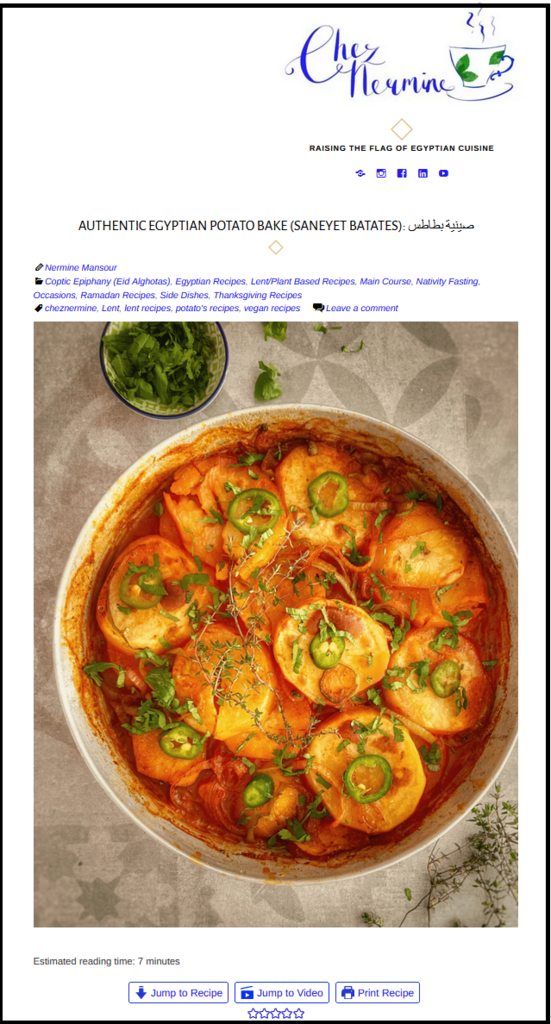
screencapture of the start of Chez Nermine’s page about Saneyet Batates – site linked to picture if you want to click through
And this was more like it! With detailed instructions, discussions about ingredient varieties, and even a video recap. So this time I made it for lunch with a friend. She has been having chemo on Friday afternoons and then I’ll pick her up and make a meal before the nausea kicks in. It has all of the fun of dining out with none of the risks of dining in public while immunocompromised. So I asked her opinions about the ingredients, and she asked for minimal garlic and onions and that it not be particularly spicy, so those are the big changes here.
Using an 8″x8″ casserole dish, I started with some oil in the base. And then I added about 1-2 Tablespoons (not measured, just was left in the container I had) of dried shallots (to replace the fresh onions) and the spices – this version called for spices, so that’s exciting – ground coriander (the last one the ones I dried from my 2025 garden), ground cumin (from the Egyptian cumin a former couchsurfer had brought me!), dry oregano (also dried from my garden), and a generous sprinkle of paprika (a little more generous than the recipe because I’m trying to use up that container). And then that got kind of mixed together.
This time, I was using a fresh bag of yukon gold potatoes. Even though the directions say to slice one inch thick, looking at her video I decided to slice them closer to half an inch thick. And then I sliced up some fresh bell peppers without any spiciness to them. That gets tossed with the spices to distribute as evenly as possible.
I still used the same kind of canned whole tomatoes, so I first poured out some of the liquid and mixed it with tomato paste and vegetable soup base. Then I sliced the tomatoes on top again and poured the enriched liquid over everything. The whole large-sized can was perfect for this size casserole dish.
And then I cooked it – first on the stovetop and then in the oven. But for much longer than called for because my friend’s appointment ran later then I’d been expecting. By about an hour and a half. I had been planning the switch to the oven for right when I left the house, but it ended up almost completely finished before she even called me for a pickup. So I made sure there was enough liquid and that the heat was just high enough to keep a low bubbly simmer but low enough to not dry out or misbehave while I was out of the house.
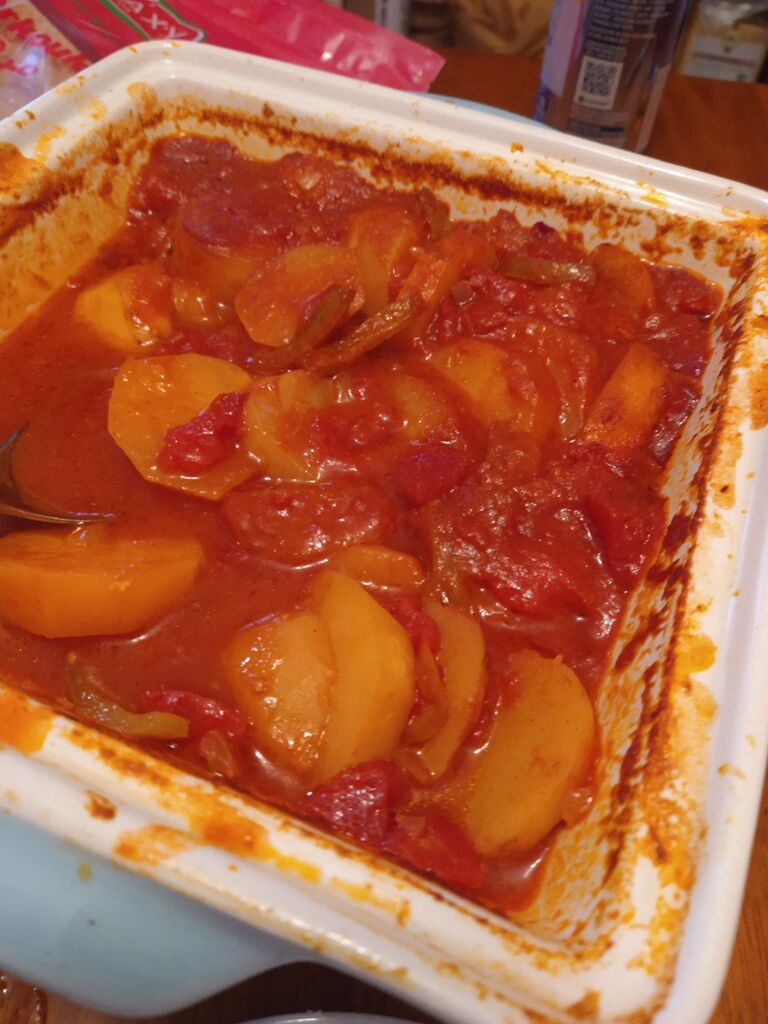
Finished dish of tomatoes that have turned orange from braising in the tomato sauce and small chunks of tomato and pepper in a saucy base.
We came back in the house, and the smell was amazing! The potatoes were very hot, but that gave us some time to chat while waiting for it to cool.
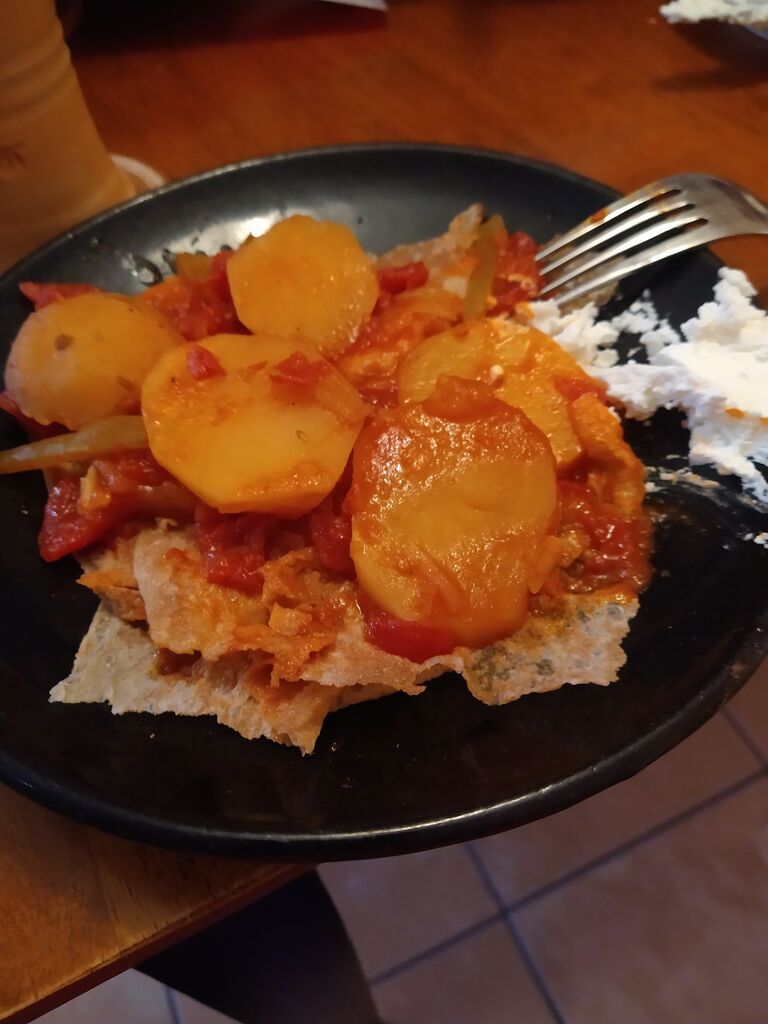
I still had a little ruqaq (an Arabic thin crepe-like bread) left from an experiment, so we used that as a base layer to soak up the sauce. And we had feta brined white cheese on the side.
A plate made up with the potatoes on top of a layer of soaked flatbread and some white cheese on the side
This version ended up amazing! A+ Would make again. The spiced tomato broth flavored the potatoes all the way through, and it was just the right amount of warm and comforting without being too heavy for lunch.
Let’s also do a quick roundup of Egyptian food blogs I found:
Chez Nermine: authored by Nermine Mansour, who was born in Egypt, a former Egyptian diplomat (her husband still seems to be a diplomat), and lives in Virginia (united states). Oldest recipe posted 17 August 2017; most recent recipe 3 April 2026. Primarily Coptic, she has recipes tagged for Christian, Islamic, and Jewish holidays and includes both vegan and meat. Has a recipe for macarona forn, saneyet batates, koshari, and molokhia. Tagline is Raising the Flag of Egyptian Cuisine. Likelihood of using: 10/10 (see above)
TheEgyptianCook: Signature cooking by Muhammed Elgammal, but posts and videos are made by a team and his site has a merchandise store “in development.” He is an Egyptian-American Muslim who resides in the United States. Oldest recipe posted 11 December 2023; most recent recipe 17 November 2025. Has a recipessddd for macarona bechemel, baked potatoes and lamb, koshari, and molokhia, Recipes are fairly meat heavy, but includes vegan kofta (as well as beverages and desserts). Likelihood of using: 1/10 (autoplay videos)
Scarf Gal Food: Simona Afifi does not have a separate “about” section, but does sprinkle anecdotes throughout the posts. Diaspora Egyptian with actual experience making and buying food in Egypt, posting from the united states. Oldest recipe posted 21 April 2015; most recent recipe 13 December 2021. Has a recipe for macarona bechamel, saneyet batates, koshari, and molukhia. Likelihood of using: 6/10 (most likely this recipe for easy ful starting with canned beans)
The Egyptian Kitchen: abissada was 1st generation born outside Egypt and lists her location as France, but she has visited Egypt. Earliest recipe posted 18 January 2010; most recent recipe . Has recipes for macarona bil bechemel, koshari, and molokhia (first posted recipe). Likelihood of using: 3/10
Food of Egypt: References christian and Islamic holidays. Oldest recipe posted 28 July 2010; most recent recipe 1 August 2013 (posted to facebook through August 2015). Has a recipe for molokheya. Likelihood of using: 2/10 (too many intrusive ads)
Cleobuttera: Tasbih is a food blogger in Egypt who specializes in pastry and baking. Oldest recipe posted 11 November 2014; most recent recipe 25 August 2019. Best web design, includes a section of which major publications have referenced her blog. Likelihood of using: 7/10 (would be higher if I were more of a baker/confectioner)
I wasn’t sure if it would be possible to make just one bowl of potato soup, but I figured I would try.
The bowl of soup with some bacon crumbles and cheese on top
I used my 1 quart pot so that I’d not have room to add too much.
Starting by dicing half a large onion, I put it in the pot with some bacon fat and turned the burner to medium to start sweating the onion. I washed and diced two smallish medium potatoes and added them to the pot as well (and turned the heat a little higher).
I mixed two cloves of garlic and threw those in as well, but I didn’t want either celery or carrots. I have carrots, but I didn’t feel like it
Once the vegetables were pretty evenly translucent and a bit softer, I added two teaspoons of flour. Then I thoroughly stirred that into everything and let it cling evenly to the vegetables and get cooked until it was no longer raw flour.
Then I added just enough soy milk to cover. (Last time I was ordering groceries, I wanted a little dairy but the smallest quantity was a half gallon and the soy milk was cheaper than the cow milk. The main thing I look for in a plant milk is that it has no sweetener and no vanilla flavoring. If I want sweet milk, I can always add sugar, but there’s no taking it out when I want savory (which is most of the time).
I added a bunch of seasonings – salt, black pepper, gochugaru, paprika, powdered thyme, and some mushroom powder. Because that was what was on hand. Because my paprika is losing its color so I want to use it up.
The soy milk thickened faster than I was expecting, so I added a little more. I’m not sure if that’s because of how much flour I added or if it is party of the qualities of soy milk and how it behaves. But I made sure I kept cooking long enough for the potatoes to be cooked through.
Then I topped it with cheddar cheese and bacon crumbles.
It’s was very rich, but definitely tasty. As long as I still have an abundance of ‘milk’, I might make this again. It was a very satisfactory dinner
Close up of the finished dish with a nest of cooked shredded kale and a soft poached/steamed egg in the middle of that nest
I’ve already written up this recipe a couple of times, but I wanted to update it. Here’s the post where I cite the original Roman recipes that inspired this meal.
Diced purple onions in a skillet
Start with finely chopping up a few slices of purple onion and sauteing them in a little olive oil.
A pile of shredded kale with a bottle of sweet red wine and a bottle of Red Boat fish sauce in the background
Let’s talk about ingredients
Kale – I like growing Red Russian Kale because it has a flatter leaf that is easier than most varieties to check for bugs as it is growing, but also a softer texture that cooks up nicely when harvested. This recipe will work with any variety of kale.
Wine – This should be a red wine, and I prefer a sweeter variety. Honestly, I love the kosher Manischewitz concord grape or blackberry flavors both for drinking and cooking with. But I also keep a bottle in my refrigerator of boiled down and concentrated red wine from any time I have a leftover partial bottle, and that would also work well here. Whatever you’ve got.
Fish sauce – I am pretty sure the ancient Romans used at least two different kinds of fish sauce. There’s the garum, which is very light colored and quite polite. That’s the table fish sauce for adjusting flavor after cooking. And then there’s the liquamen, which is almost ubiquitous in these recipes and seems to function for adding salt. So I look for the funkiest and saltiest fish sauces available. I’ve had good luck with the Squid Brand and Red Boat. Use the salty one with kale!
[if you want to avoid fish sauce, then you can switch to a powdered bouillon (maybe half a cube or less), soup base, or Maggi cube]
Skillet with some onions and kale
Okay, so your onions are getting caramelized around the edges and a little brown. Your patience will be rewarded. Now you can fill your pan with shredded kale (this is about 5 or 6 large leaves) and you can throw in other green herbs (parsley, cilantro, dandelion greens, scallion greens, dill, mint, random foraged edible things) if you want, but I usually just go with kale because if I’m growing it in my garden, then I already have too much of it to get through.
Cook the kale until it just brightens. If you want, you can add a teaspoon or two of water to help it move around, but it should be pretty dry right now. Because as soon as it’s a little cooked, v you’re going to add a teaspoon of fish sauce and a teaspoon of red wine and that with sizzle and steam everything up.
Mix everything together well and then tuck everything toward the middle of the pan with a little divot in the middle to make a nice nest.
Then crack an egg into the middle of the nest, grind some black pepper on top, and cover the pan and let the egg poach in that steam to cook.
A skillet with a silly hat of an aluminum takeout container as a lid.
I’m just a few minutes (it’s okay to peek) the egg will set. The yolk will turn from yellow to a pinkish color and the white might jiggle but it will all be white. If you want the white harder, you can go a little longer, but you risk your yolk solidifying and not being as runny. It’s your egg, so make it the way you like.
The finished dish!
I like to eat this with a bagel and cream cheese. And with a spoon. Enjoy!
So I’ve been self soothing by stocking up on groceries, but then I ended up with too many types of vegetables that require intensive prep in order to turn into food and not enough easy meals.
There’s still three quarters of a kabocha squash, two ears of corn, and some tomatillos to reckon with. But those are for another day.
Today I was gardening and it was very hot and I didn’t really want to cook much. Then I remembered I had lettuce! So this salad is based on one head of romaine lettuce, cleaned and cut up.
Ginormous bowl of the complete salad with even an egg on top
Then I had bought new carrots, but I still had three old carrots. So I pulled those out and sliced them up for pickling (quick pickle with a dried chili and seasoned rice wine vinegar) and the slices that weren’t pretty for cut a little more finely and added to the salad.
Then I pulled out the package of small Persian cucumbers. I really do like them more than other cucumbers and they’ve been pretty cheap recently, but they barely last a week in the refrigerator. So I washed all the ones I haven’t eaten (4) and sliced them. I also got out a red onion and thinly sliced half of one. Most of the slices I pickled separately with red wine vinegar, but I added some to the cucumbers for extra flavor. And then all the parts of the cucumber that were a little soft but still good went into the salad.
I cleaned and finely sliced one scallion and added it to the salad.
I grabbed the third ear of corn and cleaned it. The husks compost better if you slice them across the grain a few times. Then I sliced off about half of the kernels and put them into the salad raw. But that was enough raw corn, and I wasn’t sure how to save half an ear of corn like that. So I took a pat of butter and thinly sliced some of the remaining purple onion and put that to cook while I sliced off the rest of the kernels. My mother would have also taken the back of her knife and scraped it all of the corn milk, too, but I just gnawed on the corn cob while I was working. Anyway, the remaining corn kernels then went into the butter and onion and was cooked until just soft and hot before being added to the salad.
But wait, there’s more!
I’d bought a little of the good mozzarella (good within the category of grocery store mass produced cheese), so I cubed that and added it on top.
And I had some soft boiled eggs, so I peeled one and put it in hot water to both wash off any tiny shell crumbs and to take the chill off.
But then I also decided to cook some leftover thinly sliced (hot pot style) fatty beef that I’d gotten from the Asian market. Instead of thawing and unrolling them, I just put them in the hot skillet as chunks – they still cooked through just fine.
And that was everything… except I had no plan for salad dressing. But I did have a pan with a couple Tablespoons of beef fat that had rendered off, so I thought about the Pennsylvania Dutch bacon fat dressing, and figured I might as well improvise. So I whacked a Tablespoon of Dijon mustard into the hot fat and stirred it around until it started to break down (not my plan, but that was what happened), and then I added some pickle sauce and stirred until it emulsified, and then poured it over the salad. And that worked really well! It had enough salt and brought everything together without feeling fatty.
Another view of the complete salad
Oh, and then I sliced the soft boiled eggs on top, which was really gilding the lily, but eggs don’t last forever.